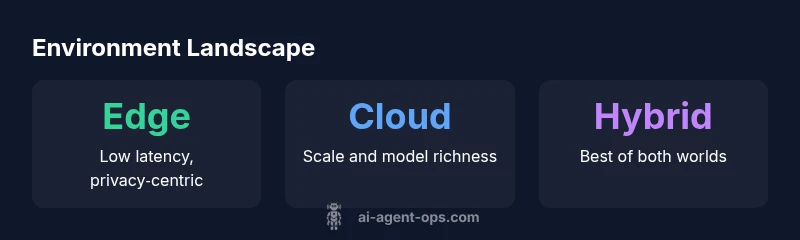
Where Do AI Agents Run? Environments and Trade-offs
A data-driven guide to where AI agents run—edge, cloud, on-prem, or hybrid—and how to choose the right environment for performance, privacy, and cost.


Where do ai agents run is a question that matters because it defines where execution happens—edge devices, cloud data centers, on‑premises servers, or hybrid setups. From Ai Agent Ops, understanding these options helps teams balance latency, privacy, and cost. The answer is not one-size-fits-all; it evolves with hardware advances, data governance needs, and orchestration capabilities. This quick definition sets the stage for deeper exploration of environments and trade-offs.
Where do ai agents run? Core environments
Where do ai agents run is a question that matters because it defines where execution happens—edge devices, cloud data centers, on‑premises servers, or hybrid setups. From Ai Agent Ops, understanding these options helps teams balance latency, privacy, and cost. The decision is not one-size-fits-all; it evolves with hardware advances, policy changes, and vendor ecosystems. Organizations typically start by mapping workload requirements—real‑time responsiveness, data locality, and update cadence—and then align those needs with feasible environments. The phrase where do ai agents run has become a practical shorthand for choosing execution venues and governance rules across a distributed stack. As the ecosystem matures, orchestration tools and standards will increasingly influence these choices, making hybrid approaches more common in agentic AI workflows.
Edge devices: real-time processing at the source
Edge computing brings AI agent execution physically closer to data sources. Lightweight models, optimized runtimes, and specialized edge accelerators let agents respond in milliseconds, even without a steady cloud connection. This reduces data movement, preserves privacy by keeping data near the source, and enables offline operation. Trade-offs include limited compute and memory, frequent software updates, and the need for robust over‑the‑air (OTA) governance. For consumer devices, industrial sensors, or autonomous agents, edge runtimes are a natural fit when latency and autonomy outrun the benefits of centralized processing.
Cloud and data centers: scalable compute and storage
Cloud environments offer scalable GPUs/TPUs, centralized model management, and rapid experimentation with large language models and multi‑modal agents. They support complex reasoning, knowledge integration, and batch processing at scale. The costs scale with usage, and data governance often shifts toward centralized controls and data pipelines. For many teams, cloud is the default starting point, providing a robust playground for prototyping and production deployments while enabling easier A/B testing and model upgrades.
On-premises and private clouds: control and compliance
On‑premises deployments prioritize strict data control, regulatory compliance, and insulated security environments. Organizations with sensitive customer data or strict residency requirements may choose private clouds or isolated data centers to avoid crossing sensitive boundaries. The main challenges are higher capital expenditure, maintenance friction, and slower iteration cycles. When compliance or latency constraints trump flexibility, on‑premises AI workloads become the preferred choice.
Hybrid and orchestration patterns: matching workloads to environments
Most modern AI agent systems use hybrid patterns that combine edge, cloud, and on‑premises resources. Orchestration frameworks route tasks to the environment best suited for a given workload, with policy-driven data movement and fault tolerance baked in. This approach supports real‑time decisions at the edge while leveraging cloud resources for model updates, analytics, and long‑term storage. The practical reality is a dynamically managed network of agents, models, and data streams that must be governed by clear security, privacy, and reliability rules.
Practical design blueprint: decision criteria you can apply
A repeatable checklist helps teams decide where to run AI agents. Consider latency requirements, data sensitivity, compute availability, and update cadence. Evaluate cost per inference, the complexity of orchestration, and governance constraints. Reflect on reliability needs and how outages in one environment affect the entire workflow. Finally, design for evolution: begin with a simple architecture and plan explicit migration and failover paths between environments. This mindset supports scalable, compliant, and resilient agent ecosystems.
dataTableDescriptionTargetedContentOnlyFieldsInHTML?Turbo?
dataTableCaptionPositionOverride?NotUsed
mainTopicQuery there is no requirement to populate?
Environments for running AI agents
| Environment | Latency/Real-Time | Cost per Run | Privacy/Compliance | Best Use Case |
|---|---|---|---|---|
| Edge devices | Low to moderate latency | Moderate | High privacy (data local) | Real-time control; offline operation |
| Cloud data centers | Variable latency; scalable | Low to high (model‑dependent) | Moderate privacy; centralized governance | Large language models; batch processing |
| On-premises private cloud | Low to moderate latency | Moderate | High privacy; strict compliance | Regulated industries; sensitive data |
| Hybrid (edge + cloud) | Balanced latency | Flexible | Hybrid governance | Workloads needing both real-time and scale |
Questions & Answers
What factors determine where AI agents should run?
Key factors include latency requirements, data sensitivity, compute availability, model size, and update cadence. Organizations typically start with a baseline environment and adjust as needs evolve.
Latency, data sensitivity, and cost drive the choice between edge, cloud, and on‑premises. Start with a baseline and iterate.
Can AI agents run entirely on edge devices?
Some workloads can run completely on the edge, especially lightweight or real‑time decision tasks. Most advanced agents rely on cloud or hybrid patterns for scale and model updates.
Edge works for lightweight tasks; bigger models usually need cloud or hybrid support.
What are the security risks of edge vs cloud?
Edge increases distributed attack surfaces and requires robust device security and OTA updates. Cloud platforms centralize controls but demand strong identity, access management, and data governance.
Edge means more devices to secure; cloud gives centralized controls but needs solid IAM.
How do I design a hybrid deployment?
Map workloads to environments based on latency, privacy needs, and cost. Use orchestration to route data and tasks, with clear governance and failover paths.
Plan by workload, then orchestrate between edge and cloud.
Are there industry standards for AI agent runtimes?
There are no universal standards yet. Teams rely on best practices from cloud providers and research communities and tailor them to regulatory requirements.
Standards are evolving; follow best practices and compliance guidelines.
“Choosing where to run AI agents is a strategic decision that balances latency, privacy, and cost; the optimal pattern is often a carefully designed hybrid.”
Key Takeaways
- Define latency and data needs before architectural decisions
- Hybrid deployments unlock agility and resilience
- Edge reduces data movement and can lower costs for real-time tasks
- Security and governance must guide environment choices; plan for updates
- Design for orchestration early to enable scalable agent workflows