Where AI Agents Are Deployed: Environments, Patterns, and Planning
Explore where AI agents are deployed across cloud, edge, and on-prem environments, including common architectures, governance concerns, and practical planning tips for 2026.


Where are AI agents deployed? Across cloud, edge, and on-prem environments—most programs now blend these for hybrid operation, balancing scalability with data locality. In 2026, organizations increasingly standardize multi-environment agent architectures, supported by governance and secure integration practices to enable fast, reliable automation.
What deployment landscapes look like today
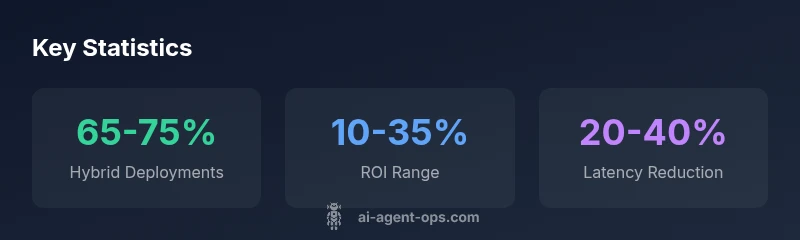
Where are ai agents deployed? Today, organizations deploy AI agents across cloud, edge, and on-premises environments, often in hybrid configurations that mix centralized data processing with local decision-making. This landscape reflects a shift toward distributed orchestration where agents operate close to data sources yet remain tethered to central governance. Across industries—from finance to manufacturing—the deployment footprint has grown as teams seek faster automation, better data fidelity, and scalable workflows. In Ai Agent Ops analyses for 2026, we see broad adoption patterns that hint at the direction of the field: more organizations standardizing agent architectures, more emphasis on governance, and more experimentation with multi-agent orchestrations. In practical terms, the question isn't whether AI agents are deployed, but where and how they are integrated into existing tech stacks to accelerate decision-making and execution. We will unpack the major deployment configurations, the trade-offs, and the actionable steps to plan for scale. According to Ai Agent Ops, the shift toward hybrid architectures is accelerating, with governance and secure integration as key enablers.
Environments: cloud, edge, on-prem, and hybrid
The environment you choose shapes latency, data sovereignty, cost, and security posture. Cloud deployments offer scalability, rapid updates, and centralized monitoring but can introduce data egress costs and dependency on connectivity. Edge deployments bring reactions closer to data sources and enable offline operation, yet require distributed management and tighter resource constraints. On-prem deployments maximize control and data sovereignty, at the expense of scale and agility. Hybrid architectures blend these approaches, letting critical data stay local while leveraging cloud for compute bursts and model updates. According to Ai Agent Ops, the most successful programs today use a hybrid pattern as default, then tailor the mix by workload type, regulatory requirements, and latency targets. For teams, this means designing a cohesive governance layer that spans environments and ensures consistent policy enforcement, identity management, and auditing.
Deployment patterns by industry
Different sectors emphasize different deployment patterns based on data sensitivity, regulatory requirements, and operational goals. Financial services favor on-prem or tightly governed hybrid models to protect customer data while enabling real-time risk scoring. Healthcare organizations often rely on edge processing within secure networks to support clinical decision aids with patient privacy in mind. Retail and e-commerce use cloud-first patterns for chatbots and demand forecasting but frequently deploy edge components in point-of-sale environments to reduce latency. Manufacturing leverages both cloud orchestration for planning and edge agents for equipment monitoring, anomaly detection, and predictive maintenance. Across these industries, the pattern that emerges is a move toward modular agent architectures with clear data boundaries, strong identity and access controls, and auditable decision logs to support governance and compliance.
Architecture choices: agents, orchestration, and middleware
AI agents come in many flavors, from autonomous decision-makers to reactive assistants. The architecture you pick should align with data flows, governance, and the orchestration layer you rely on. Key elements include: 1) agent cores that encapsulate decision logic, 2) task orchestration to coordinate multiple agents and services, 3) adapters or middleware that connect data sources, APIs, and on-device sensors, and 4) observability tooling to track outcomes and explainability. Modern deployments favor a layered approach: lightweight agents on the edge for fast responses, backed by centralized orchestration in the cloud, with on-prem control for sensitive data. This pattern reduces single points of failure and improves resilience. In practice, teams often adopt an agent-mode philosophy to switch between planning and reacting as workloads change, plus a governance layer that enforces policies across all environments.
Data governance, privacy, and security considerations
With AI agents handling sensitive data and critical decisions, governance is not optional. Establish data classification, access controls, and encryption in transit and at rest across cloud, edge, and on-prem components. Implement role-based and attribute-based access controls, and ensure that agents produce auditable logs and explainability records to support compliance. Data minimization should be a default; only feed agents the data they need to act, and consider synthetic or anonymized data for training and testing. Secure model updates and software provenance to prevent supply-chain attacks, and implement continuous monitoring for anomalous agent behavior. Finally, prepare incident response playbooks that cover both cyber threats and data leakage, with clear escalation paths across every deployment environment.
Overview of deployment environments
| Environment | Typical Pros | Typical Cons |
|---|---|---|
| Cloud | Scalability; easy updates | Latency sensitivity; data egress costs |
| Edge | Low latency; offline capability | Complex deployment; resource constraints |
| On-prem | Full control; data sovereignty | Higher CapEx; maintenance overhead |
| Hybrid (cloud+edge) | Balanced latency and scale | Coordination overhead; governance complexity |
Questions & Answers
What environments are AI agents typically deployed in?
AI agents are typically deployed in cloud, edge, and on-prem environments, often in hybrid configurations that balance scalability, data locality, and governance. The choice depends on data sensitivity, latency requirements, and organizational constraints.
Most teams deploy AI agents across cloud and edge, with on-prem for sensitive workloads.
Which industries are leading in AI agent deployments?
Financial services, healthcare, manufacturing, and retail are early adopters, each with patterns tuned to data privacy, latency needs, and regulatory requirements. Across sectors, modular architectures and strong governance are becoming standard.
Finance, healthcare, and manufacturing are leading; governance is now a baseline.
What are the main security concerns when deploying AI agents?
Key concerns include data leakage, model updates integrity, supply-chain risk, and ensureable audit trails. Implement encryption, access controls, and continuous monitoring across all environments.
Protect data, verify updates, and monitor for threats across cloud, edge, and on-prem.
How should ROI from AI agent deployments be measured?
ROI should be measured via process automation coverage, latency reductions, decision accuracy, and business KPIs like cost savings or cycle-time improvements. Tie metrics to baseline performance and governance outcomes.
Track automation reach, speed, and impact on business goals.
Can AI agents be deployed on-premise?
Yes, AI agents can be deployed on-premise for data sovereignty and control. Hybrid strategies often blend on-prem with cloud for updates and scale while maintaining security.
On-prem is possible and common for sensitive workloads.
What patterns optimize agent orchestration at scale?
Use modular agent designs, clear interfaces, centralized policy enforcement, and cross-environment observability. A layered architecture with edge agents, cloud orchestration, and robust logging helps scale safely.
Plan modular agents and strong governance for scaling.
“AI agents deployed across cloud, edge, and on-prem environments unlock faster automation, but success hinges on robust governance and security.”
Key Takeaways
- Define workloads and data locality requirements first
- Prioritize governance and security from the start
- Prefer hybrid patterns to balance latency and scale
- Plan for orchestration across multiple agents
- Pilot with clear success metrics before scaling