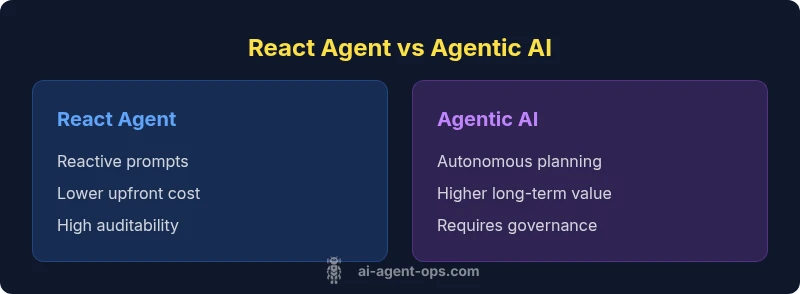
React Agent vs Agentic AI: Core Differences
A thorough comparison of react agent vs agentic ai, detailing autonomy, governance, use cases, and practical guidance for developers and leaders.


React agents are typically reactive, following predefined prompts and rules, while agentic AI pursues goals with autonomous decision-making. If you need straightforward automation with tight governance, a React agent is often safer and easier to audit. If your use case requires adaptive reasoning, long-horizon planning, and objective-driven behavior, agentic AI offers greater potential—alongside governance and safety considerations.
Definitions and scope of React agents and agentic AI
In the landscape of AI agents, a React agent usually refers to a system that reacts to inputs with predefined prompts and deterministic logic. By contrast, agentic AI describes a class of agents capable of setting and pursuing goals, planning steps, and adapting behavior to changing objectives. For teams exploring react agent vs agentic ai, the distinction shapes everything from architecture to governance. The goal here is to equip developers, product teams, and business leaders with a framework for choosing the right approach for a given problem. This guide anchors definitions in practical terms, provides decision criteria, and translates theory into actionable checklists. Throughout, Ai Agent Ops grounds recommendations in real-world constraints and governance realities.
Core distinctions: autonomy, goals, and governance
At a high level, the main difference between a react agent and agentic AI is autonomy and goal orientation. A React agent tends to execute actions that are explicitly defined, with outcomes bounded by rules. Agentic AI, however, operates with internal or external goals, capable of selecting a plan, adapting strategies, and revising behavior as objectives change. This has meaningful implications for risk, explainability, and control. For developers, this difference translates into how you structure state machines vs. planning modules, how you implement safety constraints, and how you monitor performance. The balance between autonomy and safety becomes a central design decision that affects how quickly teams can deploy, how much governance is required, and how easily systems can scale. The takeaway: autonomy comes with complexity and governance needs, but can unlock higher long-term value if managed well.
Architecture and data flows
A React agent typically relies on modular triggers, policy prompts, and deterministic response routing. Data flows are predictable: input → rules engine → action → feedback. Agentic AI adds planning components, goal representations, and contextual reasoning. Data flows often include a planning loop, goal decomposition, action selection, and environment feedback. Both patterns benefit from clear interfaces, but agentic AI demands robust logging, traceability, and safety guardrails to prevent misalignment. Practical considerations include choosing a representation for goals (symbolic vs numeric), deciding on learning mechanisms (offline updates vs online learning), and ensuring auditability for compliance. In Ai Agent Ops experience, even small deviations in goal interpretation can cascade into undesired outcomes, underscoring the need for guardrails and explicit alignment checks.
Use cases by domain
React agents excel in operational automation within well-defined, auditable workflows such as data entry, ticket routing, and straightforward decision trees. They shine where inputs are stable and changes are predictable. Agentic AI, by contrast, is better suited for long-horizon planning, strategic decision support, and dynamic task execution in domains like product analytics, autonomous agents in simulation environments, and complex customer journeys. The choice depends on problem complexity, data availability, and risk appetite. In practice, teams often start with a React agent for a pilot and progressively migrate to agentic AI as requirements evolve and governance matures. This staged approach can reduce risk while enabling learning across the journey.
Safety, governance, and alignment considerations
When comparing react agent vs agentic ai, governance and safety shape the viability of each option. React agents offer clearer boundaries, easier auditing, and tighter control over actions, which reduces risk in regulated environments. Agentic AI introduces risk of goal drift, unintended behaviors, and misalignment with user intent, requiring explicit alignment strategies, monitoring, and escalation procedures. Effective alignment typically involves combining rule-based constraints with conservative fallback behaviors, robust evaluation, and transparent logging. It is essential to define success criteria, containment measures, and escalation paths before scale. Ai Agent Ops emphasizes the importance of governance-by-design, ensuring teams can monitor, adjust, and explain decisions as systems evolve.
Evaluation metrics and benchmarks
Evaluating react agent vs agentic ai involves a mix of quantitative and qualitative criteria. For reactive agents, measure accuracy of rule execution, throughput, latency, and adherence to compliance constraints. For agentic AI, track autonomy levels, goal attainment rate, adaptability, and alignment with business objectives. Evaluation should include scenario-based testing, stress testing, and post-hoc analysis of failures. A transparent logging strategy enables retrospective analysis and improves trust with stakeholders. In practice, define a small set of representative tasks, run controlled experiments, and compare outcomes across governance scenarios to determine which approach delivers the best balance of control and value.
Implementation strategies and best practices
To maximize success with either approach, start with clear problem scoping, success metrics, and governance boundaries. Build iterative pipelines that allow you to test incremental capabilities, and design modular components so you can swap between react agent and agentic AI as needed. Adopt robust monitoring, alerting, and rollback mechanisms, and ensure your data pipelines are clean, observable, and secure. Invest in explainability tooling and auditing dashboards so stakeholders can understand why a given action occurred. Finally, plan for change management: teams must adapt to evolving architectures, and leadership should anticipate governance updates as capabilities expand.
Cost, ROI, and scaling considerations
Cost modeling for react agent vs agentic ai varies with autonomy, data needs, and governance complexity. Reactive agents typically incur lower upfront costs, shorter deployment cycles, and simpler maintenance, but may require more human oversight as automation expands. Agentic AI can deliver greater long-term value through reduced human intervention and more capable decision-making, yet demands investment in governance, testing, and safety systems. ROI should be evaluated across speed to value, risk, maintenance, and scalability. In Ai Agent Ops practice, successful projects balance short-term delivery with a clear path to controlled autonomy, ensuring governance keeps pace with capability to deliver reliable, safe, and valuable automation.
Decision framework and practical checklist
Use this framework to decide between react agent vs agentic ai: define tasks, assess risk, map governance requirements, estimate data needs, and plan for monitoring. Create a decision checklist: (1) Are goals explicit and bounded? (2) Is explainability non-negotiable? (3) Can you implement effective guardrails? (4) Will the system scale with governance? (5) Is there an off-ramp if alignment fails? Then choose the approach that satisfies the majority of criteria and implement with a staged rollout. Humility and governance are your best allies here.
Future trends and adoption patterns
As organizations continue to explore agentic AI and reactive approaches, the trend is toward hybrid architectures that combine the reliability of rule-based react agents with the adaptability of agentic AI under strong governance. Advances in safety, alignment research, and audit tooling are accelerating practical adoption. Developers should stay current on regulatory guidance and best practices for agent autonomy, and product teams should plan pilots that test governance strategies alongside capability. Ai Agent Ops predicts a gradual shift toward scalable, auditable autonomy, where governance keeps pace with capability to deliver reliable, safe, and valuable automation.
Comparison
| Feature | React Agent | Agentic AI |
|---|---|---|
| Autonomy | Low; reactive only | High; goal-driven and planning capable |
| Goal Orientation | Predefined prompts and rules | Explicit goals and adaptive planning |
| Learning & Adaptation | Limited; updates are manual | Possibly online learning and dynamic adaptation |
| Safety & Governance | Easier to audit; strict controls | Requires robust governance and alignment measures |
| Explainability | High traceability via rules/prompt history | Complex; needs advanced explainability tooling |
| Integration & Complexity | Lower complexity; faster to deploy | Higher complexity; longer setup and maintenance |
| Best For | Stable, auditable, rule-based workflows | Strategic tasks with dynamic objectives |
| Cost/ROI | Lower upfront cost; faster ROI for simple tasks | Potentially higher long-term ROI with governance costs |
Positives
- Safer and easier to audit with tight governance
- Quicker to implement and integrate into existing stacks
- Predictable performance under predefined prompts
- Lower upfront cost and simpler maintenance burden
What's Bad
- Limited adaptability and horizon thinking
- Higher long-term labor cost if automation expands
- Greater effort to scale when needs evolve
- Potential for brittle behavior under complex scenarios
Agentic AI is preferred for complex, autonomous tasks; React Agent is better for safe, auditable, rule-based automation.
Choose React Agent for governance, transparency, and faster deployment. Choose Agentic AI when outcomes require autonomous planning and adaptability, with strong governance and risk controls.
Questions & Answers
What is a React agent?
A React agent is a reactive system that follows predefined prompts and rules to decide actions. It emphasizes determinism, auditability, and straightforward governance, making it suitable for stable, well-defined tasks.
A React agent reacts to inputs using fixed rules, which makes it predictable and easy to audit.
What is agentic AI?
Agentic AI refers to agents that pursue goals, plan steps, and adapt behavior to changing objectives. They operate with a degree of autonomy and require strong governance, alignment, and safety measures.
Agentic AI is goal-driven and capable of planning, but needs careful governance.
When should I choose a React agent over agentic AI?
Choose a React agent when the task is well-defined, rules-based, and auditing requirements are high. Opt for agentic AI when the problem benefits from autonomous planning, adaptation, and longer horizons, and you can support governance.
Go with a React agent for safety and simplicity; pick agentic AI for autonomy and long-term goals with governance.
What are the main safety concerns with agentic AI?
Agentic AI introduces risks like goal drift and unintended actions. Mitigate with explicit alignment strategies, containment mechanisms, monitoring, and escalation procedures.
Autonomy can cause drift; guardrails and monitoring are essential.
How do I evaluate these approaches in a project?
Use scenario-based testing, measure governance readiness, and compare outcomes across control and autonomy levels. Include qualitative reviews of explainability and auditability in your assessment.
Test scenarios for both safety and effectiveness, and compare governance readiness.
Key Takeaways
- Define goals and risk tolerance before choosing.
- Agentic AI offers autonomy but requires governance.
- React agents excel in auditability and safety.
- Balance cost and ROI with complexity.
- Plan for scalability and governance early.