LangChain vs LangGraph for Agentic AI: A Practical Comparison
A rigorous, objective comparison of LangChain and LangGraph for agentic AI workflows, covering architecture, tooling, governance, and deployment considerations to help teams decide which path best fits their goals.


LangChain and LangGraph shape agentic AI workflows, and the choice hinges on goals and constraints. langchain vs langgraph for agentic ai: LangChain shines with mature tooling and broad integrations, while LangGraph emphasizes graph-based reasoning and explicit provenance. For most teams, LangChain offers speed and ecosystem, whereas LangGraph serves deeper, verifiable decision graphs.
Context and Objective
Understanding langchain vs langgraph for agentic ai is essential for teams building autonomous agents. This article analyzes how LangChain and LangGraph approach agentic AI workflows, balancing practicality with theoretical rigor. We explore architecture, orchestration patterns, and decision criteria so developers, product teams, and leaders can decide which path aligns with their goals. As Ai Agent Ops notes, the choice often hinges on the priority between ecosystem maturity and graph-based reasoning. The goal is to provide a structured framework to compare capabilities, interoperability, risk, and governance implications for different use cases. This comparison also considers how each framework handles agent initiation, decision loops, and feedback integration in real-world deployments.
Architectural Foundations of LangChain and LangGraph
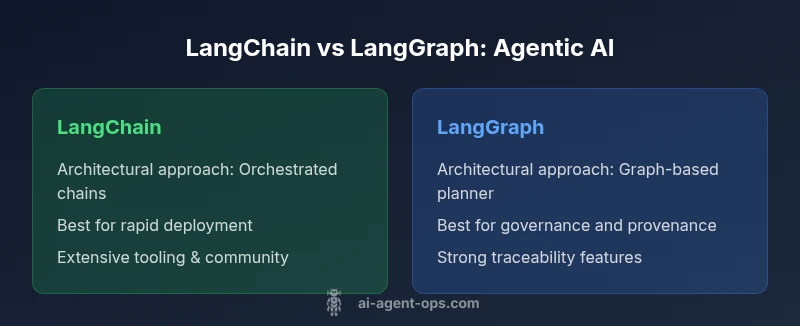
LangChain emphasizes modular orchestration through chains, tools, and agents. It provides a rich set of connectors to data sources, LLM providers, and execution environments, enabling rapid assembly of end-to-end AI workflows. Its design favors pragmatic patterns that engineers can adopt quickly, with broad community examples that cover common agentic tasks such as task decomposition, tool invocation, and result aggregation. In contrast, LangGraph centers a graph-based planner where actions are nodes and data dependencies are edges. This approach can improve transparency, provenance, and auditability, especially for multi-step decision processes. While LangChain prioritizes plug‑and‑play flexibility, LangGraph prioritizes explicit reasoning structure and verifiable execution traces. Teams should map their primary needs to these architectural traits when choosing a path for agentic AI initiatives.
Graph-Driven Reasoning vs Orchestration Paradigms
The core tension between a graph-driven approach and orchestration-based design lies in how decisions are made and how actions are coordinated. LangChain’s orchestration pattern excels at rapid tool chaining, parallelizable calls, and easy reuse of existing components. It shines in environments where time-to-value matters and where numerous integrations are required. LangGraph, by contrast, emphasizes graph-based reasoning with explicit nodes, dependencies, and provenance trails. This makes complex plan evaluation, constraint handling, and traceability more natural to implement. For teams seeking demonstrable traceability and formal governance, LangGraph’s model offers clearer auditability, while LangChain provides flexible, scalable execution pathways. When both are combined, an organization might use LangChain for rapid prototyping and LangGraph for critical decision pipelines that require rigorous provenance.
Ecosystem, Maturity, and Community Support
Ecosystem maturity often drives short-term success. LangChain enjoys a broad ecosystem of tutorials, third-party tools, and ready-made components across multiple languages, which translates into faster onboarding, more examples, and easier hiring of experienced engineers. This maturity also supports rapid experimentation and a wealth of Real-World patterns, making it easier to scale pilot projects. LangGraph’s ecosystem, while smaller, emphasizes formal reasoning, verification, and provenance tooling. It benefits from strong academic and enterprise interest in explainability and governance for agentic AI. Ai Agent Ops analysis suggests growing attention to graph-based approaches as teams seek stronger governance, though adoption rates lag behind LangChain in many organizations. The choice may hinge on whether you value ecosystem breadth over formal reasoning capabilities.
Safety, Verification, and Observability
Safety and observability are critical in agentic AI. LangChain offers mature logging, monitoring, and debugging utilities for chains and tool invocations, which helps teams diagnose failures quickly. It supports testing patterns that emphasize end-to-end behavior and fault containment. LangGraph contributes robust provenance and graph-level tracing, which enhances transparency of decision sequences and dependencies. This makes it easier to verify whether outputs follow authorized constraints and policies. Both frameworks benefit from standardizing guardrails, access controls, and auditing across deployments. Organizations should implement centralized policy enforcement and centralized telemetry to compare behavior across environments and to improve reliability over time.
Integration, Deployment, and Tooling
Practical deployment decisions depend on how easily teams can integrate with existing systems. LangChain’s connectors, SDKs, and community examples reduce the friction of integrating LLMs, data stores, and apps. It is well suited for rapid prototyping, MVPs, and multi-LLM experimentation. LangGraph requires more upfront design to model the graph and planning logic, but it provides stronger guarantees around dependency management and reproducibility of results. In real-world deployments, teams often adopt a hybrid approach: LangChain for rapid experimentation and LangGraph for critical decision pathways where provenance and governance are paramount. This hybrid strategy can optimize speed while preserving accountability across iterations.
Use Cases and Scenarios
Common agentic AI scenarios include autonomous task execution, data-driven decision making, and conversational agents with persistent memory. For LangChain, typical use cases involve orchestrating tasks across services, issuing tool calls, and aggregating results to deliver timely responses. LangGraph is particularly strong in workflows where a formal plan must be evaluated under constraints, with a clear audit trail for every decision. In regulated industries or safety-critical environments, a graph-based plan helps demonstrate compliance and traceability. A careful blend allows teams to exploit LangChain’s agility while leveraging LangGraph’s governance for high-stakes steps.
Decision Framework for Teams
To decide between LangChain and LangGraph for agentic AI, teams should start by clarifying priorities: speed vs. governance, ecosystem breadth vs. graph-based reasoning, and team familiarity with graph concepts. Create a two-column evaluation: one column for LangChain and one for LangGraph, and fill in criteria such as integration readiness, tooling maturity, observability, governance capabilities, and long-term maintainability. Consider a phased approach: prototype with LangChain to validate use cases quickly, then pilot LangGraph for critical decision workflows that require strong provenance. Establish success metrics focused on time-to-value, traceability, and risk controls. Finally, involve stakeholders from security, governance, and product to ensure alignment with organizational goals.
Comparison
| Feature | LangChain | LangGraph |
|---|---|---|
| Architectural approach | Modular orchestration with chains, tools, and agents | Graph-based planner with explicit nodes and dependencies |
| Best for | Rapid integration and broad ecosystem | Complex, verifiable reasoning with provenance |
| Ecosystem & integrations | Extensive connectors and abundant community resources | Graph-centric tooling with provenance capabilities |
| Observability & debugging | Mature logging for chains and tool invocations | Graph-level tracing and node-level provenance |
| Learning curve | Lower barrier due to established patterns | Steeper due to graph concepts and planning models |
| Cost model | Open-source with enterprise options; usage-based costs vary | Dependent on licensing and graph resources; integration complexity can affect cost |
Positives
- Faster time-to-value due to mature ecosystem
- Extensive tooling, templates, and community support
- Flexible deployment options and broad integration capabilities
- Strong pattern for rapid experimentation and iteration
What's Bad
- Can incur integration overhead with many moving parts
- May complicate governance if patterns are not standardized
- Less explicit provenance without additional tooling
- Graph-based reasoning features are not as deep as dedicated planners
LangChain is typically the default choice for most teams; LangGraph is best when graph-based reasoning and provenance are essential
Choose LangChain for speed, ecosystem, and ease of adoption. Opt for LangGraph when you need explicit decision graphs, traceability, and formal governance for high-stakes agentic AI workflows.
Questions & Answers
What is LangChain?
LangChain is a framework for building AI applications by composing chains, tools, and agents. It emphasizes modular orchestration and easy integration with a wide range of services and LLM providers.
LangChain is a framework that helps you stitch together AI tools and tasks using chains and agents. It's designed for fast prototyping and broad compatibility.
What is LangGraph?
LangGraph is described here as a graph-based agent framework that models actions as nodes and data flow as edges. It focuses on explicit reasoning traces and provenance for governance.
LangGraph uses a graph-based approach to plan and verify agent actions, emphasizing traceability and clear decision trails.
Which is better for agent orchestration?
For rapid orchestration with many integrations, LangChain generally offers speed and familiarity. If you require formal decision graphs and provenance, LangGraph provides stronger governance and auditability.
If you need quick orchestration, LangChain; if you need strong governance with clear decision trails, LangGraph.
Can both be used for agentic AI?
Yes. Both can support agentic AI, though their strengths differ. LangChain is excellent for broad tool use and rapid iteration, while LangGraph suits scenarios where decision traceability matters.
Both can support agentic AI, with LangChain great for speed and LangGraph for provenance.
How should I approach governance and safety?
Prioritize guardrails, access controls, and observable telemetry in any setup. LangGraph’s provenance can help demonstrate compliance, while LangChain should be paired with governance patterns and tests.
Set guardrails and telemetry from the start; provenance helps with compliance in graph-based workflows.
What about cost and licensing?
Both frameworks have open-source cores with potential enterprise options. Costs depend on usage, hosting, and additional tooling; plan for environment, data storage, and monitoring needs.
Costs vary with usage and deployment; expect open-source bases with potential enterprise options.
Key Takeaways
- Choose LangChain for rapid deployment and broad tooling
- Prioritize LangGraph when governance and provenance are critical
- Consider a hybrid approach to balance speed and rigor
- Invest in consistent guardrails and observability from the start