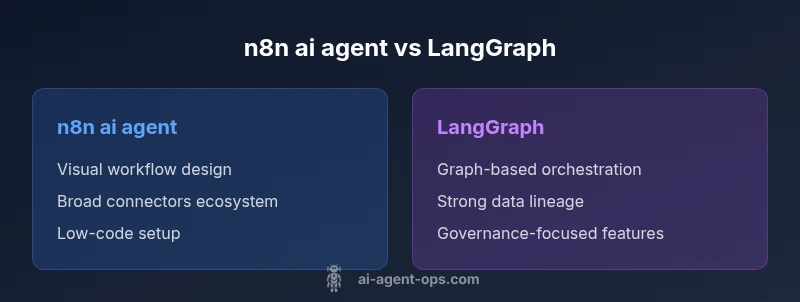
n8n ai agent vs langgraph: A detailed comparison for AI agents
An analytical side-by-side comparison of n8n ai agent and LangGraph, covering architecture, features, integrations, deployment options, and use cases for developers, product teams, and business leaders.


For most teams prioritizing rapid integration and low-code automation, n8n ai agent offers faster setup and a broader connector ecosystem, while LangGraph excels at complex graph-based orchestration and governance. The full comparison reveals nuanced trade-offs in architecture, ease of use, and scalability.
n8n ai agent vs langgraph: landscape of AI agent orchestration
The AI agent ecosystem is expanding beyond simple automation toward agentic workflows that reason, decide, and act with minimal human input. In this landscape, two prominent players often surface in evaluations: n8n ai agent and LangGraph. According to Ai Agent Ops, the choice between them is less about a single feature and more about how teams prioritize ease of use, ecosystem richness, and governance at scale. This section sets the stage by clarifying how each tool positions itself in terms of workflow design, integration depth, and target users. Expect a spectrum from rapid, low-code automation to heavy-duty graph-based orchestration for complex decision trees.
Core design philosophies and architecture
n8n ai agent centers on a visual, node-based workflow designer that enables developers and business users to assemble AI-assisted tasks with drag-and-drop simplicity. Its architecture emphasizes modular connectors, event-driven triggers, and straightforward orchestration of AI calls within familiar, low-code patterns. LangGraph, by contrast, emphasizes graph-based orchestration with modular components that can be composed into sophisticated agent pipelines. The graph abstraction supports complex data lineage, dependency tracking, and more explicit control over data flow and governance. These fundamental architectural differences influence everything from onboarding time to scalability and debugging strategies.
Key features and capabilities: side-by-side lens
When comparing features, it helps to map capabilities directly to typical agent-use cases. n8n ai agent shines in rapid prototyping, experimentation, and scenarios where teams want to wire together APIs, AI prompts, and decision logic with a minimal configuration burden. LangGraph tends to excel when intricate agent chains are required, with advanced flow control, graph mutations, and robust data lineage. Both platforms support multi-LLM integration, task parallelization, and conditional branching, but the ergonomics, debugging tools, and governance layers differ in meaningful ways. This section breaks down critical capabilities—prompt management, state handling, observability, and security—under the two paradigms, highlighting where each approach yields tangible benefits.
Integration and ecosystem: connectors and extensions
A robust ecosystem often differentiates winners in the AI agent space. n8n ai agent benefits from a large pool of pre-built connectors, community workflows, and a marketplace that accelerates integration with popular services. LangGraph typically emphasizes extensibility through graph components and language- or DSL-based configuration, which can deliver deeper customization for complex agents but may require more upfront setup. A key consideration is whether your stack relies on a wide array of SaaS services or prioritizes rigorous data lineage and governance across a sophisticated orchestration graph. Ai Agent Ops notes that ecosystem breadth can shorten time-to-value for standard workflows, while governance-focused tools pay dividends as complexity grows.
Performance, reliability, and security considerations
Performance hinges on how well the chosen approach maps to real-time decisioning and parallel task execution. n8n ai agent's node-based model generally offers predictable performance for moderate workloads and simpler graphs, with robust community-tested integrations. LangGraph can deliver sophisticated parallelism and precise data lineage, which helps with auditable processes and compliance at scale but can introduce additional planning and monitoring overhead. Security considerations include access controls, audit logs, and data isolation across agent flows. Both platforms typically provide RBAC, activity logs, and secure execution environments, but the granularity of governance and the ease of implementing policy enforcement differ according to design philosophy.
Use-case fit: when to choose each
For teams that need quick wins, rapid prototyping, and a broad set of connectors, n8n ai agent is often the practical choice. It reduces time-to-value by enabling non-developers to assemble AI-powered automations with familiar UI patterns. LangGraph is preferable when you’re building enterprise-grade agent orchestration with strict governance, data lineage, and complex dependency management. If your workflows involve multi-step reasoning, cross-domain data transformations, and require formalized auditing, LangGraph’s graph-centric approach may pay off in the long run. Ai Agent Ops emphasizes aligning tool choice with organizational maturity and risk tolerance.
Practical guidance: deployment, governance, and migration
A pragmatic approach starts with a staged pilot. Define a core use case, map data sources, and document non-functional requirements such as latency targets and compliance needs. For n8n ai agent, begin with a small workflow, validate connectors, and progressively introduce error handling and retries. For LangGraph, design the orchestration graph on a smaller scope, establish governance policies, and annotates nodes with clear ownership. Migration plans should include data provenance, versioning of prompts, and a rollback strategy. In both cases, invest in observability: traces, logs, and dashboards that illuminate how AI agents reason and act over time.
Expert perspective: Ai Agent Ops insights and community perspectives
From a practical viewpoint, the choice between n8n ai agent and LangGraph often mirrors an organization’s appetite for experimentation versus discipline. The Ai Agent Ops team has observed that teams with strong no-code capabilities tend to gain momentum quickly with n8n ai agent, while those pursuing robust governance and data traceability gravitate toward LangGraph. This aligns with broader industry patterns where speed-to-value competes with governance-heavy architectures. The balance you strike should reflect your product goals, risk posture, and team competences. The Ai Agent Ops team recommends a staged, evidence-based evaluation to avoid premature commitment to either path.
Comparison
| Feature | n8n ai agent | LangGraph |
|---|---|---|
| Core design | Node-based visual editor for rapid prototyping | Graph-based orchestration with emphasis on data lineage |
| Ease of use | Low-code, approachable for non-developers | Steeper learning curve, deeper customization |
| Extensibility | Broad connector ecosystem and community workflows | Graph components and DSLs for advanced flows |
| LLM integration | Supports multiple LLMs via nodes and prompts | Integrated prompt templates and chaining within graphs |
| Deployment options | Cloud SaaS and self-hosted via Docker | Cloud-first with on-premise options varies by plan |
| Governance & security | Standard RBAC, audit trails common across flows | Enhanced governance with graph-level controls and lineage |
| Best use case | Rapid automation, rapid iteration, broad integrations | Enterprise-scale orchestration demanding governance and traceability |
| Pricing model | Tiered pricing with free tiers for experimentation | Tiered/enterprise pricing emphasizing governance features |
Positives
- Rapid deployment with low-code workflows
- Large connector ecosystem and community support
- Intuitive visual design accelerates prototyping
- Strong foundation for quick AI-assisted automation
What's Bad
- Possible vendor lock-in to ecosystem
- Complex graphs can become hard to manage at scale
- Advanced governance features may require higher tiers
- Graph-based approaches may have steeper learning curves for new users
n8n ai agent is ideal for rapid, low-code AI automation; LangGraph suits enterprise-grade, graph-driven orchestration with governance.
Choose n8n ai agent for speed and breadth of integrations. Choose LangGraph for control, traceability, and complex agent workflows at scale.
Questions & Answers
What is the primary difference between n8n ai agent and LangGraph?
n8n ai agent prioritizes rapid, low-code automation with a broad connector library, whereas LangGraph emphasizes graph-based orchestration with stronger governance and data lineage. The choice depends on whether speed and breadth or governance and complexity matter more for your use case.
The main difference is in workflow style: n8n is fast and visual for quick AI automations, while LangGraph focuses on complex, governable graphs for large-scale agent orchestration.
Which is easier for beginners to adopt?
n8n ai agent generally offers a gentler learning curve due to its visual, node-based editor and vast template library. LangGraph requires more upfront design thinking and familiarity with graph concepts, but pays off as complexity grows.
n8n is usually easier for beginners; LangGraph is better for teams ready to work with graphs and governance.
Can both be self-hosted and integrated with existing stacks?
Both platforms support deployment in cloud environments; self-hosted options and enterprise deployments vary by plan. Verify capabilities for your security and data governance requirements during due diligence.
Both offer deployment options, but check exact self-hosting support and compliance features for your setup.
Which scales better for enterprise workloads?
LangGraph’s graph-centric approach typically scales governance and data lineage for complex, enterprise-grade workflows. n8n can scale with modular connectors, but very large, intricate graphs may require careful management.
LangGraph scales governance-heavy workflows well; n8n scales through modular connectors with careful design.
How do pricing models compare for long-term use?
Both use tiered pricing models with options for experimentation at low cost. Enterprises should evaluate total cost of ownership, including governance features, data transfer, and support commitments.
Expect tiered pricing with optional enterprise terms; compare TCO including governance and support.
Do they support the same LLMs and connectors?
Both support popular LLMs and a variety of connectors, but the integration patterns differ (node-based versus graph-based). Consider which interface aligns with your team’s development practices.
Both support common LLMs and connectors; choose based on preferred integration style.
Key Takeaways
- Start with a clear pilot for quick wins
- Map governance requirements before architecture choice
- Leverage connectors first, then extend with advanced flows
- Plan observability upfront for maintainability