Design AI Agent: A Practical How-To Guide
Learn to design an AI agent that automates tasks, reasons about goals, and operates safely. This comprehensive, step-by-step guide covers goals, architecture, data flows, governance, and observability for robust agent design.


Designing an AI agent starts with a clear problem, defined goals, and a governance plan. This quick answer highlights the essential prerequisites and a practical path to build, test, and iterate an agent that can automate tasks, learn from feedback, and operate safely within boundaries. It also emphasizes stakeholder alignment and traceable decision-making.
What does it mean to design ai agent in practice?
Designing an ai agent means building a decoupled system that perceives inputs, reasons toward a goal, selects actions, executes them, and observes outcomes. It isn’t merely a chatbot; it’s a looped engineering problem that requires architecture, data, and governance. The phrase design ai agent implies a deliberate balance between autonomy and control, with explainability to humans and seamless integration into existing software ecosystems. According to Ai Agent Ops, designing AI agents starts with a clear problem statement and governance framework that defines escalation paths and override rights. This foundational step limits scope creep and aligns technical work with business value. In this section, we map the lifecycle from problem framing to iterative improvement and set realistic expectations for real-world deployment.
- Key takeaway: a well-designed AI agent behaves within defined boundaries and evolves through feedback.
Core design principles for AI agents
Effective AI agents embody a set of core principles: clarity of purpose, controllable autonomy, reliable operation, and auditable behavior. First, define a narrow but meaningful objective; avoid scope creep by enforcing explicit constraints. Second, design for reliability with error handling, retries, and graceful degradation. Third, ensure transparency by recording decisions and exposing triggers that humans can review. Fourth, embed safety and governance early—guardrails, risk assessments, and escalation procedures should be baked into the architecture. Finally, enable observability through dashboards, alerts, and logging that help operators understand why the agent acted as it did. These principles apply across industries—from customer support to supply chain automation—and encourage modular design so components can be swapped without rewriting the system.
Defining goals, constraints, and success metrics
Start with a problem statement that describes the desired outcome and the measurable impact. Translate goals into concrete constraints such as latency targets, data access policies, and allowed action sets. Establish success metrics that reflect user value and risk: throughput, accuracy, recovery rate, and human-in-the-loop intervention rates. Create a simple scoring rubric to quantify progress during testing, and set go/no-go criteria for pilot launches. Document any assumptions and edge cases, as they will shape both data requirements and safety rails. As you refine metrics, keep business stakeholders in the loop to ensure that the agent’s objectives stay aligned with organizational priorities. Ai Agent Ops recommends pairing goals with governance checks to minimize drift over time.
Data strategy and system integration
A functioning AI agent relies on well-managed data streams and trusted integration points. Identify data sources the agent will perceive, such as APIs, databases, or user inputs, and map how data will flow through perception, reasoning, and action stages. Establish data quality gates: schema validation, anomaly detection, and versioning so updates don’t break behavior. Plan for privacy and security by applying access controls, encryption, and audit trails. Design integration patterns that accommodate rate limits, fallback paths, and circuit breakers. Build a lightweight simulation environment to validate data interactions before production, and ensure the agent can operate in environments with intermittent connectivity. Thorough data governance helps maintain reliability as the agent scales.
Architectures: planners, reflex agents, and hybrid designs
There are several viable architectures for AI agents, and the choice depends on task complexity and safety needs. A planner-based design uses a goal decomposition strategy and symbolic rules to decide actions, providing strong interpretability. A reflex-based agent reacts to inputs with minimal deliberation, offering speed but less adaptability. Hybrid designs blend planning with reflex responses and memory modules, enabling fast responses while preserving context. Hybrid approaches are well-suited for real-world automation where tasks vary and regulatory requirements demand explainability. Regardless of the model, ensure a modular architecture with clear interfaces, so you can swap components without destabilizing the entire system. This flexibility is essential for extending agents over time without re-engineering from scratch.
Evaluation, governance, and risk management
Develop a practical evaluation plan that combines synthetic and real-world data to test core capabilities. Use unit tests for individual components, integration tests for data flows, and end-to-end tests to validate goal achievement. Establish governance processes that specify risk assessments, ethics reviews, and escalation procedures for uncertain decisions. Create a risk register and track mitigations, including safety rails and monitoring dashboards. Set up a formal review cadence to evaluate performance, safety, and compliance. For authoritative guidance, consult established standards and research, noting that Ai Agent Ops analysis emphasizes governance alignment as a cornerstone of successful AI agent design. In addition, maintain a living doc that records design choices, experiments, and outcomes.
Safety, reliability, and observability
Safety must be designed in, not tacked on later. Implement guardrails that prevent dangerous actions, limit autonomy, and require human approvals for high-risk decisions. Build observability from day one with logging, metrics, tracing, and anomaly alerts so operators can detect drift or failures quickly. Design for reliability with graceful degradation, retry policies, and clear error states surfaced to users. Regularly test edge cases and simulate outages to ensure the agent maintains safe behavior under stress. Establish a post-mortem culture to learn from incidents and continuously improve guardrails, data quality, and decision transparency. A well-monitored design reduces risk and increases user trust over time.
Implementation blueprint: artifacts, roles, and workflows
Create a practical blueprint that includes artifacts such as a design requirements document, data schema, risk register, test plan, and deployment playbooks. Define roles—product owner, data engineer, ML engineer, safety officer, and site reliability engineer—and map responsibilities to decision points in the agent lifecycle. Outline workflows for development, testing, release, and monitoring, with gates at each milestone. Keep dashboards simple and actionable: key metrics, incident alerts, and decision explainability indicators. This blueprint helps teams ship reliable AI agents at pace while maintaining clear accountability.
Practical templates, checklists, and next steps
Use ready-to-adapt templates to accelerate design work: goal statements, data flow diagrams, risk registers, test plans, and incident playbooks. A 10-item pre-flight checklist ensures you cover governance, data privacy, security, and user consent. As you progress, run lightweight pilots, collect feedback, and adjust scope. Finally, plan for scaling by modularizing components, expanding to new data sources, and incorporating user feedback loops. With disciplined templates and checklists, your team can consistently produce safe, valuable AI agents.
Tools & Materials
- Laptop with development environment(CPU/RAM adequate for ML tasks; Python 3.9+; Linux or macOS recommended)
- Access to AI APIs/Model endpoints(API keys; manage rate limits; ensure secure storage)
- Data sources and testing data(Real or synthetic datasets; ensure privacy constraints are respected)
- Version control (Git)(Branching strategy; commit messages for traceability)
- Experiment tracking tool (optional)(WandB or MLflow for reproducibility)
- Security and privacy tooling(OAuth, encryption, access controls, and audit logging)
Steps
Estimated time: 6-10 weeks
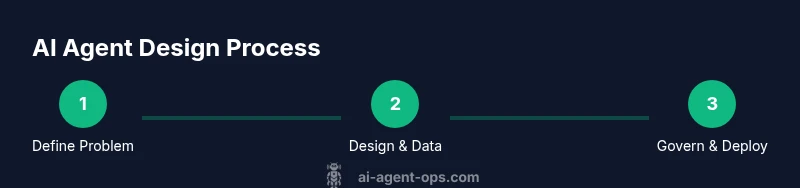
- 1
Define the problem and success criteria
Articulate the business objective and translate it into measurable success criteria. Specify failure modes and who will intervene if the agent misbehaves. Create a lightweight design document to lock in scope and expectations.
Tip: Capture a crisp problem statement and a 2-3 sentence success rubric you can review with stakeholders. - 2
Choose architecture and data flows
Select an architecture that fits the task—planner, reflex, or hybrid. Map data inputs to perception, reasoning, and action, and define data contracts between components.
Tip: Draft a simple data-flow diagram showing inputs, processors, and outputs before coding. - 3
Implement safety rails and governance
Embed guardrails, access control, and escalation paths. Document decision boundaries and ensure monitoring hooks are in place for alerts and audits.
Tip: Prioritize human-in-the-loop for high-risk decisions early on. - 4
Build a minimal viable agent
Create a focused MVP that handles a single task with clear success criteria. Keep components modular to simplify testing and future expansion.
Tip: Start with a narrow scope to validate the end-to-end loop quickly. - 5
Test iteratively and measure
Run unit, integration, and end-to-end tests using both synthetic data and real-world scenarios. Track performance against predefined metrics and adjust as needed.
Tip: Use synthetic edge cases to probe weaknesses and resilience. - 6
Deploy with monitoring and governance
Roll out to a controlled environment, set up dashboards, alerts, and incident response playbooks. Schedule regular reviews of performance and safety.
Tip: Automate anomaly detection to catch regressions early.
Questions & Answers
What is the primary purpose of designing an AI agent?
The primary purpose is to automate decisions and actions within a defined domain while maintaining safety and governance. The agent should be able to perceive inputs, reason toward a goal, act, and report outcomes, with human oversight when needed.
An AI agent automates decisions within a defined task, with safety and governance built in, and ongoing oversight.
How does an AI agent differ from a traditional chatbot?
A chatbot typically focuses on dialog and user interaction, while an AI agent encompasses perception, reasoning, and action across systems. Agents operate with goals, can take non-dialog actions, and require governance and observability.
A chatbot talks; an AI agent perceives, reasons, and acts, with governance and observability.
What architectures are common for AI agents?
Common architectures include planner-based systems for interpretable goal decomposition, reflex agents for fast responses, and hybrid designs that combine planning with memory. The choice depends on task complexity and safety requirements.
Planner-based, reflex, or hybrid architectures are common, chosen by task needs and safety needs.
How should you evaluate an AI agent’s performance?
Use a mix of unit, integration, and end-to-end tests, plus real and synthetic data. Define clear success metrics and regularly review results with stakeholders to ensure alignment with goals.
Evaluate with unit, integration, and end-to-end tests using real and synthetic data; align with goals.
What safety and governance practices are essential?
Embed guardrails, access controls, and escalation paths. Maintain a risk register, perform regular audits, and keep transparent logs for accountability.
Guardrails, access controls, and escalation paths are essential for safety and governance.
Watch Video
Key Takeaways
- Define goals before architecture to prevent scope drift.
- Choose a suitable architecture and map data flows early.
- Incorporate governance and safety rails from day one.
- Prototype with a narrow scope and test thoroughly.
- Monitor, iterate, and document decisions for accountability.