Developing AI Agents: A Practical Step-by-Step Guide
A comprehensive guide to designing, building, and deploying AI agents with safety, governance, and scalable architectures for reliable agentic workflows.


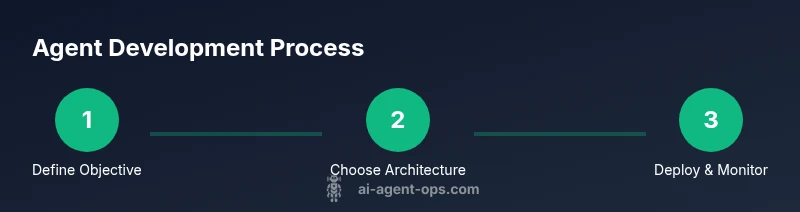
By following a structured, step-by-step approach, you can design, build, and validate AI agents that perform tasks autonomously with oversight. Start with a clear objective, choose a scalable architecture, integrate tools and data sources, implement safety controls, and test iteratively to refine behavior before production. In the context of agentic AI, these elements lay a solid foundation for reliable automation.
What is an AI agent?
An AI agent is software that perceives its environment, reasons about goals, and takes actions to achieve them, often using a memory or toolkit to extend capabilities. According to Ai Agent Ops, a robust agent combines a core reasoning loop with tools and memory while maintaining visibility into its decisions. The term covers autonomous assistants, workflow automations, and decision-support agents that can operate with limited human intervention while staying auditable.
Architectural patterns for AI agents
Successful agent systems often mix three patterns: (1) reactive agents that respond to events, (2) planning agents that generate sequences of actions, and (3) hybrid or multi-agent architectures where small agents coordinate to accomplish complex tasks. A common approach is to pair a large language model with a persistent memory store and a toolkit of actions (APIs, databases, or local scripts). Hierarchical agents delegate subtasks and aggregate results, improving scalability and reliability.
Data, prompts, and tool integration
At the heart of an AI agent are well-crafted prompts, robust memory or context management, and reliable tool integration. Designers should separate decision logic from action by using a planning module that can call tools (search, computation, or domain APIs) and then observe outcomes. Memory modules help agents recall prior interactions, reduce repetition, and personalize behavior while ensuring privacy and compliance through careful data handling.
Safety, governance, and ethics
Agent development requires guardrails to prevent unsafe actions. Implement access controls, telemetry, and runtime checks that validate decisions before execution. Establish a governance model with review workflows, logging, and rollback capabilities. Align agent behavior with organizational policies and legal requirements, and consider bias mitigation, data minimization, and user consent throughout the lifecycle.
Tooling and stack for developing AI agents
A typical stack combines a host language (Python or JavaScript), an LLM API, a memory layer, and a tools framework to orchestrate calls. Libraries and platforms such as prompt templating, vector stores, and tool registries enable modular, reusable agent components. While choices vary, aim for a design that favors composability, observability, and secure access to external services.
Building a minimal viable agent (MVA)
Start with a narrow objective and a limited toolset to reduce risk. Build a simple perception-to-action loop: observe input, decide on an action, execute the action, and evaluate the result. Add memory gradually, then layer in additional tools and safety checks. Validate the MVA with synthetic scenarios before any live deployment, and document decisions for auditability.
Deploying, monitoring, and updating agents
Deployment requires secure hosting, versioned artifacts, and continuous monitoring. Track KPIs such as latency, accuracy, and failure rate, and implement alerting for anomalies. Plan for updates: retraining prompts, refreshing tools, and governance reviews. Regularly audit logs to ensure compliance and traceability, and prepare rollback procedures if issues arise.
Common pitfalls and anti-patterns
Avoid hard-coding tool choices or data sources that hinder adaptability. Don’t confuse prompts with logic; separate planning from execution to simplify debugging. Beware over-automation without safeguards, which can compound errors. Plan for data drift, tool deprecation, and evolving requirements to keep agents resilient.
Real-world use cases to inspire your project
AI agents are finding homes in customer support, incident response, data analysis, and software automation. Use cases span from chat assistants that escalate complex requests to orchestrated workflows that combine multiple tools to complete end-to-end tasks. Tailor agents to your domain, measure outcomes, and iterate toward safer, more capable agentic workflows.
Tools & Materials
- Python 3.11+ development environment(Setup a virtual environment and IDE (e.g., VS Code))
- Node.js 18+ runtime(Useful for tooling and front-end interfaces)
- LLM API access (e.g., OpenAI or equivalent)(Ensure rate limits and keys are secured)
- Memory layer and vector store (e.g., vector DB)(Persistent context across sessions)
- Tool integration framework (prompts, adapters)(Modular adapters to call external tools)
- Testing data and prompts corpus(Representative scenarios for validation)
- Observability tooling(Logging, metrics, tracing for production)
Steps
Estimated time: 2-4 weeks
- 1
Define objective and constraints
Specify the agent’s primary goal, success metrics, and any guardrails or ethical constraints. Clarify what success looks like and what the agent must not do.
Tip: Write a one-sentence success criterion for quick reference. - 2
Choose architecture and tools
Decide whether to use a single model with memory, or a planning architecture with sub-agents. Select tools and data sources that will be required.
Tip: Prefer modular components you can swap without re-architecting. - 3
Prototype perceptions and actions
Build the agent’s loop: observe input, decide on actions, and execute. Start with a narrow task to validate the loop end-to-end.
Tip: Keep the scope small to accelerate feedback. - 4
Add memory and context handling
Introduce a memory layer to recall prior interactions, enabling continuity across sessions while respecting privacy.
Tip: Anonymize or surface only essential context. - 5
Implement safety and monitoring
Incorporate runtime checks, prompts that enforce safety, and observability to detect anomalies early.
Tip: Log decisions and reason when possible for auditing. - 6
Test, iterate, and prepare for deployment
Run synthetic tests, then staged live tests with guardrails. Iterate on prompts and tool adapters based on results.
Tip: Automate test coverage for common failure modes.
Questions & Answers
What is an AI agent and how does it differ from a traditional program?
An AI agent perceives its environment, reasons about goals, and takes actions to achieve them, often using memory and tools. It differs from traditional programs by its autonomous decision-making and ability to adapt.
An AI agent is an autonomous decision-maker that can perceive, reason, and act, often with memory and tools.
What are the essential components of an AI agent?
A core reasoning loop, a memory/context store, tool adapters, and a safety/monitoring layer. Together they enable perception, planning, action, and auditing.
The essential components are reasoning, memory, tools, and safety.
How do you test an AI agent before production?
Use synthetic scenarios and staged environments to validate behavior, monitor decisions, and verify safety guards before deployment.
Test with synthetic scenarios and staged runs before live use.
What are common risks when deploying AI agents?
Risks include data leakage, tool misuse, hallucinations, and lack of observability. Implement guardrails, monitoring, and audits to mitigate.
Risks include leakage, misuse, and hallucinations; monitor and audit.
Do I need a memory layer for my AI agent?
A memory layer helps maintain context across interactions and tasks, improving consistency and user experience. It should be designed with privacy in mind.
Memory helps maintain context and consistency, with privacy considerations.
Where should I start if I’m new to agent development?
Begin with a small objective, a minimal toolset, and iterative testing. Learn by building a simple agent before adding complexity.
Start small, test often, and learn by building a simple agent.
Watch Video
Key Takeaways
- Define clear objectives and guardrails.
- Use modular architecture for scalability.
- Prioritize safety, observability, and auditability.