How to write AI agents: A practical guide for developers and leaders
Learn how to plan, build, test, and deploy AI agents that can autonomously perform tasks. This educational guide covers architecture, data handling, tooling, and governance for reliable, agentic AI.


Goal: learn to design and implement a capable AI agent that can reason, select tools, and perform tasks with minimal human input. You’ll define goals, choose a reliable architecture, and establish safety and governance. The steps below outline planning, prototyping, and deployment for projects that aim to write ai agent in real-world workflows.
What it means to write ai agent and why it matters
Writing an AI agent means designing a system that can perceive a goal, reason about options, select appropriate tools, and act in the world with minimal human input. For developers, product teams, and business leaders, this capability promises automation at scale, faster decision-making, and more consistent user experiences. According to Ai Agent Ops, the most effective AI agent projects start with clear objectives, guardrails, and a plan for governance from day one. The phrase write ai agent is not just about coding; it’s about architecture, data hygiene, and responsible experimentation. In practice, you’ll translate business aims into measurable tasks, define how the agent will interact with data and tools, and set up monitoring that signals when behavior deviates from expectations. This foundation helps teams iterate safely and build trust with users and stakeholders.
From a technical standpoint, you’ll decide what the agent should know, how it should think, and which tools it may use. You’ll also establish safety bounds so that the agent doesn’t perform unsafe or undesired actions. The Ai Agent Ops mindset emphasizes modularity, testability, and governance as you move from concept to production. By grounding your project in these principles, you reduce risk and create reusable patterns for future agentic workflows.
Step-by-step overview of building an AI agent
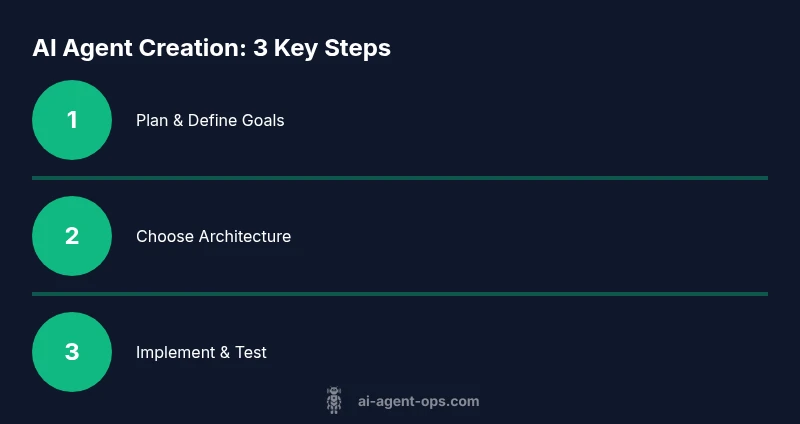
A practical build starts with a mapping from business goals to concrete tasks, followed by architectural design and iterative testing. Begin with a high-level objective, define success criteria, and outline the main decision points the agent will encounter. Next, sketch how the agent will perceive data, reason about options, and execute actions through tools. Design patterns for planning, execution, and feedback loops help you scale. Finally, set up measurement, monitoring, and governance to catch drift early. This section provides a blueprint you can adapt to your domain, whether it’s customer support, automation of internal workflows, or data analysis tasks. Remember: the agent should be able to justify its choices and log its reasoning for auditability. The goal is to move from a single-use prototype to a robust, reusable agentic system.
Throughout the process, you’ll prototype in stages, validating each component before moving on. Small, incremental tests reduce risk and accelerate learning.
In a typical project, you start with a minimal viable agent, then iterate on capabilities like tool selection, prompt design, and safety gating. This phased approach helps you understand trade-offs and refine your approach before committing to a full-scale rollout.
Core components of AI agent architecture
A well-engineered AI agent typically comprises several core components: a goals module that captures the objective, a reasoning engine that plans steps, a tool-using interface to interact with external services, and a memory or context store to retain relevant information across interactions. Perception layers translate user input into structured prompts or queries. The action layer executes tasks via tools, APIs, or autonomous sub-agents, while the governance layer enforces safety, privacy, and compliance constraints. A robust agent also includes telemetry for observability, so you can monitor performance, detect anomalies, and roll back if needed. In practice, modular design pays off: you can swap or upgrade individual components without reworking the entire system. A clean separation of concerns also makes testing easier and enables parallel experimentation with different tool sets and reasoning strategies.
For teams learning to write ai agent, it helps to model these parts as independent services with well-defined interfaces. This reduces coupling and makes it easier to diagnose failures when they occur. You’ll want a shared vocabulary for goals, actions, and tools to ensure consistent behavior across experiments. When you align architecture with business outcomes, you maintain focus on real value rather than collecting gadgets that sound impressive but don’t move the needle.
Data considerations and safety
Data is the lifeblood of AI agents, but it carries responsibilities. Start with quality data that reflects the domain the agent will operate in. Cleanse inputs to reduce bias, ensure privacy and compliance, and implement data minimization where possible. Prompts should be designed to avoid leaking sensitive information and to guard against prompt injection or adversarial inputs. Logging should be structured and auditable, enabling you to trace decisions back to inputs and tool calls. Safeguards like rate limits, action approvals for high-risk tasks, and fail-safes are essential as you push an agent into production. A strong governance model includes risk assessments, incident response plans, and periodic reviews of agent behavior. In practice, you’ll pair data stewardship with robust testing across edge cases to minimize cascaded errors and maintain user trust. When you consider data quality and safety from day one, you significantly improve long-term reliability and compliance.
Tools, libraries, and platforms
There is a rich ecosystem of tools for building AI agents. You’ll typically combine a model service with a reasoning framework, a tool-bridging layer, and a retrieval mechanism for knowledge. Popular patterns use prompt templates, planning modules, and a tool-usage engine that can call APIs or run sub-tasks. Libraries for vector storage, memory management, and orchestration help you scale. When selecting platforms, favor those with clear governance controls, good observability, and strong security practices. Avoid vendor lock-in by designing interfaces that let you swap models or tools with minimal changes. A practical approach is to start with a lightweight stack for prototyping, then layer in more advanced components as you validate requirements. The emphasis should be on modularity, testability, and measurable outcomes rather than chasing every new capability.
As you explore tooling, document decisions so future teams can reproduce results. This reduces confusion and speeds up onboarding for new engineers or product managers who join the project.
Designing for reliability and governance
Reliability starts with formal requirements: define what success looks like, how to measure it, and what to do when things go wrong. Build guardrails for safety, privacy, and legal compliance, and implement access controls so only authorized users can trigger sensitive actions. Introduce versioning for prompts, tools, and policies, with a clear rollback path. Establish a testing regime that includes unit tests for components, integration tests for end-to-end flows, and scenario testing that mimics real-world user interactions. Governance is not a one-off task: it’s a continuous discipline. Schedule regular audits of data usage, model behavior, and decision logs. Foster a culture of transparency by logging the agent’s reasoning path when feasible, and provide explainability to stakeholders. By embedding reliability and governance into the design, you reduce risk and create a foundation for scalable agentic AI programs.
Deployment, monitoring, and iteration
Deployment should follow a staged approach: from local development to sandbox environments, then to limited production with active monitoring. Use telemetry to track success rates, failure modes, latency, and user impact. Establish dashboards that highlight drift, tool failures, and policy violations. Set up alerting so your team can respond quickly to anomalies. Post-deployment, conduct regular reviews to adjust objectives, prompts, and tool configurations based on feedback and observed data. Iteration is essential: treat the agent as a living system that improves with each cycle. Document lessons learned and reuse successful patterns across teams to accelerate future work. With disciplined deployment and ongoing oversight, your AI agent becomes a dependable asset rather than a fragile experiment.
Common pitfalls and how to avoid them
Many teams stumble by overloading an agent with too many capabilities, assuming everything must be solved in one release. Start small, prove value, and iterate. Misaligned incentives can drive unsafe behavior; always anchor actions to explicit guardrails and require human approvals for risky tasks. Another common pitfall is poor observability: without clear logs and metrics, debugging becomes guesswork. Invest in structured telemetry and explainable decision logs. Finally, neglecting data hygiene and governance can erode trust; establish data handling policies, access controls, and regular audits. By anticipating these issues and building safeguards from the outset, you reduce risk and create a sustainable path to scaling agent-driven automation.
Real-world patterns and case studies
Real-world AI agent deployments often follow a set of recurring patterns: modularization (separating planning, reasoning, and action), closed-loop feedback (agents learn from outcomes), and orchestration across multiple tools and data sources. Pattern-based design helps teams reuse templates for common workflows, such as document processing, customer support routing, or data gathering. One effective approach is to implement a central orchestrator that coordinates smaller sub-agents, each specialized for a task. This separation of concerns improves reliability and makes it easier to audit behavior. Case studies show that agents benefit from strong governance, incremental rollout, and continuous evaluation against business metrics. While every domain requires customization, these patterns provide a pragmatic blueprint for building durable, scalable agentic workflows.
Tools & Materials
- Development environment (Python 3.x / Node.js)(Install and configure virtual environments or version managers; set up linting and testing tools)
- API access to AI services(Credentials stored securely; rotate keys regularly; respect rate limits)
- Prompt design documentation(Templates, style guides, and example prompts for consistent behavior)
- Data sample and evaluation dataset(Representative tasks to validate goals and edge cases)
- Version control repository(Git or similar; include CI checks and code reviews)
- Security and privacy guidelines(Data handling policies, access controls, and logging standards)
- Testing and observability tooling(Locally run tests, monitoring dashboards, and alerting)
- Knowledge retrieval index (optional)(Vector store or data index for context retrieval)
Steps
Estimated time: 2-4 hours
- 1
Define objectives and success criteria
Articulate the task the agent should accomplish and how you will measure success. Specify constraints, acceptable risk, and the human-in-the-loop threshold.
Tip: Start with a single concrete task to validate your approach before expanding scope. - 2
Design agent architecture
Outline the modules: planning, reasoning, tool-use, memory, and governance. Define interfaces and data contracts between components.
Tip: Favor modularity; define clear API boundaries to simplify testing. - 3
Prepare data and prompts
Assemble clean prompts and prompts templates; sanitize inputs; prepare prompts for edge cases and safety checks.
Tip: Create reusable prompt templates to accelerate iteration. - 4
Implement reasoning and tool-use
Connect the reasoning module to tool calls, API wrappers, and memory storage. Ensure deterministic behavior where possible.
Tip: Log tool calls and outcomes to support debugging. - 5
Integrate safety rails
Add guardrails, input validation, rate limits, and human approval for high-risk actions.
Tip: Document what actions require authorization and why. - 6
Build testing harness
Create unit and integration tests, plus scenario-based tests that cover normal and edge cases.
Tip: Automate tests to run on every change in the agent workflow. - 7
Deploy to sandbox
Move the agent to a controlled environment with limited scope and synthetic data.
Tip: Monitor for unintended behavior before broader exposure. - 8
Monitor, evaluate, and iterate
Collect telemetry, assess performance against criteria, and refine prompts, tools, and policies.
Tip: Adopt an iterative loop: plan → build → test → measure → adjust.
Questions & Answers
What is an AI agent?
An AI agent is a software system that can perceive a goal, reason about options, select tools, and execute actions to achieve tasks with minimal human input.
An AI agent is a software system that can pursue a goal, reason through options, and act with limited human input.
How is an AI agent different from a traditional bot?
A traditional bot follows scripted flows, while an AI agent can reason, plan, and autonomously select tools to accomplish complex tasks. It adapts to new inputs beyond fixed dialogues.
An AI agent reasons and adapts; a traditional bot sticks to scripted paths.
What architectures are common for AI agents?
Common patterns include a planning module, a reasoning engine, tool connectors, and a memory layer. Governance and observability are layered in for reliability and safety.
Most AI agents use planning, reasoning, tools, and memory with governance baked in.
What safety considerations should I plan for?
Plan for data privacy, prompt safety, rate limiting, approvals for risky actions, and transparent logging to support audits and accountability.
Key safety concerns are privacy, prompt safety, and governance logging.
How should I test an AI agent before deployment?
Use a layered testing approach: unit tests for components, integration tests for end-to-end flows, and scenario tests mirroring real tasks. Validate safety gates in edge cases.
Test components, then test end-to-end scenarios with edge cases.
Where can I learn more about writer AI agents?
Explore practitioner guides, architecture patterns, and governance frameworks from reputable AI engineering resources and industry analyses.
Look for practitioner guides and governance frameworks from trusted AI engineering sources.
Watch Video
Key Takeaways
- Define clear goals and governance first.
- Design modular architectures for scalability.
- Prioritize safety rails and auditability.
- Iterate with real-world scenarios and telemetry.
- Document decisions to accelerate future work.