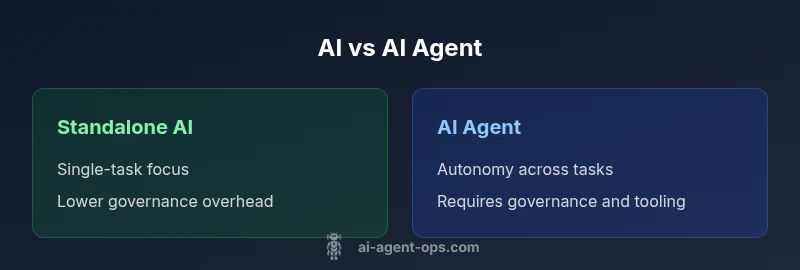
ai vs ai agent: A Practical Comparison for Builders
An analytical, practitioner-focused comparison of standalone AI models vs AI agents, focusing on autonomy, governance, architecture, and real-world adoption to guide teams toward scalable, responsible automation.


ai vs ai agent describes two approaches to intelligent software: a standalone AI model that performs tasks directly, and an AI agent that acts as an autonomous decision-maker operating within an environment. The choice hinges on autonomy, control, and integration needs. By weighing goals, governance, and expected latency, teams can pick the pattern that best matches their project.
Defining ai vs ai agent
According to Ai Agent Ops, the terminology often confuses practitioners because both rely on similar AI foundations, yet they encode different patterns of autonomy and control. In practice, 'ai' usually refers to isolated models or services that perform a defined task, whereas 'ai agent' implies an agentive architecture: an autonomous system that can observe, decide, and act in a dynamic environment. This distinction matters for scale, governance, and the speed at which teams can deliver value. By unpacking the structural differences and the expected workflows, teams can map the right pattern to their product strategy and risk tolerance. The following sections break down the core components, typical toolchains, and decision criteria you can use to decide between an ai approach and an ai agent approach. The Ai Agent Ops perspective emphasizes practical balance between speed, safety, and scalability, so readers can orient decisions within real-world constraints.
Core capabilities of standalone AI systems
Standalone AI refers to models or services that execute a task end-to-end under predefined prompts or configurations. They excel at pattern recognition, generation, or classification when given clear input-output specifications. Because they are typically stateless and request-driven, these systems are often easier to integrate into existing pipelines, with predictable latency and fewer moving parts. However, limitations include the need for explicit orchestration for multi-step tasks and a higher burden on external controllers to enforce policy, safety, and audit trails. By contrast, standalone AIs shine for narrow, well-scoped problems where stability and reproducibility trump broad adaptability. Organizations should expect to manage retries, input validation, and security boundaries at the application layer when using these models as the main workhorse.
Core capabilities of AI agents
AI agents are designed to operate with autonomy and context. They couple a decision-making loop with sensory inputs, a set of tools or APIs, and a goal-driven plan. The agent can monitor its environment, select actions, and revise plans without human step-by-step guidance. This enables complex, multi-step workflows such as data gathering, synthesis, action execution, and feedback-driven improvement. But agent architectures introduce new challenges: increased surface area for failures, governance complexity, and the need for reliable logging and red-teaming to prevent unintended behavior. The upshot is a powerful pattern for dynamic environments where tasks require reasoning across domains rather than a single scripted operation. Teams should prepare for richer toolchains and more sophisticated testing regimes to keep agents aligned with business objectives.
Use-case alignment and decision criteria
Choosing between ai and ai agent hinges on use-case requirements: autonomy vs. control, complexity vs. simplicity, and speed of delivery vs. governance overhead. For high-stakes contexts with strict compliance, a standalone AI component may be safer and easier to audit. For iterative product journeys that demand adaptive decision-making and long-running processes, an AI agent can deliver end-to-end automation with built-in tooling. We also discuss alignment with team skills: data scientists comfortable with model-centric work may lean toward standalone AI, while product and platform teams seeking orchestration patterns may prefer agents. Finally, consider integration points: if your system sits behind a heavy API layer with well-defined triggers, a single AI model could suffice; if your system must coordinate multiple services, an agent workflow often scales better.
Architectural patterns and integration considerations
Architectures for ai vs ai agent differ in orchestration, state, and observability. A standalone AI typically sits behind a single interface, with stateless calls and clear input-output contracts. An AI agent requires a controller or planner component, a memory or short-term store, a toolset (APIs, plugins, or executors), and a policy layer to govern behavior. Observability for agents must cover decision traces, tool usage, and failure modes, not just output accuracy. Integration considerations include latency budgets, data governance, and security boundaries. Teams often adopt a modular pattern: separate model services, a middleware layer, and an agent platform that coordinates tasks and logs. This architectural separation supports safer experimentation and clearer rollback paths when guiding a system from a non-agent to an agent-enabled workflow.
Performance, cost, and governance trade-offs
Performance considerations span latency, throughput, accuracy, and resilience. Standalone AI can be cheaper to operate at small scale and simpler to benchmark, but may incur higher orchestration costs as tasks grow beyond single-shot execution. AI agents can deliver faster end-to-end outcomes for complex tasks, yet require investment in governance, safety, and monitoring infrastructure. Cost contexts depend on usage patterns, tooling, and the level of automation. In governance terms, standalone AI patterns tend to offer clearer audit trails for single decisions, while agents require robust policy controls, containment strategies, and safety nets to prevent drift or unsafe actions. Ai Agent Ops analysis shows that investing early in policy design and observability pays dividends when ecosystems scale.
Practical implementation guidelines
To start, map your desired workflows and identify decision points that could become agentable steps. Start with a pilot combining a robust prompt design and a lightweight agent scaffold, then expand tooling as you observe real-world needs. Emphasize guardrails: limit capabilities, define explicit exit criteria, and implement monitoring dashboards. Consider data quality, security, and privacy from day one, and design with observability in mind (trace IDs, decision logs, and rollback options). Finally, foster cross-functional collaboration between ML, software, and risk teams to ensure governance stays aligned with business goals. A phased approach helps teams learn how best to balance speed with safety, while maintaining a clear path to scale.
Safety, security, and compliance considerations
Safety is central to choosing ai vs ai agent. Standalone AI reduces the surface area for autonomous action, which can simplify risk management, but still requires safeguards to avoid misuse or data leakage. AI agents demand stronger safety protocols: sandboxed environments, tool permissions, explicit action limits, and continuous evaluation of decision boundaries. Compliance concerns include data handling, access control, and auditability of actions performed by the agent. Build-in red-teaming, anomaly detection, and failsafe shutoffs. When documenting architecture, include a clear line of responsibility for each decision the agent makes and a plan for accountability. The Ai Agent Ops team emphasizes that governance is a team sport and should evolve with the tooling.
Real-world adoption lessons and planning
In practice, organizations often start with a blended approach: deploy a strong standalone AI for well-defined tasks, then incrementally introduce agent layers to handle orchestration where it provides concrete value. Start small, measure outcomes, and iterate. Ai Agent Ops's experience indicates that success hinges on governance maturity and a clear mapping of use cases to capabilities. For teams, invest in tooling that supports both experimentation and reproducible deployment, including versioned policies, end-to-end testing, and secure, auditable operation. The journey from ai to ai agent is not a single leap; it's a sequence of small, validated steps that scale responsibly.
Comparison
| Feature | Standalone AI | AI Agent |
|---|---|---|
| Autonomy | Low autonomy | High autonomy with environment interaction |
| Decision-making scope | Single-step or task-specific | Multi-step, goal-driven planning |
| Tool integration | Limited tool use beyond API calls | Built-in tool orchestration (APIs, plugins) |
| Observability | Output-focused logging | Decision traces & tool usage |
| Governance & safety | Single decision audit trail | Policy-driven, containment controls |
| Deployment complexity | Simpler to deploy | More complex due to controller & state |
| Cost implications | Lower upfront cost | Higher initial investment but scalable |
| Best for | Narrow tasks with deterministic outcomes | Dynamic, multi-domain workflows requiring autonomy |
Positives
- Faster time-to-value for narrow tasks
- Simpler governance for small-scale deployments
- Lower upfront integration effort
- Easier to audit single decisions
What's Bad
- Limited adaptability for complex workflows
- Requires external orchestration for multi-step tasks
- Potential scalability limitations without a clear agent pattern
- May require more governance as complexity grows
AI agents generally outperform standalone AI for complex, multi-step workflows; choose based on autonomy needs and governance maturity
Choose AI agents when autonomous, multi-domain reasoning is essential. Opt for standalone AI for simpler, well-scoped tasks that favor speed and ease of auditing.
Questions & Answers
What is the difference between ai and ai agent?
AI typically refers to a standalone model or service that performs a task with clear input-output boundaries. An AI agent combines a decision-making loop with tools and environmental awareness to act autonomously within a context.
AI is a standalone model; an AI agent adds autonomy and tool use to act in a context.
When should I use a standalone AI instead of an AI agent?
Choose standalone AI for simple, well-defined tasks with minimal orchestration requirements. If your workflow benefits from dynamic decision-making and cross-domain actions, an AI agent is often a better fit.
Use standalone AI for simple tasks; use AI agents for complex workflows.
What governance considerations matter for AI agents?
AI agents require explicit policy controls, safe-action boundaries, and robust logging. Establish ownership, auditability, and containment strategies to prevent unsafe behavior.
Agents need strong governance with clear responsibilities and safety checks.
How do latency and reliability differ between the two patterns?
Standalone AI typically offers predictable latency driven by model inference. AI agents add orchestration and decision steps, which can affect latency but improve end-to-end reliability through retries and containment.
Agents can improve reliability, but may add latency from orchestration.
What are common pitfalls when migrating from AI to an AI agent?
Migrations can fail due to governance gaps, insufficient observability, or underestimating tooling needs. Start with a focused pilot and incrementally add agent capabilities with guardrails.
Start small, add guardrails, and monitor decisions.
Can both patterns be combined in a single system?
Yes. A blended approach uses standalone AI for certain tasks and an AI agent for orchestration across services. This can provide safety and flexibility during the transition.
A blended approach often makes sense during transitions.
Key Takeaways
- Define the autonomy you need first
- Plan governance and safety from day one
- Pilot incrementally and measure outcomes
- Map use cases to capabilities early