Ai Agent vs GPT: A Practical Comparison for AI Workflows
Explore how ai agents differ from GPT models, covering control, orchestration, use cases, integration considerations, and governance for scalable AI workflows in modern teams.


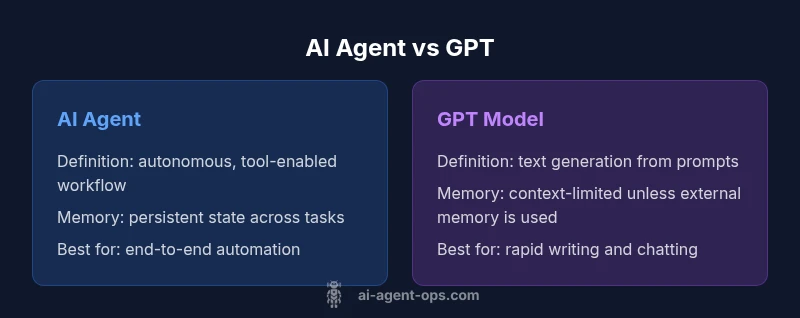
AI agents and GPT models serve different roles in AI systems. An ai agent combines decision logic, memory, and tool integration to autonomously execute tasks, while a GPT model focuses on flexible text generation from prompts. For end-to-end automation, agents excel; for rapid content and dialogue, GPT has the edge. The Ai Agent Ops perspective highlights how to balance both for scalable, safe AI workflows.
The Core Distinction: AI agents vs GPT
At its heart, the question ai agent vs gpt boils down to role and capability. An ai agent is an orchestrator that can plan, decide, remember state, and call external tools to achieve a goal. It behaves as an autonomous actor within a larger system, with policies governing what it can and cannot do. In contrast, a GPT model is a powerful text generator that excels at producing natural language output given a prompt. It does not natively manage state across sessions or wire itself to tools unless you attach an orchestration layer. The Ai Agent Ops team frames this distinction as a practical design choice: agents handle workflows, while GPT handles generation. This lens helps teams decide when autonomy is required versus when fluent language is the primary objective.
When you evaluate ai agent vs gpt for a project, anchor the decision to business outcomes: reliability, repeatability, and security for agents; speed, creativity, and adaptability for GPT. For teams exploring agentic AI workflows, remember that neither is a silver bullet; most successful deployments blend both, leveraging the strengths of each at the right moment.
Comparison
| Feature | ai agent | GPT model |
|---|---|---|
| Definition / Primary role | Autonomous, goal-directed orchestrator with memory, policies, and tool use | Stateless or memory-light language model focused on text generation from prompts |
| Context & memory | External memory, persistent state across tasks, and session continuity | Context window limits; relies on prompts for context unless external memory is integrated |
| Tool use / integration | Native support for plugins, APIs, and external tools within a policy framework | Does not natively call tools; integration requires adapters or wrappers |
| Control & predictability | Explicit governance, traceable decisions, auditable actions | Generated text can be unpredictable; prompts must guide behavior |
| Learning & adaptation | Learning via policy improvement, feedback loops, and memory updates | Static model weights; adaptation through prompts or fine-tuning |
| Latency & cost | Latency from orchestration and tool calls; complex cost model | Often lower per-call cost; price tied to tokens and model choice |
| Best for | End-to-end automation, multi-step workflows, decision trees | Creative writing, Q&A, coding assistance, rapid ideation |
| Security & governance | Stricter data handling, tool-use governance, and auditability | Governance depends on input prompts; tool integration is external |
Positives
- Clear separation of decision-making from generation for better governance
- Stronger auditability and safety controls in autonomous workflows
- Composable using plugins and tools enables scalable automation
- Facilitates reusable, modular architectures across teams
What's Bad
- Increased system complexity and maintenance overhead
- Potential latency from orchestration layers and multiple calls
- Requires new skills in agent design, memory management, and policy authoring
- Dependency on tooling and adapters can introduce integration fragility
AI agents are the stronger choice for autonomous, tool-enabled workflows, while GPT models excel at rapid, flexible text generation.
For end-to-end automation and governance, AI agents provide structure and control. For content-heavy tasks and conversational capabilities, GPT models offer speed and versatility. In practice, most teams benefit from a hybrid approach that leverages agents for orchestration and GPT for generation.
Questions & Answers
What is the core difference between an AI agent and a GPT model?
An AI agent combines decision-making, memory, and tool integration to act autonomously within a workflow. A GPT model is primarily a text generator that responds to prompts without built-in orchestration or persistent state.
Agents plan and act across tasks, while GPT mainly generates text based on prompts.
Can a GPT model be turned into an autonomous agent?
Yes, by adding an orchestration layer, tool adapters, and memory, you can convert a GPT-based system into an agent-capable platform. This requires governance, monitoring, and a policy framework.
You can turn a GPT into an agent with extra plumbing for tools and memory.
What are common use cases for ai agents vs gpt?
AI agents are well-suited for automated workflows, data gathering pipelines, and decision-heavy processes. GPT models excel in chat, creative writing, code assistance, and quick ideation.
Agents automate tasks; GPT helps with writing and brainstorming.
How do memory and context work in AI agents?
Agents typically store state in external memory and maintain context across steps, enabling long-running conversations and complex planning.
Agents remember past steps with memory stores to keep track of goals.
What about cost and pricing between ai agents and GPT usage?
Costs depend on architecture. Agents incur infrastructure and tool usage costs plus model tokens, while GPT usage costs depend on prompts and model selection. Plan for ongoing maintenance.
Costs come from tools and memory, not just prompts.
What governance and safety practices are recommended?
Implement access controls, auditing, and failure handling; monitor tool usage, data handling, and action intent to ensure safe operation.
Set clear rules, monitor for unexpected actions, and audit decisions.
Key Takeaways
- Define the goal: automation vs generation
- Leverage agents for tool use and memory across tasks
- Use GPT for fluent, flexible text and rapid ideation
- Invest in governance and safety from the start
- Adopt hybrid patterns to balance strengths