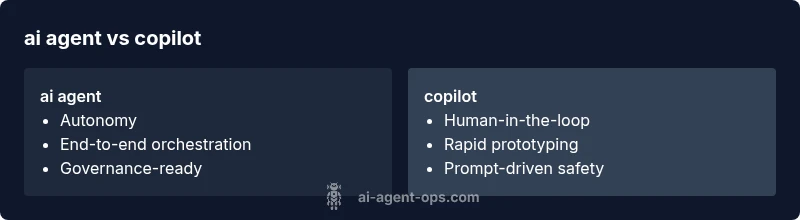
ai agent vs copilot: A practical side-by-side comparison
Analytical, in-depth comparison of ai agent and copilot roles for autonomous automation, human-in-the-loop guidance, governance, and ROI for developers, product teams, and business leaders.


For organizations prioritizing autonomous workflows, the ai agent vs copilot distinction helps decide between autonomous task execution and guided assistance across systems. If your needs center on end-to-end orchestration, an ai agent delivers proactive automation; if you require rapid prototyping and human-in-the-loop decision support, a copilot-style assistant is typically preferable. In practice, many teams blend both to balance automation with oversight.
Framing the comparison: Definitions and roles
In modern AI ecosystems, two archetypes frequently surface: ai agent and copilot. An ai agent is designed to autonomously interpret goals, plan a course of action, and execute tasks across multiple tools, apps, and data sources. A copilot, by contrast, acts as a high-precision assistant that augments human decision-making with suggestions, templates, and rapid prototyping. The distinction is not just about capability; it reflects ownership, governance, and risk posture. According to Ai Agent Ops, the choice between these paradigms should start with the organization’s objectives, governance model, and the degree of autonomy required. The Ai Agent Ops team emphasizes that most teams do not rely on one approach alone; instead, they blend agentic capabilities with human oversight to balance speed and safety. This frame sets the stage for a deeper comparison of how each approach handles goals, actions, and accountability.
Core capabilities contrasted
Both ai agents and copilots leverage large language models, tooling connectors, and environment awareness, but they instantiate these capabilities differently. An ai agent typically maintains a working model of tasks, can monitor progress, adjust strategy, and push actions to APIs or services without continuous human prompts. A copilot focuses on interpretation of user intent, generation of options, and rapid prototyping. For developers, the practical difference is in control loops: agents own the plan and the execution; copilots share control with the user by proposing next steps and seeking confirmation. The result is a spectrum: from fully autonomous orchestration to guided, incremental automation. Across industries, the preference often tracks task complexity, governance needs, and tolerance for risk.
Autonomy and control: Who decides?
Autonomy is not binary. An ai agent can decide to initiate subtasks, check results, and adjust its approach in response to outcomes, within safety constraints. A copilot relies on human-in-the-loop for critical turns, such as approving a deployment, overriding a suggestion, or selecting a path forward. The degree of decision ownership affects auditability: agent-driven decisions leave more traceable action logs, while copilot decisions are often more narrative and prompt-based. Organizations sometimes implement hybrid patterns: an agent handles routine work, while a human reviewer validates exceptional paths. The decision boundary is defined by policy, risk appetite, and the ability to observe and roll back actions quickly if outcomes diverge from expectations.
Context handling and memory
Context is the memory of a system. Ai agents usually maintain persistent context about goals, environment state, tool capabilities, and past results, allowing them to reason across tasks over time. Copilots rely on session context and prompts, with memory typically externalized in the user interface or enterprise data stores. The difference matters when you scale: agents that remember prior states enable long-running workflows, complex orchestration, and proactive issue resolution. Copilots excel at short-lived interactions and rapid experimentation, but they may require repeated prompt engineering to sustain context. Effective adoption often depends on a robust data architecture and clear memory governance to prevent drift.
Tool integration and orchestration
A key differentiator is how each approach connects tools, services, and data sources. An ai agent is designed to orchestrate across a network of APIs, message queues, and databases, coordinating parallel tasks and handling failures gracefully. Copilots typically integrate with a subset of tools relevant to the current session and guide users to execute actions, offering templates, snippets, and connectors. The orchestration capability of an agent can dramatically reduce manual handoffs and context-switching, leading to faster throughput in multi-step processes. However, this power comes with the need for disciplined integration patterns, observability, and error handling at scale.
Safety, governance, and compliance
Any system that autonomously acts across environments must adhere to governance, risk, and compliance constraints. Ai agents can be configured with explicit policies, memory guards, and sandboxed environments to minimize unintended effects. A copilot carries safety by design through prompts, approvals, and human oversight, but governance can be looser if not properly managed. The Ai Agent Ops analysis suggests that the best practice is to combine policy-driven constraints with human-in-the-loop review for sensitive actions. This hybrid approach reduces risk while preserving operational speed.
Performance and reliability considerations
Latency, throughput, and reliability surfaces differ between autonomous agents and copilots. Agents that perform many actions in parallel can achieve higher throughput but require robust error handling, retry logic, and circuit breakers. Copilots deliver rapid, low-latency responses but may stall if the user’s decisions block progress. Reliability also depends on data quality, tooling availability, and monitoring. In practice, teams implement service level objectives (SLOs) for both styles: agents with end-to-end task success rates and copilots with prompt response metrics. Observability—traces, metrics, logs—must cover decision points, tool interactions, and outcomes to diagnose drift and failure modes.
Use-case fit: when to pick ai agent
- Complex multi-tool automation: If your goal is to orchestrate dozens of services with minimal human intervention, an ai agent is typically the better fit.
- Long-running workflows: For processes that span hours or days and require memory of prior steps, agents excel.
- Compliance-forward environments: Where governance and auditable action trails matter, agents offer stronger control.
- Scale and reuse: Operational teams benefit from reusable agent patterns across teams and products. In these scenarios, Ai Agent Ops’s framework recommends starting with a small pilot to demonstrate reliability before broader rollout.
Use-case fit: when to pick copilot
- Rapid prototyping and iteration: Copilots shine when you need quick ideas, templates, and code suggestions.
- Human-in-the-loop decision moments: For decisions that benefit from expert judgment or where incorrect actions carry high risk, copilots help guide decisions.
- User empowerment in front-line tasks: Front-end assistants that augment agents but rely on humans for final approval.
- Training and onboarding: Copilots provide a gentle ramp for teams new to automation, enabling faster learning curves.
Pricing, ROI, and total cost of ownership
Pricing models for ai agent vs copilot depend on deployment context, toolchains, and governance needs. Agents often involve higher upfront integration effort and ongoing maintenance, but can reduce operational costs by removing repetitive manual steps. Copilot-like assistants may have lower initial integration costs but can lead to higher long-term costs if human-in-the-loop usage remains frequent or if governance gaps require repeated remediation. In evaluating ROI, consider total cost of ownership, including integration, observability, governance overhead, and change management. Ai Agent Ops’s framework stresses the importance of pilot programs, clear success metrics, and governance alignment to realize tangible value.
Implementation patterns and best practices
- Start with a clear objective menu: define a few high-impact tasks to automate autonomously and a few to keep human-in-the-loop.
- Build modular capabilities: separate planning, execution, and monitoring components to enable reuse and testing.
- Establish governance gates: define policies, approval flows, and rollback procedures.
- Invest in observability: end-to-end traces, tool-level metrics, and alerting for failure modes.
- Pilot iteratively: begin with a controlled environment and scale gradually, validating outcomes at each stage.
Real-world scenarios and hypothetical examples
- Scenario A: A product-integration team uses an ai agent to coordinate data extraction, transformation, and loading across cloud services, while a separate copilots assists developers with code reviews and proposal generation.
- Scenario B: A customer-support operation deploys an agent to triage tickets and route them, while agents and copilots collaborate on draft responses and knowledge base updates.
- Scenario C: A field operations team uses agents to orchestrate IoT device commands and maintenance workflows, with copilots providing dashboards and alerts for operators.
Roadmap to adoption: next steps and decision criteria
To move from theory to practice, teams should map decision criteria to concrete actions: define success metrics, identify integration partners, establish governance policies, and run small pilots that compare autonomy versus assisted workflows. Clarify risk tolerance and required auditability, align with regulatory constraints, and set up a cadence for reviewing performance. The final decision should reflect a balance between speed and safety, guided by ongoing learning and measurement. For many organizations, a phased approach that blends ai agents with copilots yields the best path forward and aligns with Ai Agent Ops's recommended practices.
Comparison
| Feature | ai agent | copilot |
|---|---|---|
| Autonomy level | High autonomy with goal-directed actions and memory | Guided assistance with user prompts and escalation |
| Decision ownership | Agent-driven planning and execution | User-directed prompts with suggestions |
| Tool integration | Orchestrates across tools and services | Works within a workspace with context provided by user |
| Governance & safety | Policy-driven constraints and monitoring | Prompts-based safety with oversight |
| Learning & updates | Continuous learning and long-term memory | Prompts-based updates with versioned knowledge |
| Best for | Autonomous automation and orchestration | Hands-on workflows with rapid iteration |
| Pricing model | Usage-based for full runtimes and orchestration | Bundled as add-on in platforms |
Positives
- Enables end-to-end automation and orchestration
- Reduces context switching for users
- Can scale repetitive tasks across teams
- Improves decision speed with proactive actions
What's Bad
- Increased risk if misconfigured or misinterprets goals
- Requires governance and monitoring to avoid drift
- Potential higher operational complexity and cost
Prefer ai agent for autonomous automation; choose copilot for guided, human-in-the-loop tasks; most teams benefit from a thoughtful hybrid approach.
If your priority is end-to-end orchestration and governance, ai agents deliver. If your priority is rapid prototyping and decision support, copilots are better. Ai Agent Ops team recommends starting with a hybrid pilot to balance risk and speed.
Questions & Answers
What is the fundamental difference between an ai agent and a copilot?
An ai agent autonomously plans and executes tasks across tools, while a copilot acts as a guided assistant that augments human decision-making. The core distinction is in ownership of action and the need for human oversight.
An ai agent acts on its own plans; a copilot offers suggestions and requires user review.
When is an ai agent the better choice over a copilot?
Choose an ai agent for complex automation, long-running workflows, and environments requiring strong governance and auditable actions. If you need end-to-end orchestration with minimal human intervention, agents tend to outperform copilots.
Use an ai agent for autonomous orchestration.
Can ai agents and copilots be used together effectively?
Yes. A common pattern is to run autonomous agents for routine tasks while copilots provide decision support and human validation for critical moves. This balance often yields both speed and safety.
Yes, blend them for best results.
What governance considerations matter for these systems?
Policy enforcement, auditing trails, access controls, and rollback mechanisms are essential. Agents should operate within sandboxed environments with clear escalation and approval flows.
Governance keeps automation safe.
Are there common pitfalls to avoid when adopting ai agents or copilots?
Overestimating capabilities, underinvesting in observability, and neglecting memory governance can lead to drift, unexpected costs, and unsafe actions. Start with small pilots and clear success criteria.
Watch for drift and safety gaps.
How should an organization start evaluating which approach to adopt?
Begin with a well-defined objective set, run side-by-side pilots, measure governance readiness, and assess integration complexity. Use a hybrid plan to test both patterns before full-scale deployment.
Pilot first, compare autonomy vs guidance.
Key Takeaways
- Define objective: autonomy vs assistance
- Governance first: policy + oversight
- Architect for memory and context
- Pilot before scale; blend agents and copilots
- Measure ROI with holistic costs and outcomes