How to Validate AI Agents: Practical Validation Guide
Learn a comprehensive, step-by-step method to validate AI agents, covering reliability, safety, alignment, and governance with practical checks, metrics, and best practices.


To validate AI agents, follow a structured, end-to-end checklist that covers reliability, safety, alignment, and governance. Start with clear objectives, define measurable metrics, and apply testing in representative environments. Use versioned data, standardized evaluation pipelines, and monitoring dashboards to detect drift and failures. This guide provides practical steps to validate AI agents.
Why validate AI agents matters
Validating AI agents is essential for ensuring they perform reliably, safely, and in a manner aligned with human goals. For developers, product teams, and business leaders, a robust validation process reduces risk, increases stakeholder trust, and speeds up deployment cycles. According to Ai Agent Ops, rigorous validation practices help teams catch subtle failures that automated testing alone can miss, especially in complex, real-world scenarios where agentic AI operates in dynamic environments. By treating validation as a first-class phase—not an afterthought—you build governance that scales with your agents and their evolving capabilities. The goal is to create repeatable, auditable checks that prove the agent’s behavior remains within acceptable bounds over time and across use cases.
In practice, validation should be viewed as a lifecycle activity: plan, execute, observe, learn, and iterate. This mindset helps teams uncover issues related to data quality, prompt behavior, decision logic, and interaction with humans or other systems. A well-validated AI agent is one that can be trusted to perform its intended tasks with predictable outcomes, even as inputs drift or external conditions change. The Ai Agent Ops team emphasizes that validation must be ongoing, not a one-off exercise, because the agent’s operating context and data can evolve dramatically after launch.
Defining validation objectives for AI agents
Clear objectives anchor every validation activity. Start by translating high-level business goals into concrete, testable criteria. Ask: What tasks should the agent accomplish? What constitutes acceptable performance in real use? Which user or stakeholder risks require mitigation? Write these goals as measurable success criteria, such as response accuracy within a tolerance, adherence to safety constraints, or the ability to recover from user errors. Map each objective to a corresponding test type (unit, integration, end-to-end, adversarial, or live-challenge tests) so you have a balanced validation portfolio. By framing objectives this way, you can design tests that reveal whether the agent is meeting the intended outcomes under diverse conditions. Ai Agent Ops notes that aligning validation objectives with governance and compliance requirements from day one prevents scope creep and rework later in the project.
Core validation metrics and signals
Validation metrics should cover multiple dimensions of agent performance. Core signals include:
- Reliability: does the agent complete tasks without unexpected failures?
- Safety: does the agent avoid unsafe or harmful actions and respect user boundaries?
- Alignment: does the agent stick to user intent and domain rules?
- Robustness: how well does the agent handle noisy inputs, partial information, or edge cases?
- Transparency: are the agent’s decisions explainable and auditable?
- Drift detection: do outputs change as data distributions evolve over time?
Concrete metrics can be expressed as qualitative criteria (accept/reject) or quantitative thresholds (target accuracy, latency, or safety violation rate). It’s important to document how each metric is calculated, the data used, and the acceptable range. In practice, rely on a mixed approach: automated checks for obvious regressions and human-in-the-loop reviews for complex judgments. Ai Agent Ops’s analysis emphasizes that a balanced mix of metrics reduces blind spots and supports continuous improvement.
Building a validation pipeline: environments, data, and tooling
A mature validation pipeline mimics real-world usage while remaining controllable. You’ll want:
- A dedicated validation environment that mirrors production constraints but remains isolated.
- A versioned data strategy so test inputs and ground truth remain reproducible.
- A modular evaluation framework that can plug in different tests without reworking the entire suite.
- Observability: dashboards, logs, and alerts that show trend data and anomaly signals.
Set up data pipelines that track provenance from source to test input, including any preprocessing steps. Use standardized evaluation pipelines that apply the same test suites across builds. This makes comparisons fair and decisions auditable. Consider governance gates that require validation results before deploying new agent versions. Ai Agent Ops recommends documenting the pipeline’s design choices to ease audits and future maintenance.
End-to-end testing scenarios for real-world use cases
End-to-end testing exercises complex interactions, including prompts, decision paths, and human-agent handoffs. Create representative scenarios that mirror user journeys, such as:
- A multi-turn conversation where the agent must understand evolving intent.
- A task flow that requires safe-guarding and escalation to human operators.
- A multi-agent coordination scenario with message passing and conflict resolution.
For each scenario, specify expected outcomes, success criteria, and potential failure modes. Run each scenario under varied data conditions (noise, partial information, conflicting inputs) and record the agent’s behavior. Use red-teaming exercises or synthetic edge cases to uncover brittle logic. The goal is to demonstrate not just “works in ideal cases” but resilience across real-world conditions.
As you expand coverage, maintain a living catalog of scenarios, with versioned tests that align to the agent’s capabilities as they evolve. This strategy is central to maintaining confidence in production deployments.
Operational governance: monitoring, logging, and incident response
Validation does not end at release. Implement continuous monitoring to detect deviations in performance, safety breaches, or misalignment triggers. Log decisions, prompts, and outputs in a structured format to enable post-hoc analysis. Establish incident response playbooks that describe how teams should react to abnormal agent behavior, automated rollback criteria, and customer communication guidelines. Regularly review logs, metrics, and incidents to refine tests and update governance policies. Ai Agent Ops stresses that governance should scale with the agent’s risk profile and deployment footprint, ensuring that the validation framework remains fit for purpose over time.
Common pitfalls and anti-patterns
Many teams fall into familiar traps when validating AI agents. Common pitfalls include:
- Treating validation as a single milestone rather than an ongoing discipline.
- Relying on a single metric or dataset that does not capture real-world variability.
- Inadequate coverage of edge cases and adversarial inputs.
- Insufficient logging and traceability for decisions and prompts.
- Poor change management, where updates are deployed without re-validation.
To avoid these, implement a diverse test suite, maintain test data provenance, and require validation gates before every production deployment. The Ai Agent Ops team recommends pairing automated checks with periodic human reviews for high-stakes tasks.
Bringing it all together: a repeatable validation rhythm
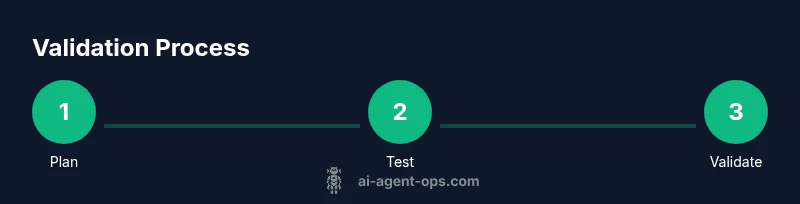
A repeatable rhythm combines planning, testing, observation, and iteration. Establish a cadence for:
- Planning and scoping validation for each release.
- Running full test suites in a sandbox whenever a version changes.
- Analyzing drift signals and safety events on a scheduled basis.
- Incorporating feedback from users and operators into the validation pipeline.
- Publishing a concise validation report for stakeholders.
Following a disciplined rhythm helps teams maintain trust with users and regulators while enabling faster iteration. The Ai Agent Ops team advocates documenting each cycle to support audits and future improvements.
Authoritative sources and governance foundations
For readers seeking formal guidance, consult established standards and research on AI validation.
- https://www.nist.gov/topics/artificial-intelligence
- https://ai.stanford.edu
- https://www.mit.edu
These sources provide foundational concepts and best practices for responsible AI testing, model governance, and system validation. Referencing credible authorities strengthens validation credibility and aligns practices with evolving expectations.
Tools & Materials
- Validation environment (sandbox/staging)(Must mirror production constraints while remaining isolated)
- Version control system(Git or equivalent to track changes in tests and configurations)
- Data versioning and lineage tool(Track datasets used for testing and ground truth mapping)
- Evaluation framework(Modular tests that can plug into pipelines (e.g., custom or open-source frameworks))
- Observability platform(Dashboards and alerts for drift, latency, safety, and reliability signals)
- Experiment tracking(Tool to record experiments, configurations, and results)
- Documentation and governance playbooks(Clear procedures for validation gates and incident response)
Steps
Estimated time: 4-6 weeks
- 1
Define validation objectives
Translate business goals into concrete, testable criteria. Document success metrics and failure modes for each objective. Ensure alignment with governance and compliance requirements from the start.
Tip: Create a checklist that maps each objective to a specific test type (unit, integration, end-to-end). - 2
Design data strategy for testing
Determine sources, sampling methods, and ground-truth annotations. Establish data versioning and provenance so tests are reproducible across builds.
Tip: Use representative and diverse data to capture real-world variability. - 3
Build a reproducible evaluation environment
Create a sandbox that mirrors production constraints, with isolated risk controls and clear deployment boundaries. Version all configurations.
Tip: Automate environment provisioning to reduce setup errors. - 4
Implement measurement framework
Define how metrics are calculated, what thresholds apply, and how results are recorded. Separate safety, reliability, and alignment metrics for clarity.
Tip: Include both automated checks and human-in-the-loop reviews for complex judgments. - 5
Execute tests with edge cases
Run tests across normal, noisy, conflicting, and adversarial inputs. Document observed failures and categorize by severity.
Tip: Automate regression tests to catch reintroductions of old issues. - 6
Validate in live-like scenarios
Simulate real user interactions, including escalation to humans, prompts in dynamic contexts, and multi-agent coordination.
Tip: Involve stakeholders from product and security teams for holistic validation. - 7
Monitor, log, and respond
Enable continuous monitoring with alerting rules for drift and safety violations. Prepare incident response playbooks and rollback procedures.
Tip: Automate rapid rollback if critical thresholds are breached. - 8
Review, learn, and iterate
Analyze results, update tests, and refine governance. Ensure changes go through re-validation gates before each release.
Tip: Maintain a living document of lessons learned and test improvements.
Questions & Answers
What is AI agent validation?
AI agent validation is a structured process to verify that an AI agent behaves as intended, safely and reliably, under diverse conditions. It combines objectives, data strategy, testing, and governance to ensure trust and accountability.
AI agent validation is a structured process to verify safe and reliable behavior under diverse conditions, using objectives, data tests, and governance.
How long does validation take?
Validation duration depends on scope and risk. For a typical release, expect a defined validation cycle that includes planning, test execution, and review, followed by re-validation after changes.
Validation timing varies, but it usually includes planning, testing, and review, plus re-validation after updates.
Which metrics matter most in validation?
Key metrics include reliability, safety, alignment, robustness, and drift detection. Use a mix of automated metrics and human judgments to capture nuanced behavior.
The most important metrics are reliability, safety, alignment, robustness, and drift detection.
How do you handle data drift in validation?
Monitor outputs for distribution shifts and refresh test data periodically. Establish thresholds and automated alerts to trigger re-validation when drift is detected.
Monitor for drift, update test data, and re-validate when drift is detected.
Can validation ensure safety and compliance?
Validation helps enforce safety and governance, but it complements, not replaces, regulatory requirements. Use validated processes as evidence in audits and risk assessments.
Validation supports safety and governance and aids audits, but doesn't replace regulatory rules.
What tools support validation of AI agents?
Tools include versioned data pipelines, modular evaluation frameworks, and observability dashboards. Choose platforms that support reproducibility, auditability, and collaboration.
Use a modular evaluation framework, data versioning, and dashboards for reproducibility and audits.
Watch Video
Key Takeaways
- Define clear objectives before testing
- Use a modular, reproducible validation pipeline
- Combine automated checks with human reviews
- Monitor continuously and iterate tests
- Governance and documentation enable scalability