Ai Agent Evaluations: A Practical Guide for Teams
Learn how to design, run, and interpret ai agent evaluations to improve reliability, safety, and ROI. This educational guide covers metrics, benchmarks, and workflows for developers and leaders.


Ai agent evaluations provide a structured approach to verify how AI agents interpret prompts, select actions, and manage state under real-world conditions. By applying formal tests, teams can detect drift, bias, and unsafe behavior early, ensuring reliability, safety, and business alignment across products and operations. This quick check helps leaders decide whether to invest in a full evaluation program.
What ai agent evaluations are and why they matter
aI agents automate decisions and actions across domains, making it crucial to verify their behavior in real-world conditions. According to Ai Agent Ops, rigorous evaluations validate agent behavior against defined goals, help detect drift, bias, and unsafe actions, and reduce operational risk before scaling. Effective evaluation ties technical performance to tangible outcomes like user satisfaction, turnaround time, and policy compliance. It also supports governance by providing auditable evidence of product safety and reliability. In practice, evaluations examine how agents interpret prompts, manage conversation state, and recover from errors, while considering latency, fairness, and robustness under distribution shifts. A solid evaluation plan includes clear success criteria, repeatable tests, and a framework for ongoing monitoring. Without evidence-based evaluation, agents may drift from intended behavior, produce biased results, or make unsafe decisions that erode trust. The goal is to build an evidence base that leadership can rely on for product decisions, resource allocation, and risk management. This alignment is essential for scalable, responsible AI programs.
Designing a robust evaluation framework
A robust framework begins with alignment to strategic product outcomes and governance requirements. Ai Agent Ops emphasizes turning high-level goals into testable criteria, so involve product, engineering, legal, and customer-support stakeholders early. Translate goals into concrete tests: scripted scenarios, edge cases, and measurable signals. Establish a lightweight pilot to validate the framework before broader adoption, and document scope (agents, tasks, data sources, latency targets, and acceptable error rates). Decide on a sampling strategy that covers routine usage and known failure modes, then set up a reproducible environment with versioned data, fixed seeds, and traceable experiment records. The outcome is a living specification guiding evaluations from initial release to major updates. This approach makes evaluation repeatable, auditable, and scalable across teams and products.
Core metrics and evaluation categories
Effective ai agent evaluations span multiple metric families. Performance metrics like accuracy, latency, and throughput measure how well agents complete tasks within time bounds. Reliability and robustness assess stability under noisy inputs and edge cases, while safety and guardrails evaluate adherence to policies and risk controls. Explainability, auditability, and traceability ensure decisions can be reviewed and understood by humans. Governance metrics track compliance with data usage, privacy, and regulatory requirements. Finally, business-impact metrics (e.g., time saved, error reduction, or policy alignment) connect technical signals to ROI. When selecting metrics, prioritize relevance to core tasks and ensure each metric has a clear acceptance threshold and a method for ongoing re-evaluation as the system evolves.
Data strategy for tests and coverage
A strong evaluation rests on representative test data. Design test sets that reflect normal operation, edge cases, and distribution shifts. Use synthetic data to cover rare scenarios while preserving privacy, and grow real-world datasets with consent and governance. Maintain data versioning and seed control so experiments are reproducible. Document data provenance and ensure coverage for critical decision points, prompts, and kinds of user interactions. Regularly refresh test data to mirror changing user needs and agent capabilities. This ensures that evaluations stay meaningful as agents learn and evolve.
Experimental design and repeatability
Controlled experiments help isolate causes of performance changes. Use randomization and baselines to compare new agent versions against a stable reference. Predefine sample sizes, significance criteria, and stopping rules to avoid overfitting to a specific dataset. Run parallel experiments where feasible to accelerate learning, but isolate test groups to prevent cross-contamination. Record every variation, including environment, data slices, and versioned code, so results can be reproduced and audited later. Document when results are inconclusive and plan follow-up tests to gather more evidence. The emphasis is on repeatable methods that support ongoing improvement rather than one-off wins.
Governance, safety, and risk management
Evaluation data and results must be governed with clear policies. Establish roles for accountability, maintain comprehensive audit trails, and ensure privacy protections in data handling. Implement guardrails to detect and interrupt unsafe behaviors during tests. Regularly review evaluation plans with compliance and risk teams and keep artifacts (test plans, run logs, and dashboards) accessible to stakeholders. A disciplined approach reduces the likelihood of hidden failure modes and supports safer scaling of AI agents across teams and use cases.
Tooling, templates, and automation
Leverage evaluation templates, dashboards, and automation pipelines to scale activities. Use a centralized repository for test scenarios, metrics definitions, and result visualizations. Automate experiment runs, data versioning, and report generation to minimize manual effort and human error. Integrate evaluation outputs with CI/CD pipelines so critical regressions trigger alerts. Create reusable templates for evaluation plans, data schemas, and result interpretation guides to accelerate adoption across new projects and teams.
Roadmap to scale evaluations across teams
Start with a core governance group and a small set of reference agents. Expand to pilot teams, then progressively onboard product, legal, and customer-support collaborators. Establish cadence for quarterly evaluations, monthly dashboards, and post-release reviews. As capabilities mature, build an internal catalog of approved test scenarios and a decision framework to determine whether to roll out a given agent enhancement. The result is a scalable, iterative process that maintains safety, quality, and business value as AI agents proliferate across the organization.
Tools & Materials
- Evaluation plan template(Structured document outlining goals, metrics, data, and governance)
- Test datasets and scenario library(Representative samples covering routine and edge cases)
- Data versioning and seed control tools(Ensure reproducibility of experiments)
- Experiment tracking dashboard(Centralizes results, visuals, and interpretations)
- Governance and compliance checklists(Aligns tests with privacy and regulatory standards)
- Templates for result interpretation(Guides teams on actionability of findings)
Steps
Estimated time: 2-3 weeks
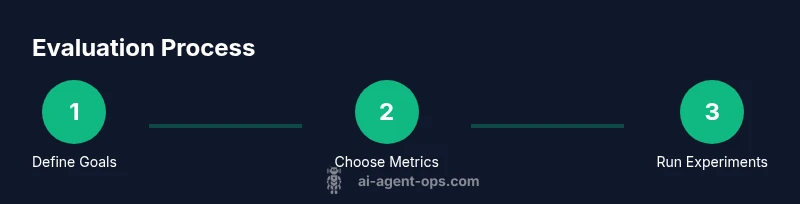
- 1
Define evaluation goals
Identify business outcomes, safety requirements, and stakeholders. Translate goals into measurable criteria and acceptance tests that guide all further steps.
Tip: Document goals with clear success criteria and expected business impact. - 2
Choose evaluation metrics
Select metrics aligned with goals across performance, reliability, safety, and governance. Define acceptance thresholds and data slices for analysis.
Tip: Prefer composite metrics that combine multiple signals for easier interpretation. - 3
Assemble test data and scenarios
Curate representative data, include edge cases, and plan for distribution shifts. Use synthetic data when privacy is a constraint.
Tip: Keep data provenance and permissions documented for each scenario. - 4
Run controlled experiments
Set up randomized experiments with baselines and proper controls. Ensure isolation between test groups to prevent leakage.
Tip: Use fixed seeds and versioned code to ensure reproducibility. - 5
Analyze results and identify failure modes
Aggregate signals, inspect corner cases, and categorize failures by impact and frequency. Prioritize issues that block deployment or harm users.
Tip: Create actionable remediation plans tied to each failure mode. - 6
Validate with stakeholders
Present findings to product, legal, and risk teams. Gather feedback and adjust acceptance criteria as needed.
Tip: Document assumptions and rationale for decisions. - 7
Iterate and document
Update tests, data, and governance artifacts. Embed learnings into the product development lifecycle for continuous improvement.
Tip: Publish a living evaluation plan so teams can reuse it.
Questions & Answers
What is ai agent evaluation and why is it important?
Ai agent evaluation is the process of systematically testing AI agents to verify they meet defined goals, safety standards, and business outcomes. It helps detect drift, bias, and unsafe behavior before deployment, reducing risk and improving trust.
Ai agent evaluation is a formal test of how an AI agent performs against set goals, making deployments safer and more predictable.
Which metrics should I start with for ai agent evaluations?
Begin with core performance metrics, reliability, safety, and governance signals. Add business impact metrics as you clarify ROI and align with product goals.
Start with performance, reliability, safety, and governance metrics, then add ROI signals as you define success.
How often should evaluations be run?
Run evaluations at planned release milestones and on a cadence that matches your risk profile. Re-evaluate after major updates or when data distributions shift.
Run evaluations with each major update and periodically to catch drift.
How do I handle data privacy in evaluations?
Use de-identified or synthetic data where possible. Establish data handling policies, access controls, and audit trails to protect user privacy.
Prefer de-identified data or synthetic datasets and enforce strong access controls.
Can ai agent evaluations predict ROI or impact?
Evaluations inform ROI by quantifying improvements in accuracy, efficiency, and user outcomes, though exact monetary impact requires contextual business modeling.
Evaluations help estimate ROI by showing efficiency and outcome gains, but precise dollars need business modeling.
What are common pitfalls to avoid?
Avoid biased test data, overfitting to a narrow scenario, and ignoring governance. Ensure tests reflect real-world use and include diverse data.
Watch for biased data, overfitting, and missing governance considerations.
What tooling supports ai agent evaluations?
Use templates, dashboards, and automation pipelines. Integrate with CI/CD where feasible and maintain an accessible repository of scenarios and results.
Leverage templates, dashboards, and automated pipelines for scalable evaluations.
How do we start if we are new to evaluations?
Begin with a small pilot, define a few high-priority metrics, and build a repeatable process. Involve cross-functional stakeholders from the start.
Start small with key metrics and a repeatable process, and involve stakeholders early.
Watch Video
Key Takeaways
- Define clear goals and acceptance criteria.
- Use multi-faceted metrics spanning performance and safety.
- Ensure reproducibility with versioned data and seeds.
- Governance and documentation enable scaling.