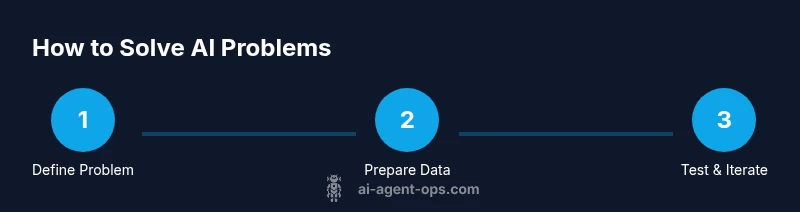
How to Solve AI Problems: A Practical Step-by-Step Guide
A practical, step-by-step guide to diagnosing and solving AI problems, with reproducible workflows, data quality checks, and robust evaluation strategies. Learn how to frame problems, design experiments, and iteratively improve AI systems.


You will learn a practical, step-by-step approach to solving ai problems, from framing the issue to validating fixes. This method emphasizes reproducibility, data integrity, and iterative experimentation. You’ll need access to relevant data, debugging tools, and a clear success metric to achieve reliable results. How to solve ai problems begins with a precise problem statement, a testable hypothesis, and a reproducible workflow that can be audited later.
Understanding AI Problems: Framing and Context
In the realm of how to solve ai problems, success hinges on how well you frame the issue. Too often teams rush to tune models without a crisp problem statement and visible success criteria. Start by articulating the business or research objective in plain language, then translate that into measurable targets. This framing helps distinguish data issues from model shortcomings and clarifies what constitutes a win for stakeholders. A strong frame also identifies constraints, such as latency, privacy, or safety requirements. As you sketch the context, consider common failure modes: data drift, label noise, feature leakage, or misalignment between evaluation metrics and real-world outcomes. By the end of this section you should have a concise, testable hypothesis and a plan for validating it with concrete experiments. Practically, that means creating a minimal reproducible example, assembling representative data, and agreeing on a concrete success metric that reflects user impact. With a clear problem and goal, you set the stage for faster, safer, and more reliable AI work. The foundation of solving ai problems is a disciplined problem frame that stays observable as you iterate.
Building a Reproducible Debugging Playbook
A reproducible debugging playbook is the backbone of efficient AI problem solving. Start with a standard workflow: reproduce, isolate, test, and document. Use deterministic seeds, versioned data, and containerized environments so experiments can be repeated exactly. Maintain a centralized log of hypotheses, configurations, and outcomes, so any failure can be retraced to its root cause. An auditable workflow makes it easier to compare competing approaches and to justify decisions to teammates and stakeholders. As you grow, automate routine steps—data quality checks, metric calculations, and environment setup—to reduce human error and speed up iteration. A solid playbook scales from a single notebook to a multi-team project with consistent practices across teams.
Data Quality and Validation: The Cornerstones
Data quality is the linchpin of reliable AI. Problems often stem from missing values, mislabeled data, or skewed distributions that mislead models. Begin with a data health check: inspect distributions, identify outliers, and quantify missingness. Guard against data leakage by ensuring that features derived from training data are not inadvertently exposed to evaluation data. Use holdout sets and cross-validation when appropriate, and validate that data splits reflect real-world usage. Document data provenance and transformation steps so future engineers can reproduce results. A robust validation plan pairs data quality checks with domain-specific checks (e.g., medical data constraints or financial risk rules) to ensure you’re solving the right problem and not chasing artifacts.
Diagnosis: Common Failure Modes in AI Systems
Diagnosing AI problems requires partitioning potential causes into data, model, and implementation issues. Data issues include drift, label noise, and sampling bias. Model issues cover capacity limits, misalignment of loss functions with objectives, and optimization challenges. Implementation issues often involve data pipelines, feature engineering mistakes, or incorrect encoding of prompts in NLP tasks. Start with quick telemetry: summarize current metrics, compare them against baselines, and identify which component most affects performance. Then test targeted hypotheses (e.g., does drift cause the drop in accuracy, or is the model underfitting?). Prioritize fixes with the highest expected impact and the least risk to production.
Experiment Design: Testing Hypotheses with Rigor
Treat each improvement as a testable hypothesis and design experiments accordingly. Use simple baselines to quantify progress and guard against overfitting by validating across multiple data slices. Predefine success criteria, significance thresholds, and correction for multiple comparisons when running many experiments. Use randomized assignment for A/B tests where possible, and preserve seeds to reproduce results. Document the experimental plan, including metrics, sample sizes, and stopping rules, so learnings are auditable and shareable. A rigorous experiment design keeps you honest about gains and helps you scale improvements across teams.
Implementation: Fixing Models, Prompts, and Pipelines
Implementation involves code changes, data handling updates, and sometimes prompt engineering. Apply fixes incrementally and maintain a changelog so each modification is traceable. Re-run the full pipeline with the updated components and compare results against the baseline on the same datasets. If results regress, revert or adjust with a controlled experiment. Maintain backward compatibility whenever possible and clearly communicate any behavioral changes to end users. This step translates insights into reliable, deployable improvements.
Evaluation and Monitoring: Ensuring Long-Term Reliability
After implementing fixes, evaluate on held-out data and monitor production signals to catch drift or regression. Use both quantitative metrics and qualitative reviews to assess performance in real-world settings. Establish dashboards that track key metrics over time and set alarms for anomalous changes. Include stress tests for edge cases and evaluate fairness, safety, and privacy considerations as part of ongoing validation. A robust monitoring plan ensures that improvements persist beyond initial testing.
Documentation and Post-Mortems: Learning and Sharing
Finally, capture what worked, what didn’t, and why. Write concise post-mortems that include the problem, the hypothesis, the experiments run, the results, and the final decision. Share learnings with relevant teams to prevent repeated mistakes and to accelerate future efforts. Maintain lightweight, versioned documentation so new team members can climb the ladder quickly. This habit turns individual fixes into organizational intelligence and makes future problem-solving faster and more reliable.
AUTHORITY SOURCES
- https://www.nist.gov/topics/artificial-intelligence
- https://www.mit.edu
- https://www.acm.org
Tools & Materials
- Relevant dataset(s) and test data(Representative samples; include labeled examples if supervision exists)
- Compute resources(Sufficient CPU/GPU; scalable for experiments)
- Debugging and logging toolkit(Structured logs, tracing, error reporting)
- Experiment tracking system(Record hypotheses, configurations, metrics, results)
- Version control and reproducible environment(Git; Dockerfile or environment spec (conda/venv))
- Clear problem statement and acceptance criteria(Document success metrics and constraints)
- Validation and test datasets(Separate holdout validation; avoid leakage)
- Monitoring dashboards(Post-deployment drift and alerting)
- Notebooks/IDE with debugging support(For exploration and sharing insights)
Steps
Estimated time: 3-6 hours
- 1
Define the problem and success criteria
Articulate the business or research objective and translate it into measurable targets. Ensure stakeholders agree on what constitutes a win and how it will be measured.
Tip: Tie success metrics to user outcomes and constraints. - 2
Collect and inspect data
Gather data relevant to the problem and perform basic quality checks. Look for distribution shifts, missing values, and labeling inconsistencies that could distort results.
Tip: Document data provenance and any preprocessing steps. - 3
Reproduce the issue locally
Create a minimal reproducible example that demonstrates the problem under controlled conditions. This makes debugging focused and shareable.
Tip: Use deterministic seeds and versioned data. - 4
Establish a baseline model and metrics
Select a simple baseline model to establish a performance floor. Define metrics that reflect the real objective and guard against metric misalignment.
Tip: Prefer simple baselines to avoid masking issues. - 5
Diagnose root causes
Systematically test hypotheses about data quality, model capacity, and pipeline correctness. Use targeted experiments to validate each potential cause.
Tip: Prioritize root-cause hypotheses by expected impact. - 6
Design experiments to test hypotheses
Plan focused experiments with clear success criteria, controlling for confounders and avoiding data leakage. Predefine sample sizes and stopping rules.
Tip: Use randomization and proper holdout splits. - 7
Implement fixes and rerun experiments
Apply changes incrementally and re-run the same evaluation suite to compare against the baseline. Maintain a changelog for traceability.
Tip: If results worsen, back out changes or adjust the experimental design. - 8
Evaluate on holdout data and monitor drift
Assess improvements on unseen data and set up monitoring for production signals. Check for fairness, safety, and privacy considerations.
Tip: Create dashboards and alert thresholds for drift or anomalies. - 9
Document learnings and iterate
Capture what worked, what didn’t, and why. Share a concise post-mortem and update knowledge bases for future projects.
Tip: Keep documentation lightweight but versioned.
Questions & Answers
What is the first step to solve ai problems?
Begin by defining the problem and success criteria, ensuring alignment with stakeholders. Establish measurable targets to guide experimentation.
Start by defining the problem and the measurable goals with your team.
How do I prevent data leakage when testing models?
Split data properly, use holdout sets, and ensure features derived from training data are not exposed to evaluation data.
Use proper data splits and guard against leakage.
What is a good baseline for an AI task?
A simple baseline provides a floor for comparison and helps detect when improvements are real, not artifacts.
Start with a simple baseline to measure progress.
How long does it take to solve complex AI problems?
Timing varies; focus on building a repeatable workflow and logging time per experiment to track progress.
Progress comes from iterative, disciplined experimentation.
What tools support reproducible AI work?
Version control, environment management, and experiment tracking are essential for reproducibility.
Use version control, environments, and experiment tracking.
When should you escalate to a more advanced model?
If the simple baseline cannot meet targets after iterations, consider more capable models or prompts, with proper evaluation.
If baselines fail, consider a more capable approach.
Watch Video
Key Takeaways
- Frame problems with measurable goals.
- Build a reproducible debugging workflow.
- Use simple baselines and rigorous evaluation.
- Guard against data leakage and drift.
- Document learnings to inform future work.