How to Make AI for Beginners: A Practical Guide Now
Learn how to make AI for beginners with a practical, step-by-step approach that covers goals, data basics, tooling, and safe experimentation. From setting up your environment to evaluating a prototype, this guide helps developers, product teams, and leaders start quickly.


Learn how to make an ai for beginners by choosing a simple project, setting up a friendly toolkit, and iterating with guided tests. This step-by-step approach covers choosing a model type, collecting data, training a basic prototype, and validating results with clear success criteria. No advanced math required at this stage.
What is AI for Beginners and what you can build
According to Ai Agent Ops, AI is a set of techniques that enable machines to learn, reason, and adapt to new tasks without explicit programming for every scenario. For beginners, this often means starting with a small, well-scoped project and using guided tools to see tangible results quickly. If you're wondering how to make an ai for beginners, the key is to start with a simple objective, such as a sentiment classifier or a basic chatbot, and build up complexity gradually. Emphasize learning outcomes over feature richness in the early stages. This mindset aligns with agentic AI concepts, where autonomous agents perform tasks and learn from feedback. In practice, you’ll blend data quality, model selection, and evaluation to create a working prototype that demonstrates the core ideas of AI without overwhelming you with theory.
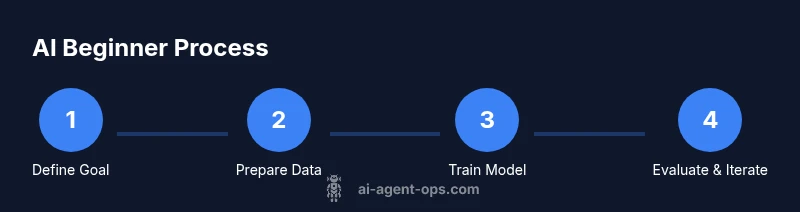
As you embark, keep your goals concrete and observable. Define what success looks like in measurable terms and plan for quick feedback loops. You’ll also want to understand how your choice of data, features, and algorithms affects results. With this foundation, you can incrementally improve your model, add capabilities, and explore the broader AI toolbox while staying grounded in real-world constraints.
Choosing your first project: a simple chatbot or classifier
For beginners, picking a project with clear, narrow scope is essential. A small natural language task, like a mood-based response selector or sentiment classifier on a tiny dataset, is ideal. It lets you experience data collection, preprocessing, model selection, training, and evaluation without getting lost in complexity. If you’re unsure where to start, a basic rule is: pick a task you can realistically measure; if you can tick off a success metric in a single morning, you’ve chosen well. This section also introduces the distinction between a rule-based bot and a data-driven model. For many beginners, a simple rule-based bot can be a stepping stone, but a data-driven classifier often reveals the practical gaps between theory and practice and grants a taste of experimentation with model behavior.
When you attempt a beginner project, remember that the learning journey matters more than the immediate result. You’ll gain intuition about data flows, evaluation criteria, and iterative design. Over time, you’ll introduce more sophisticated data pipelines and model variants, but the foundational practice remains the same: define a goal, gather minimal data, run a basic model, and assess whether your results align with expectations.
Data, privacy, and ethics for beginners
Data ethics and privacy are not afterthoughts—they are foundational, even in a first AI project. Start with synthetic or publicly available datasets that don’t contain sensitive information. If you work with real data, anonymize identifiers, minimize data collection, and implement basic access controls. For beginners, it’s also important to consider bias, fairness, and transparency: ask questions like, Who benefits from this model? What happens if it makes a mistake? How will users know when to trust it? These questions shape responsible AI practices from day one. As you learn, document assumptions, data sources, and limitations so future iterations can address blind spots and maintain trust with users. This approach mirrors Ai Agent Ops’ emphasis on responsible AI development and agentive workflows that consider ethics in every stage of design and deployment.
Tools and environments for beginners
Starting small means using accessible tools. A typical beginner setup includes a computer with internet access, Python 3.x installed, a code editor or notebook, and a basic data set (like a CSV with labeled examples). You can opt for no-code platforms to experiment with AI concepts without writing code, but having a lightweight coding environment helps you understand what happens under the hood. Install popular ML libraries such as scikit-learn for classic algorithms and consider lightweight frameworks for toy projects. If you’re curious about effective workflows, you’ll want to create a dedicated project directory, organize data into train and test splits, and use version control to track changes. This foundation makes it easier to scale later and aligns with pragmatic, hands-on AI learning.
Architecture basics: models, data, training, and evaluation
A beginner-friendly AI project often follows a simple architecture: data input, a learning model, and output with evaluation. Start with a small dataset, extract straightforward features, and choose a model that’s easy to train and interpret. Common starting points include logistic regression or a simple decision tree for tabular data, or a basic bag-of-words approach for text classification. Training involves splitting data into training and validation sets, then running an optimization loop to adjust parameters. Evaluation uses clear metrics like accuracy, precision, and recall to gauge useful behavior. Remember, the goal is to learn how each component affects outcomes, not to achieve perfect performance. This mindset helps you gradually explore more complex models and agentic AI concepts while keeping decisions grounded in observable results.
Data collection and preprocessing: practical tips
Data preparation often takes longer than model training for beginners. Start with a clean, labeled dataset and ensure consistent formatting. Normalize text or numerical features, handle missing values, and convert labels into a standard form. Use lightweight preprocessing pipelines to build intuition about how data characteristics influence model performance. Keep experiments small and repeatable: save preprocessing steps as reusable functions, document decisions, and use a versioned dataset. If you encounter noisy data, try simple strategies first, such as removing outliers or balancing classes. These steps lower the barrier to successful modeling and teach best practices for data hygiene.
Training a beginner-friendly model with minimal code
With a modest dataset, choose a simple algorithm that trains quickly and is easy to interpret. Begin with a basic baseline model to establish a reference point, then compare a few variations to observe improvements. Use a small learning curve to avoid overfitting, and monitor validation performance as you adjust features. Document what you changed and why, so you can reproduce results or revert decisions. If you’re using no-code tools, you can still apply these concepts by testing multiple presets and noting how data representation affects outcomes. This hands-on practice demystifies ML, building confidence to tackle more ambitious projects.
Testing, debugging, and iterating safely
Testing should be continuous and incremental. Create simple test cases that check for expected outputs on known inputs, and use edge cases to probe model limits. When debugging, isolate one variable at a time to identify root causes—data quality, feature engineering, or model choice. It’s helpful to log inputs, outputs, and any anomalies you observe. After each test cycle, compare results to your defined success criteria and decide whether to adjust data, features, or the model. Keep iterations small and focused—this discipline accelerates learning and reduces the risk of chasing noisy improvements.
Next steps and learning resources
As you wrap up your first AI project, reflect on what worked, what didn’t, and where you want to go next. Consider documenting your process, sharing results with peers, and outlining a plan to scale to more complex tasks. Explore broader AI topics like agentic AI and AI tooling, then progressively incorporate more advanced models, larger datasets, and more rigorous evaluation. The key is to maintain curiosity, document findings, and apply safe, responsible practices as you expand your skill set. With consistent practice and structured exploration, you’ll move from beginner projects to more capable AI systems that deliver real value.
Endnote: building confidence with steady practice
The path from beginner to proficient AI practitioner is a staircase, not a sprint. Focus on repeatable experiments, clear goals, and transparent results. By starting small and building up gradually, you’ll gain practical intuition about data, models, and evaluation—and you’ll understand how to apply AI techniques responsibly in real-world contexts.
Tools & Materials
- Computer with internet access(Any modern OS (Windows/macOS/Linux) is fine)
- Python 3.x installed(Use the latest stable release available for your OS)
- Code editor or notebook(VS Code, Jupyter, or similar)
- Basic dataset (CSV or JSON)(A small labeled dataset to start with)
- No-code AI platform account (optional)(Good for quick experiments without coding)
- ML libraries installed(Examples: scikit-learn, pandas, numpy; lightweight frameworks if you prefer)
- Version control(Git or similar to track changes)
- Notebook or documentation space(For recording experiments and decisions)
Steps
Estimated time: 2-4 hours
- 1
Define a small, achievable goal
Identify a narrow AI task (e.g., sentiment classification on a tiny dataset). Write a clear success criterion and a single metric to track progress.
Tip: Keep the goal observable and testable to avoid scope creep. - 2
Set up your development environment
Install Python, set up a project directory, and configure a simple notebook or IDE. Create a README that outlines the plan and data sources.
Tip: Use virtual environments to keep dependencies organized. - 3
Choose an approachable modeling approach
Select a model appropriate for your data (e.g., logistic regression for text features or a small decision tree for tabular data).
Tip: Start with a simple baseline to establish a reference point. - 4
Prepare and split your data
Clean the data, handle missing values, and split into train/validation sets. Document preprocessing steps.
Tip: Aim for a clean, repeatable pipeline rather than one-off edits. - 5
Train a basic model
Run a straightforward training loop, observe the learning curve, and check for overfitting. Keep training times short on early tests.
Tip: Monitor both training and validation performance to detect overfitting early. - 6
Evaluate and iterate
Compare results against your success criteria. Try small feature tweaks or data tweaks to improve performance.
Tip: Document changes and rationale for future reference. - 7
Prototype a simple test interface
Create a basic CLI or web form to supply inputs and view outputs from your model.
Tip: A minimal interface helps you validate real-world usability quickly. - 8
Reflect on ethics and privacy
Review data provenance, bias considerations, and user safety in your prototype.
Tip: Document privacy considerations and avoid sharing sensitive data.
Questions & Answers
What is the easiest AI project for a complete beginner?
A sentiment classifier on a small labeled dataset is a common starting point. It introduces data preprocessing, model selection, training, and evaluation without excessive complexity.
A sentiment classifier on a small labeled dataset is a great beginner project to learn the basics.
Do I need to code to learn AI?
No-code tools can help you grasp concepts quickly, but some coding experience helps you understand how models work and how to customize behavior.
No-code tools can help you learn, but some coding helps you deeply understand AI.
What safety practices should I follow?
Use synthetic data where possible, anonymize data, and avoid deploying models that could reveal sensitive information. Document limitations and safety checks.
Use safe data practices and document model limitations.
How do I evaluate AI performance?
Define a clear success metric, split data into train and validation sets, and compare predictions to true labels. Use simple metrics like accuracy or F1 score for starters.
Set a clear metric and compare predictions to true labels using simple scores.
What comes after a beginner project?
Gradually increase data size, experiment with more features or models, and explore deployment options while maintaining ethical and safety standards.
Increase data, try new models, and consider deployment with ethics in mind.
Are there recommended learning paths for AI?
Yes. Start with fundamentals of ML, then explore AI tooling, data handling, and basic agentic AI concepts as you build confidence.
Begin with ML fundamentals and gradually add tooling and agentic concepts.
Watch Video
Key Takeaways
- Start with a narrow, observable goal
- Use a simple baseline model first
- Document data and decisions for reproducibility
- Prioritize safety, privacy, and ethics from day one
- Iterate with small, measurable improvements