Sample AI Agent Instructions: A Practical Step-by-Step Guide
Learn to craft robust sample ai agent instructions that guide autonomous AI agents with clear objectives, inputs, constraints, and safety checks. A practical, step-by-step guide for developers and product teams.


By the end, you will be able to write clear sample ai agent instructions that guide an agent to perform tasks with predictable outcomes. You’ll define objectives, inputs, constraints, and safety checks, plus how to handle errors and feedback loops. This quick guide sets up scalable patterns for agentic AI workflows.
Why robust sample ai agent instructions matter
According to Ai Agent Ops, robust sample ai agent instructions are a foundation for scalable automation. Clear instructions reduce ambiguity in agent behavior and improve consistency when tasks are delegated to autonomous components. In real-world projects, teams that codify objectives, inputs, and safety checks report faster onboarding, fewer reruns, and more predictable outcomes. This is not about a single prompt; it’s about a repeatable design pattern that aligns with business goals and user expectations. By defining the scope early, you help agents act with purpose rather than improvising on each task. The Ai Agent Ops team emphasizes that structured instruction sets enable orchestration across multiple agents and tasks, laying groundwork for more advanced agentic AI workflows.
Core components of effective instructions
Effective instructions balance clarity with flexibility. At minimum, a good sample ai agent instruction should define: objectives, accepted inputs and formats, expected outputs, constraints and safety checks, and error handling and escalation paths. Include examples of both success and failure modes. Use concrete terms, avoid jargon, and keep sentences short. Ai Agent Ops suggests maintaining a single source of truth for wording to avoid drift across teams. Use templates to promote consistency across projects. Consider versioning and documenting changes to track evolution of the instruction set.
Designing for reliability: inputs, outputs, and constraints
Reliability hinges on how you constrain inputs, define outputs, and articulate limits. Specify allowed input types (text, structured data, or sensory signals), required formats (JSON, CSV, or plain text), and any preconditions. For outputs, describe the data schema, success criteria, and optional fields. Constraints include resource limits, timing constraints, security boundaries, and policy compliance. When possible, provide explicit examples of inputs and expected outputs to reduce interpretation errors. Build-ins like input validation and output schema checks catch many issues before they propagate to downstream tasks. This discipline helps large teams maintain consistent behaviors even as agents scale.
Safety and ethical considerations in agent instructions
Safety-by-design means anticipating misuse and designing safeguards into instructions. Include escalation procedures for uncertain results, boundaries for sensitive domains, and refusals when requests violate policy. Consider bias, privacy, and data minimization. Document consent and audit trails for decisions the agent renders. Involve stakeholders from compliance and product to review the instruction templates. Transparent policies create trust with users and operators while reducing risk of unintended consequences in agentic workflows.
Testing and validating instructions
Testing should cover unit tests for individual instruction components and end-to-end scenarios that mirror real user interactions. Create diverse test prompts, including edge cases and ambiguous requests. Validate that the agent adheres to success criteria, gracefully handles failures, and logs actions for traceability. Iterate on wording based on test outcomes and user feedback. Ai Agent Ops analysis shows that templated approaches improve consistency across workflows and reduce onboarding time for new team members. Document test results and maintain a test matrix to compare versions over time.
Examples: templates and real-world snippets
Provide reusable templates that teams can adapt. Example skeleton: Objective: [Describe goal]. Inputs: [Specify data types and formats]. Outputs: [Define schema and deliverables]. Constraints: [Time, resource, and policy limits]. Safety: [Escalation rules and refusals]. Escalation: [Who to notify and when]. Then show two concrete snippets: one for data extraction and one for task orchestration. Include a short rationale for each choice and a checklist for reviewers. Templates should be modular so teams can swap objectives while preserving structure and safety checks.
Patterns for scalable instruction sets
Create modular blocks that can be mixed and matched. Separate the business objective from the implementation details, and store each block in version control. Use naming conventions, tagging, and documentation to track changes over time. Encourage teams to copy templates and adapt them across projects to scale agent orchestration. Consider a standard PR review process for instruction changes and a lightweight audit trail for why changes were made. This approach supports governance and compliance across the organization.
Common pitfalls and how to avoid them
Beware vague verbs, hidden assumptions, and overly broad goals. Avoid assuming the agent understands domain-specific slang. Do not embed hard-coded heuristics that conflict with policy. Regularly review and refresh instructions as products evolve. Establish a feedback loop from users and operators to keep templates current. Also, avoid brittle prompts that rely on a single prompt format. A disciplined review cadence helps catch drift before it becomes systemic and preserves reliability across agents.
Tools & Materials
- Text editor(Choose Markdown-capable editor for drafting and revision.)
- Instruction templates (objectives, inputs, constraints, safety checks)(Use a single, sharable template to prevent drift.)
- Access to AI agent platform(For running test prompts and validating behavior.)
- Example data prompts(Include diverse inputs to test edge cases.)
- Version-controlled repository(Store templates and test results for traceability.)
- Review checklist(Ensure compliance, safety, and quality gates.)
Steps
Estimated time: 60-120 minutes
- 1
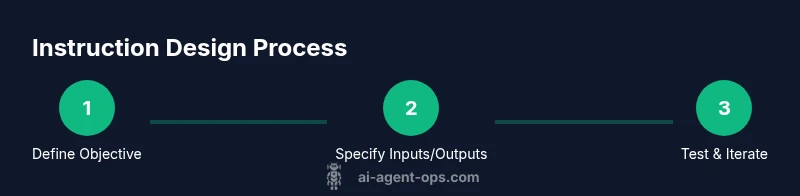
Define the task objective
Clearly articulate the goal the agent should achieve, including success criteria and a brief boundary of what constitutes completion. Tie the objective to user value and business outcomes to prevent scope creep.
Tip: Start with a single, measurable objective that can be tested. - 2
Specify inputs and expected outputs
List all input types, required formats, and any preconditions. Define the output schema and required fields so downstream tasks can consume results without guessing.
Tip: Provide concrete input examples and their formats (e.g., JSON keys and value types). - 3
Draft the instruction template
Create a working skeleton that captures objective, inputs, outputs, constraints, safety, and escalation. Use concise language and domain-specific terminology.
Tip: Keep the template modular so you can reuse components across tasks. - 4
Incorporate safety and fallback strategies
Embed refusals for unsafe requests, escalation paths for ambiguity, and safeguards that prevent policy violations or data leakage.
Tip: Define a clear escalation chain and who should be notified for exceptions. - 5
Test with varied scenarios
Run prompts across diverse and edge-case conditions. Verify adherence to success criteria, logging, and error handling behavior.
Tip: Include both typical and worst-case prompts to surface drift. - 6
Review, version control, and rollout
Store changes in a VCS, tag versions, and document the rationale for edits. Plan a staged rollout with monitoring to catch regressions.
Tip: Tag versions and maintain an audit trail for accountability.
Questions & Answers
What are sample ai agent instructions?
Sample AI agent instructions are structured templates that define a task objective, inputs, outputs, constraints, and safety rules for an autonomous agent. They establish a consistent pattern so agents can operate predictably across tasks and domains.
Sample AI agent instructions are structured templates that guide autonomous agents to perform tasks reliably. They define goals, inputs, outputs, and safety rules for consistency.
Why are constraints important in agent instructions?
Constraints bound an agent’s behavior to policy, timing, and resource limits. They prevent unsafe or undesired actions and help ensure compliance with governance and user privacy.
Constraints keep agents within safe and policy-compliant boundaries, preventing undesired actions.
How do you test agent instructions effectively?
Testing should cover unit checks of each component and end-to-end scenarios, including edge cases and ambiguous requests. Validate success criteria, error handling, and logging, then iterate based on results.
Test both individual components and end-to-end flows with edge cases, then iterate based on results.
How should you handle ambiguous inputs?
Design explicit escalation rules when input ambiguity exceeds policy or confidence thresholds. Prefer asking for clarification or deferring to a human reviewer when necessary.
If inputs are ambiguous, escalate or ask for clarification rather than guessing.
What is the difference between instructions and prompts?
Instructions provide a structured framework for behavior, while prompts are the specific text inputs that trigger actions within that framework. Instructions guide long-term consistency; prompts adapt to individual tasks.
Instructions are the framework; prompts are the task-specific triggers within that framework.
How often should you update sample ai agent instructions?
Update instructions when business needs change, policies update, or performance reviews reveal drift. Maintain version control and document changes.
Update when requirements or policies change, and keep a changelog.
Watch Video
Key Takeaways
- Define clear objectives before drafting prompts.
- Document inputs, outputs, and constraints precisely.
- Incorporate safety checks and escalation paths.
- Test across diverse scenarios and iterate.
- Use templates to enable scalable agent orchestration.