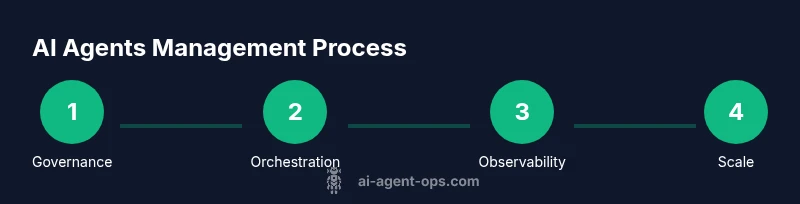
How to Manage AI Agents: A Practical, Step-by-Step Guide
A practical, step-by-step guide for developers, product teams, and leaders to manage AI agents. Learn governance, orchestration, guardrails, observability, and scaling to boost value while maintaining safety and cost control.


Goal: learn how to manage AI agents effectively across teams and use cases. This guide covers governance, orchestration, safety, and metrics, with practical steps, recommended tools, and common pitfalls. You’ll set clear objectives, choose an orchestration approach, implement guardrails, and scale responsibly while maintaining visibility, governance, and cost control across cloud, on-prem, and hybrid environments.
Why Managing AI Agents Matters
In modern product environments, you can deploy multiple AI agents across teams to automate repetitive tasks, augment decision-making, and accelerate workflows. But without a coherent management approach, agents can drift, produce inconsistent results, or create governance and security risks. According to Ai Agent Ops, disciplined management of AI agents leads to faster value, safer operations, and clearer accountability. The first step is to connect strategy with execution: define what the agents are supposed to achieve, how they will interact, and who owns each decision. You should map responsibilities across platform engineers, data scientists, product managers, and business owners, so there is a clear handoff for failures or escalations. Consider both short-term wins and long-term sustainability: a few well-governed agents can generate more impact than a large, unmanaged herd. As you begin, document success criteria, risk tolerances, and guardrails, and set up a lightweight governance board to approve agent activities at key milestones.
Defining Objectives and Governance
Creating a successful AI agent program starts with clear objectives and a governance model. Define measurable outcomes (e.g., time saved, accuracy improvements, user satisfaction) and establish decision rights for when agents should act autonomously vs. when human review is required. Governance should cover data usage, privacy, security, auditability, and escalation paths. Adopt a lightweight, scalable framework that can grow with your needs, such as a tiered approval process for higher-risk tasks and a quarterly review cadence to reassess objectives. This section sets the tone for downstream design decisions and helps align stakeholders early.
Architecting a Manageable AI Agent Ecosystem
A scalable agent ecosystem requires a thoughtful architecture that governs interactions, data flows, and failure handling. Start with a central orchestration layer that coordinates specialized agents, event buses for communication, and a standardized data contract so each component knows input/output formats. Define clear ownership: which team manages prompts, data quality, and monitoring? Use modular agents that can be swapped or upgraded without breaking the whole system. Consider latency, reliability, and security when choosing hosting environments (cloud vs. on-prem) and ensure you have rollback plans and versioned interfaces to minimize disruption.
Data, Prompts, and Interactions: Designing Contracts
Prompts and data contracts are the lifeblood of AI agents. Establish consistent prompt templates, field definitions, and response schemas to avoid drift. Define input validation rules, error handling, and expected output formats so downstream processes can reliably consume agent results. Data quality is critical: implement data provenance, lineage tracking, and data sanitization to minimize bias and leakage of sensitive information. Document interaction contracts in a shared repository so product teams understand what each agent can and cannot do, and set guardrails for prompts that could cause unsafe or biased outputs.
Observability, Metrics, and Feedback Loops
Visibility into agent behavior is essential for trust and improvement. Implement dashboards that track success metrics (like task completion time and accuracy), error rates, latencies, and human review load. Instrument agents with logging, tracing, and structured metrics to identify drift and failure modes quickly. Create feedback loops where human reviewers can annotate decisions, enabling continuous learning and prompt refinement. Regular audits and synthetic data tests help validate agent reliability without exposing real user data in development.
Safety, Guardrails, and Risk Management
Guardrails are your first line of defense against unsafe agent behavior. Implement limiters that cap actions, require human confirmation for high-risk tasks, and enforce privacy and security constraints. Establish fallback procedures for when agents fail or behave unexpectedly, including quarantine modes and automated rollback. Periodically review risk registers and run tabletop exercises to simulate edge cases. Safety is not a one-time task; it requires ongoing monitoring, rapid updates to guardrails, and proactive risk communication with stakeholders.
Pilot, Test, and Iterate
A controlled pilot allows you to validate the end-to-end flow with real tasks but limited exposure. Use a sandbox environment, defined success criteria, and a small dataset to minimize risk. Collect metrics, solicit user feedback, and observe edge cases in a safe scope. Iterate rapidly by refining prompts, data contracts, and orchestration rules, then expand gradually to broader use cases. Document learnings and update governance artefacts to reflect new capabilities.
Scaling and Operationalizing Across Teams
When expanding, apply a staged rollout: start with adjacent teams and low-risk tasks, then increase scope as confidence grows. Standardize onboarding, provide templates and playbooks, and maintain a single source of truth for policies and interfaces. Align incentives and create recognition for teams that produce reliable, safe AI agent outcomes. Continuously optimize cost by right-sizing agents and eliminating redundant tasks, all while preserving governance and security.
Documentation, Training, and Culture
A successful program relies on comprehensive documentation, practical training, and a culture of responsibility. Maintain versioned docs for interfaces, prompts, and data contracts; offer hands-on labs and recorded walkthroughs for new engineers. Encourage cross-team reviews to catch edge cases and promote shared ownership. Finally, foster a culture that values explainability, bias awareness, and ethical use of AI agents to sustain long-term trust.
Tools & Materials
- Project charter or brief(Define goals, success metrics, and governance boundaries)
- Agent orchestration platform or framework(Coordinate multiple agents and handle inter-agent communication)
- Communication protocol specs(APIs, events, data formats, and timeouts)
- Observability stack(Logs, metrics, tracing, and dashboards for agent activity)
- Security and access controls(RBAC, least privilege, and data governance policies)
- Cost monitoring and budget controls(Alerts for unusual usage and optimization opportunities)
Steps
Estimated time: 2-3 hours
- 1
Define governance and objectives
Clarify the business goals for each AI agent, success metrics, and escalation paths. Establish who approves changes and how failures are handled. Document decision rights to prevent ambiguity later.
Tip: Create a decision rights matrix and circulate it for a quick sign-off. - 2
Map agent roles and responsibilities
Identify which teams own prompts, data quality, monitoring, and incident response. Ensure clear handoffs and communications channels between teams.
Tip: Publish ownership maps in a shared workspace for visibility. - 3
Choose orchestration architecture
Select a central coordination layer, message bus, and modular agent design. Ensure interfaces are versioned and backward compatible.
Tip: Start with a minimal viable orchestration layer and iterate. - 4
Design data contracts and prompts
Create standardized input/output schemas, validation rules, and prompt templates. Define error handling and expected formats for downstream systems.
Tip: Version prompts and data contracts in a repository. - 5
Implement observability and dashboards
Instrument agents with logs, metrics, and tracing. Build dashboards showing performance, reliability, and human review load.
Tip: Set alert thresholds to catch drift early. - 6
Establish safety rails and escalation
Impose action limits, require human review for critical tasks, and define rollback procedures. Regularly audit guardrails.
Tip: Document all guardrail changes and rationale. - 7
Run a sandbox pilot
Test end-to-end workflows with non-production data. Measure against predefined success criteria and gather user feedback.
Tip: Keep the pilot scope small and focused to isolate issues. - 8
Review results and iterate
Analyze pilot outcomes, refine prompts and contracts, and adjust governance as capabilities evolve. Prepare a phased expansion plan.
Tip: Schedule a lessons-learned session after each pilot. - 9
Document guidelines and train teams
Publish playbooks, onboarding checklists, and training modules. Ensure teams understand interfaces, policies, and safety practices.
Tip: Offer hands-on labs and certification tracks for engineers.
Questions & Answers
What is an AI agent and why should I manage it?
An AI agent is a software component that autonomously performs tasks or makes decisions within defined limits. Managing agents ensures they operate safely, reliably, and in alignment with business goals. Governance, observability, and guardrails help prevent drift and risk.
An AI agent acts on tasks with some autonomy. Managing it means setting rules, watching its behavior, and ensuring it supports business goals safely.
What is agent orchestration and why is it needed?
Agent orchestration coordinates multiple agents so they work together instead of competing or duplicating work. It provides a single control point, standard interfaces, and clearer ownership, enabling scalable automation across teams.
Orchestration keeps many agents in harmony, so they cooperate and scale without chaos.
How do I ensure safety and guardrails for AI agents?
Safety requires action limits, human-in-the-loop for critical decisions, data governance, and regular guardrail reviews. Establish rollback procedures and incident playbooks to respond quickly when issues arise.
Set boundaries, involve humans for key decisions, and have a plan to roll back if something goes wrong.
What metrics should I track to measure success?
Track task completion rate, accuracy, latency, human review load, and cost. Include governance metrics like policy adherence and incident frequency to gauge safety and reliability.
Monitor completion, accuracy, speed, and the burden on humans to assess performance.
Can AI agents be scaled across teams?
Yes, but scale through controlled expansions, standardized interfaces, and shared playbooks. Use phased rollouts to manage risk and maintain governance.
Yes, but grow gradually with shared tools and clear guidelines.
What are common pitfalls in managing AI agents?
Pitfalls include drift without governance, opaque prompts, over-reliance on automation, and lacking observability. Proactively address these with contracts, dashboards, and regular reviews.
Drift, hidden prompts, and missing visibility are the usual culprits—watch for them.
Which tools support AI agent management?
Look for orchestration platforms, observability stacks, and governance templates that support agent coordination, data contracts, and security controls. Prefer tools that integrate with existing pipelines.
Choose platforms that fit with your current stack and make governance easy.
How often should I review guardrails?
Review guardrails at least quarterly or after major capability changes. Update policies to reflect new risks, data sources, and business requirements.
Review guardrails every few months or after big changes.
Watch Video
Key Takeaways
- Define governance before building agents.
- Choose a scalable orchestration architecture.
- Prioritize observability and guardrails.
- Iterate with pilots and document learnings.