How to Make AI Agents Talk to Each Other
A practical, step-by-step guide to enabling reliable inter-agent communication among AI agents, covering messaging protocols, data schemas, security, testing, and observability.


To make AI agents talk to each other, set up a shared communication protocol, define message schemas, and establish secure, authenticated channels. Implement orchestration patterns (pub/sub, direct RPC), enforce governance and logging, and provide adapters for each agent. Test with scripted scenarios and monitor for latency, errors, and policy violations. The result is coordinated, observable agent collaboration.
Why inter-agent communication matters in AI workflows
Effective inter-agent communication is the backbone of scalable AI systems. When multiple agents share intent, data, and decisions, you unlock parallel reasoning, cooperative problem solving, and faster automation, especially in complex tasks like supply chain optimization or dynamic scheduling. According to Ai Agent Ops, teams that standardize how agents exchange messages gain clearer governance, better traceability, and easier debugging. The Ai Agent Ops team found that adopting a consistent communication protocol reduces ambiguity and speeds up integration across heterogeneous agents and runtimes. In practice, you need a shared language for messages, a reliable transport layer, and clear ownership so that agents know who can send what and when. You will implement guards for safety, ensure observability, and design for graceful degradation when one agent becomes unavailable. The goal is not to force a single monolithic brain, but to enable a network of specialized agents that collaborate like a small, well-coordinated team.
Core concepts: agents, messages, schemas
At the core, an AI agent is a modular problem solver with its own capabilities, inputs, and outputs. When two or more agents communicate, they exchange messages that carry intent, context, and results. A message contract defines the fields every message must carry: sender, recipient, type, payload, timestamp, and correlation ID. Payloads can be raw data, structured commands, or JSON-like events. Schemas enforce shape and validation, so any receiving agent can parse and trust the payload. Identities and access controls help you decide who can talk to whom. Observability is built into the contract: messages should be traceable through logs and traces for debugging and audit trails. Ai Agent Ops notes that versioned contracts and forward-compatible schemas dramatically improve interoperability across evolving agent versions. Finally, define failure modes: retries, fallbacks, and escalation paths, so the system remains resilient even when an individual agent falters.
Communication protocols and patterns
There are several patterns you can apply to AI agent dialogue, each with trade-offs. Publish/subscribe (pub/sub) enables broad dissemination of events without tight coupling but requires ordering guarantees if sequences matter. Request/response provides direct coordination but can introduce latency if many steps are chained. Event streams or streaming interfaces support real-time updates, but you must handle replay and idempotency. Brokerless approaches reduce infrastructure but demand careful peer-to-peer design. When choosing, consider latency budgets, failure handling, and governance: you should have a policy for what happens if a recipient is down or a message violates policy. For security, always encrypt payloads and authenticate messages. Ai Agent Ops recommends starting with a simple request/response or pub/sub setup and progressively layering event streams as your system grows.
Designing a messaging contract and schemas
A robust messaging contract is a living agreement between agents. Start with core fields and evolve the schema with versioning. Example message contract fields:
- sender_id: string
- recipient_id: string
- message_type: string
- payload: object
- timestamp: ISO8601 string
- correlation_id: string
Example payload (for a data fetch task):
{
  "action": "fetch_data",
  "params": { "source": "warehouse-A", "limit": 1000 }
}
Guidelines:
- Use JSON Schema to validate messages.
- Include a correlation_id to trace flows across agents.
- Design payloads to be backward-compatible and forward-compatible.
- Secure sensitive fields with encryption or redaction where needed. By agreeing on a contract, agents can interoperate without bespoke adapters for every pairing.
Implementing security, governance, and observability
Security is non-negotiable in agent communication. Enforce transport security with TLS and, where possible, mutual TLS (mTLS) to verify both ends. Use token-based authentication (OAuth2 or JWT) and enforce least-privilege access per recipient. Maintain a centralized registry of agent capabilities, versions, and permissions to prevent rogue agents from masquerading as trusted peers. Governance should include versioned contracts, deprecation schedules, and a change log. Observability is essential: log every message, propagate context with trace IDs, and monitor message latency, retries, and failure reasons. Use structured logging and a lightweight tracing system to diagnose bottlenecks. Ai Agent Ops emphasizes that transparent observability reduces debugging time and improves trust in automated workflows.
Minimal viable architecture and example workflow
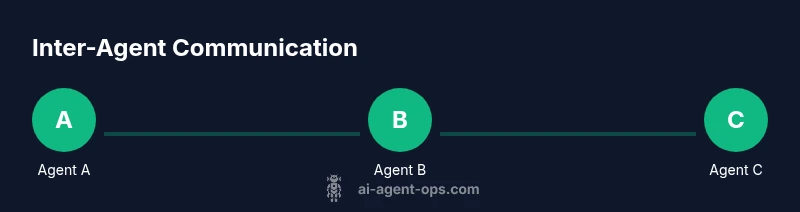
A minimal setup includes three agents communicating through a broker or routing service. Agent A issues a request, Agent B processes the request, and Agent C validates and aggregates results before returning a final decision. The data path follows a simple chain: trigger -> A sends request -> B fetches data -> C validates -> A receives answer. This structure keeps coupling low, makes testing easier, and supports independent upgrades of each agent. In practice, you start with a single, well-defined message contract, a lightweight transport layer, and a small set of message types that cover your core workflows. As you gain confidence, you can layer more complex patterns like event streams and cross-agent orchestration, always preserving observability and governance.
Testing, monitoring, and iteration
Begin with unit tests for each agent’s message handling and payload validation. Use a simulated environment to replay common scenarios and edge cases, including failure modes. Add integration tests that exercise end-to-end flows across the agent network. Monitor latency, throughput, error rates, and policy violations in real time with dashboards and alerting. Establish a feedback loop to evolve contracts and adapters without breaking existing flows. Regularly review security configurations and rotation of credentials. Ai Agent Ops recommends documenting lessons learned and updating the change log with every contract iteration.
Common pitfalls and how to avoid them
Common pitfalls include overloading messages, ignoring schema versioning, and neglecting observability. Avoid hard-coding recipient addresses and instead rely on dynamic discovery and service registries. Don’t skip security basics like mTLS and token validation. Ensure backward compatibility when evolving message schemas and provide clear deprecation paths. Finally, protect against silent failures by implementing retries with exponential backoff and explicit escalation when needed.
Authoritative references and further reading
For deeper guidance on inter-agent communication, explore the following resources:
- NIST: https://nist.gov
- MIT: https://mit.edu
- W3C: https://www.w3.org
Tools & Materials
- Message broker / orchestration layer(Choose a reliable broker for pub/sub or request/response patterns; ensure support for topics, queues, and message replay.)
- Messaging schema standard(Adopt JSON Schema or an OpenAPI-like contract for message validation and versioning.)
- Security mechanism(TLS/mTLS, OAuth2 or JWT, and per-recipient access controls.)
- Identity management(Maintain a registry of agent identities, permissions, and capabilities.)
- Agent adapters/SDKs(Wrappers to translate internal agent data to the shared message format.)
- Observability stack(Structured logging, distributed tracing, and metrics for latency and reliability.)
- Test data and simulation environment(Synthetic data and scripted scenarios to validate end-to-end flows.)
- Contract versioning system(Keep a changelog and maintain backward compatibility.)
- CI/CD pipeline(Optional for automated deployment and governance enforcement.)
Steps
Estimated time: 90-120 minutes
- 1
Define objectives and scope
Identify the agent collaboration goals, the core message types, and the minimum viable contract. Document owner teams, versioning strategy, and success metrics.
Tip: Clarify failure modes early to design robust retries and fallbacks. - 2
Design a minimal message contract
Specify required fields (sender_id, recipient_id, message_type, payload, timestamp, correlation_id) and draft example payloads for common tasks.
Tip: Use a versioned contract and include a deprecation plan. - 3
Choose transport protocol and pattern
Pick a pattern (pub/sub, request/response, or event streams) based on latency, coupling, and governance needs.
Tip: Start with simple patterns and evolve to streaming as needed. - 4
Build agent adapters
Create lightweight wrappers to convert internal agent data to the shared message format and parse incoming messages.
Tip: Keep adapters small and independently testable. - 5
Secure and govern
Implement TLS/mTLS, token-based auth, and a registry of agent capabilities with versioning and change logs.
Tip: Document all changes and enforce least-privilege access. - 6
Instrument observability
Add structured logs, trace IDs, and metrics for latency, retries, and failure reasons across the flow.
Tip: Use a lightweight tracing approach to minimize overhead. - 7
Test end-to-end with a simple loop
Run a three-agent workflow in a sandbox: trigger → process → validate → respond, with both success and failure scenarios.
Tip: Automate regression tests to catch contract drift. - 8
Deploy and iterate
Move to staging, monitor live traffic, gather feedback, and iterate on contracts and adapters.
Tip: Keep a changelog and communicate updates to all teams.
Questions & Answers
What is inter-agent communication in AI?
Inter-agent communication is the exchange of structured messages between AI agents to coordinate tasks, share context, and produce joint outcomes. It enables distributed reasoning and scalable automation.
Inter-agent communication is when AI agents exchange structured messages to coordinate tasks and share context, enabling distributed reasoning.
Do AI agents talk to each other securely?
Yes. Secure inter-agent communication uses transport security (TLS/mTLS), token-based authentication, and access controls to ensure messages come from trusted sources and are processed by authorized recipients.
Yes. Secure communication uses TLS and proper authentication to ensure only trusted agents exchange messages.
What schema formats should I use for messages?
Use forward- and backward-compatible schemas, with JSON Schema or an OpenAPI-like contract to validate message structure and payloads.
Use forward- and backward-compatible schemas with JSON Schema to validate messages.
How do you test inter-agent communication?
Test with a controlled sandbox that simulates real workloads, including failure modes, latency, and retries. Use end-to-end and regression tests to catch regressions.
Test using a sandbox that mimics real workloads and includes failures, latency, and retries.
Can agents evolve to talk in natural language?
Natural language can be used as a user-facing wrapper, but the internal agent communication should rely on structured, contract-driven messages for reliability.
Natural language can be a user-facing wrapper, but internal messages should stay contract-driven for reliability.
Watch Video
Key Takeaways
- Define a clear messaging contract before coding.
- Choose a transport pattern that matches your latency and governance needs.
- Secure, versioned contracts boost interoperability and safety.
- Observability is essential for trust and rapid debugging.
- Iterate with simple tests, then scale to real workloads.