How AI Agents Talk to Each Other: A Practical Guide
Learn how ai agent talk to each other to coordinate tasks, share state, and negotiate goals. This practical guide covers communication patterns, protocols, governance, and real-world examples for building reliable agent networks.


This guide shows how AI agents talk to each other to coordinate tasks, share state, and negotiate goals using structured messaging, protocols, and shared knowledge. You’ll learn core patterns, design principles, and practical steps to build interoperable agent networks that scale. Whether you’re prototyping with lightweight agents or building enterprise-grade workflows, this quick outline sets you up to explore conversations between agents, resolve conflicts, and improve automation outcomes.
What ai agent talk to each other really means
In practice, ai agent talk to each other refers to autonomous software agents exchanging structured messages to coordinate actions, share knowledge, and align goals without human intervention. A successful dialogue between agents rests on a shared protocol, clear contracts, and consistent semantics, so every participant knows how to interpret a message and what to do next. According to Ai Agent Ops, effective inter-agent dialogue starts with a deliberately designed interface, a minimal but expressive vocabulary, and robust handling of failure modes. At runtime, agents publish intent, request help, confirm conclusions, and update a central conversation state that all participants can inspect. The result is a dynamic workflow where tasks are decomposed, allocated, and rebalanced as conditions change. This middle layer of communication sits between high-level business goals and low-level API calls, enabling teams to compose behavior from modular agents instead of writing monolithic software. In this guide you’ll see how the pieces fit together, the common patterns teams use, and practical steps to start experimenting with talking agents in safe, observable ways.
Core communication patterns
Most inter-agent conversations rely on a small handful of message patterns that scale with complexity:
- Request-Reply: one agent asks for a concrete action and waits for a response, suitable for task handoffs and status checks.
- Publish-Subscribe: agents broadcast updates; others subscribe to relevant topics, enabling decoupled and scalable information flow.
- Negotiation and Contracts: agents declare capabilities, offer services, and bind to lightweight contracts that govern outcomes and fallback behavior.
- State Sharing and Knowledge Graphs: agents augment local context with shared facts, enabling better decisions across the network.
Each pattern has tradeoffs. Request-Reply is simple but can create bottlenecks; Publish-Subscribe supports scale but requires careful topic scoping; contracts improve predictability but demand clear versioning and governance. In real systems these patterns combine to form robust agent ecosystems. As you implement them, keep a fixed message schema, stable identifiers, and a clear correlation ID for end-to-end tracing. This reduces ambiguity when messages traverse multiple hops and improves debuggability across services.
Designing robust inter-agent protocols
Robust inter-agent protocols start with clear guarantees around ordering, delivery, and fault handling. Key elements include idempotency (so repeated messages don’t cause duplicated actions), timeouts and exponential backoff for retries, and explicit correlation identifiers that allow the entire conversation to be traced. Versioned contracts should specify supported capabilities, expected inputs/outputs, and fallback plans if a partner fails. Security is baked in from the start with mutual authentication and encrypted payloads, plus role-based access control to limit who can publish or request specific topics. Finally, define graceful degradation paths so agents can continue operating even when parts of the network fail. A disciplined approach to protocol design minimizes surprises as the system grows and evolves.
Message formats and schemas
Inter-agent communication hinges on machine-readable, versioned message schemas. Common approaches include JSON Schema for human-friendly tooling and Protobuf for compact, strongly typed payloads. Use a shared vocabulary and explicit type fields (e.g., type, version, payload) to ensure compatibility across agents and platforms. Include metadata such as sender, timestamp, and correlationId for traceability. Example message shapes help teams stay aligned:
{
  "type": "task_request",
  "jobId": "job-1234",
  "payload": { "task": "data-aggregation", "datasetId": "ds-001" },
  "sender": "agent-A",
  "timestamp": "2026-04-03T12:00:00Z",
  "correlationId": "corr-9876"
}
Version schemas together and roll out feature flags to enable gradual adoption. This reduces breakage when agents upgrade or when new features land.
Coordination strategies: negotiation, bidding, and contracts
Agents coordinate through a mix of negotiation tactics and service contracts. Simple tasks can be allocated using a priority-based bidding system where agents offer capabilities and the best-fit agent takes the job. For more complex workflows, contract-based negotiation formalizes expectations and acceptance criteria, including timeouts and rollback rules. A well-structured contract should be signature-free during runtime (for speed) but auditable for governance. Build negotiation logic to tolerate partial failures and allow fallback plans if preferred agents are unavailable. When scaling, maintain a central registry of agent capabilities and keep a dynamic map of which agents are online and ready to participate. This enables resilient, adaptable collaboration across services.
Observability: monitoring, tracing, and debugging inter-agent talks
Observability is essential for maintaining trust in an agent network. Instrument metrics such as message latency, delivery success rate, and correlationId lineage to understand end-to-end performance. Implement distributed tracing so a single task can be followed as it travels through multiple agents. Centralized logs, structured events, and dashboards help quickly surface bottlenecks or misconfigurations in the conversation graph. Set up alerting on anomalies like spike in timeouts or unexpected message types. Regular drill-downs and fault-injection tests improve resilience and help you catch subtle edge cases before they impact users.
Real-world integration patterns and pipelines
In production, inter-agent communication spans multiple environments and often crosses service boundaries. Use a clear separation between agent logic and data access layers to keep interfaces compact and portable. Integrate with existing data pipelines by publishing task outcomes to downstream services and subscribing to upstream state changes. Apply data governance policies to control who can share sensitive data and under what conditions. Finally, design for incremental rollout: start with a small set of agents in a sandbox, gather feedback, and progressively expand the network while enforcing the same protocols and observability standards.
Tools & Materials
- Container runtime (Docker/Podman)(Isolated sandbox environment for agents)
- Message broker (Kafka, RabbitMQ, or MQTT)(Choose based on scale and delivery guarantees)
- Structured schemas (JSON Schema or Protobuf)(Interoperability across agents)
- Security credentials and TLS certificates(Mutual authentication and encryption)
- Logging and tracing stack (OpenTelemetry, Jaeger, or similar)(Observability and debugging)
- Test agents or simulation environment(Optional but helpful for offline testing)
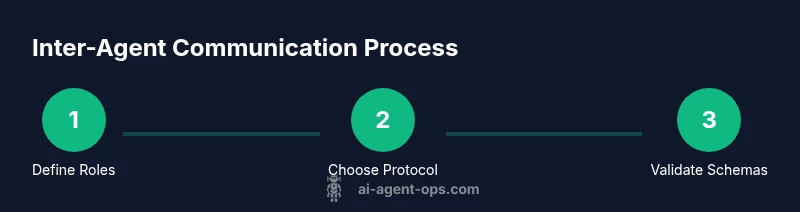
Steps
Estimated time: 3-5 hours
- 1
Define objectives and roles
Clarify the business goal and assign clear roles to each agent. Specify success criteria, acceptable failure modes, and how decisions influence the larger workflow.
Tip: Document owner and expected outcomes for each agent. - 2
Choose a messaging protocol
Select a minimal viable protocol (Request-Reply, Publish-Subscribe, or Contract-based negotiation) that fits the coordination needs. Plan for future upgrades with versioning.
Tip: Start simple and iterate; avoid premature abstraction. - 3
Design message schemas
Create stable, versioned schemas with clear type fields and payload boundaries. Include metadata like sender, timestamp, and correlationId for traceability.
Tip: Version schemas and deploy with feature flags to ease rollout. - 4
Implement agent interfaces
Build compact interfaces that expose only necessary capabilities. Ensure local state is accessible to other agents through a known API surface.
Tip: Aim for idempotent operations and deterministic behavior. - 5
Define contracts and negotiation rules
Establish service contracts that specify capabilities, expected inputs/outputs, and fallback behavior. Include timeouts and clear rollback steps.
Tip: Test contracts under partial failure to verify resilience. - 6
Instrument observability
Add end-to-end tracing, structured logs, and dashboards for visibility into conversations. Ensure correlation across the full workflow.
Tip: Use consistent correlation IDs across all messages. - 7
Test and deploy
Run deterministic tests in a sandbox, then perform fault-injection tests before production rollout. Monitor post-deploy performance and iterate.
Tip: Automate tests to catch drift when schemas or protocols evolve.
Questions & Answers
What is inter-agent communication in AI systems?
Inter-agent communication is the practice of autonomous agents exchanging messages to coordinate tasks, share context, and align on a plan. It enables scalable collaboration without direct human control.
Inter-agent communication is when AI agents exchange messages to coordinate tasks and share context.
Which messaging patterns help agents talk to each other?
Common patterns include request-reply, publish-subscribe, and contract-based negotiation. Each suits different coordination needs and system scales.
Patterns include request-reply, publish-subscribe, and contract-based negotiation.
How can I secure inter-agent messages?
Use TLS with mutual authentication, enforce strict access controls, and encrypt sensitive payloads. Rotate keys regularly and audit access.
Use TLS, authentication, and strict access controls; rotate keys.
How do you test inter-agent communication effectively?
Test in a sandbox with deterministic scenarios and fault-injection to verify resilience and proper error handling.
Test in a controlled sandbox and simulate failures to validate resilience.
Can agents talk across different platforms or vendors?
Yes, with standardized schemas and protocol negotiation. Versioning and governance are critical to long-term compatibility.
It’s possible with shared standards and careful versioning.
What are common pitfalls to avoid?
Over-coupled designs, unversioned schemas, and missing observability lead to brittle, hard-to-scale systems.
Don’t over-couple, forget versioning, or skip monitoring.
Watch Video
Key Takeaways
- Define clear agent roles and objectives
- Adopt stable, versioned messaging schemas
- Instrument end-to-end observability for reliability
- Use progressive rollout to scale safely