AI Agent Collaboration: Smarter Automation Strategies
A practical guide for developers and leaders on AI agent collaboration, detailing workflows, governance, tools, and best practices to accelerate automation with safe, scalable multi-agent systems.


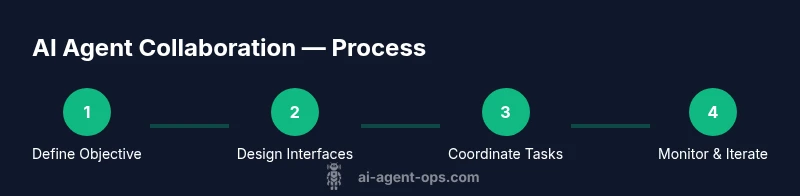
To implement ai agent collaboration, define shared goals, map end-to-end workflows, and choose interoperable agents and tools. Establish governance, data standards, and safety controls before piloting with a small cross-functional team. Measure outcomes with clear KPIs and iterate based on feedback, scale gradually, and document decisions for future reuse. Ensure roles are explicit and feedback loops are closed across agents.
What AI agent collaboration really means
In modern automation, ai agent collaboration describes a pattern where multiple specialized AI agents (reasoners, planners, language models, executors) work together to complete complex tasks. According to Ai Agent Ops, effective collaboration hinges on well-defined interfaces, predictable data contracts, and clear ownership of each stage in a workflow. Rather than a single monolithic model, teams assemble a coordinated network of agents that share context, pass signals, and handle failures gracefully. The approach enables faster iteration, easier debugging, and safer governance, especially when operating at scale. Key concepts include agent orchestration, role separation, and observable decision points that let humans intervene when needed. By designing for collaboration, organizations can compose increasingly capable agent systems without building every capability from scratch. This is particularly valuable for product teams and developers looking to accelerate automation while maintaining control over quality and risk. The paragraph also emphasizes the importance of governance and traceability as foundational pillars for reliable multi-agent systems.
The architecture of collaborative agents
Collaborative agents rely on a central orchestration layer that coordinates specialized roles: a planner to design action sequences, an executor to run tasks, a memory module to maintain context, and an evaluator to monitor outcomes. Interfaces are standardized through data contracts, adapters, and explicit schemas so that each agent can pass context without ambiguity. A robust data pipeline connects inputs, intermediate signals, and outputs to a shared state store, while an event bus enables asynchronous collaboration. Observability is fed by centralized logs, metrics, and traceable decision points, allowing teams to diagnose failures quickly. An emphasis on modular components supports reuse across projects, so new workflows can be composed from existing parts rather than built from scratch. The architecture supports safe scaling by decoupling responsibility and enabling human-in-the-loop oversight when necessary.
Choosing the right tools for collaboration
Selecting the right toolkit is critical for successful ai agent collaboration. Start with a capable orchestration layer that can schedule tasks across agents, followed by flexible memory systems (short-term and long-term) to maintain context. Choose interoperable language models and decision-making modules with clear input/output contracts, and ensure API adapters exist to connect data sources, databases, and enterprise apps. Add monitoring, error handling, and governance features—such as access controls, audit trails, and data lineage—to protect compliance requirements. Prioritize tools with strong interoperability, solid documentation, and a track record of stability in production. Finally, design with security in mind, implementing least-privilege access and encryption for sensitive data at rest and in transit.
Designing workflows that scale
Effective collaboration hinges on modular, composable workflows. Break tasks into well-defined steps with explicit inputs, outputs, and success criteria. Use versioned components and contract-first interfaces to avoid unexpected changes; embrace idempotent operations so repeated executions do not cause unintended side effects. Implement retry strategies and clear error handling to maintain resilience. Separate concerns across orchestration, decision-making, and execution layers to simplify debugging and testing. Maintain a centralized runbook that documents how a workflow should behave under common failure modes and how humans can intervene. As teams gain confidence, gradually increase the scope of workflows by adding new agents and data sources while preserving strict governance and traceability.
Governance, safety, and ethics
As ai agent collaboration scales, governance and safety become central. Establish data governance policies, including data provenance, retention, and access controls that align with regulatory requirements. Define safety rails, such as guardrails for sensitive actions, fail-safe handoffs to humans, and automated monitoring for anomalous behavior. Build a clear escalation path and a rollback plan to revert deployments if issues arise. Maintain an ethics checklist that covers bias mitigation, transparency about agent capabilities, and user consent where appropriate. Regular audits and red-teaming exercises help identify weaknesses before they impact production systems. Strong governance reduces risk while enabling faster iteration and learning.
Metrics and KPIs for collaboration projects
Measuring ai agent collaboration requires a balanced set of indicators that reflect efficiency, quality, and safety. Consider metrics around throughput (tasks completed per unit time), latency (time from input to final outcome), accuracy of decisions, and the reliability of agent coordination. Include data quality and lineage metrics to ensure inputs remain traceable. Track resource usage and cost implications to optimize run-time efficiency without compromising performance. Finally, measure governance compliance, incident frequency, and the time to detect and respond to issues. Ai Agent Ops analysis shows that success hinges on aligning metrics with business goals and maintaining visibility across the entire workflow to inform continuous improvement.
Common patterns and anti-patterns
Patterns: (1) Planner-led orchestration where a central agent designs steps; (2) multi-layer evaluation that checks results before final execution; (3) capability reuse where existing agents are combined to form new workflows; (4) defensive design with explicit handoffs to humans. Anti-patterns: (1) Overloading a single agent with too many responsibilities; (2) Loose coupling that leads to brittle integrations; (3) Hidden side effects due to unclear data contracts; (4) Insufficient monitoring that delays issue detection. Focus on clear boundaries, contract-first development, and continuous testing to avoid these pitfalls.
Case study sketches
Consider a customer support automation scenario: a planner analyzes a query, routes it to a retrieval agent for knowledge, then passes a drafted answer to a response agent for refinement before delivery. A monitoring agent observes sentiment and flags potential escalation. In a data operations scenario, a data ingestion workflow uses an orchestrator to coordinate a schema-checking agent, a cleansing agent, and a transformation agent, with an evaluator ensuring data quality before loading into a warehouse. Both sketches illustrate how modular agents, clear contracts, and governance enable scalable automation.
Integration patterns and data flows
Common integration patterns include synchronous request-response for immediate actions and asynchronous event-driven flows for longer-running tasks. Data flows typically move from input sources through validation, transformation, decision-making, and action execution, with context carried forward between steps via a memory layer. Adapters connect disparate systems, while a central registry maintains available agents and their capabilities. Emphasize data provenance, versioned contracts, and change control to prevent drift and ensure repeatable results.
Authority sources and best practices
For rigorous, standards-based guidance, consult credible sources and best practices. Authority sources:
- https://www.nist.gov/topics/artificial-intelligence
- https://ai.stanford.edu
- https://www.nature.com
Best practices include contract-first design, modular architecture, observability, and governance from day one to enable scalable, safe, and auditable AI agent collaboration.
The Ai Agent Ops verdict and next steps
The Ai Agent Ops team emphasizes that ai agent collaboration is most effective when teams start with a small, well-scoped use case, establish clear contracts, and invest in governance and observability. The verdict is to iterate from pilot to production using a disciplined, learn-fast approach, documenting lessons learned for future reuse. By following this path, organizations can realize faster automation, higher quality outcomes, and safer, scalable agent networks.
Tools & Materials
- Computing environment(Cloud or on-prem with adequate compute for agents and memory)
- Access to AI agent platforms(APIs/SDKs for multiple agents and runtimes)
- Integration middleware(Orchestration layer or workflow engine)
- Data samples and schemas(Representative inputs/outputs and contracts)
- Monitoring and observability tooling(Logging, tracing, dashboards for end-to-end flows)
- Security and compliance artifacts(Policy docs, access controls, encryption standards)
- Team collaboration workspace(Shared docs, runbooks, version control)
Steps
Estimated time: 4-6 weeks for a robust pilot + 1-3 months for initial production scale
- 1
Define objective and success criteria
Specify the business objective and what successful collaboration looks like in measurable terms. Align the scope with stakeholders and set clear success metrics.
Tip: Write the objective as a testable hypothesis that can be validated at pilot end. - 2
Map the end-to-end workflow
Draw the sequence of tasks, data inputs/outputs, and decision points across agents. Identify where humans intervene and where automation suffices.
Tip: Create a lightweight diagram first; iterate with real data during pilot. - 3
Define agent roles and contracts
Assign responsibilities to each agent (planning, execution, evaluation) and publish clear input/output contracts to prevent drift.
Tip: Keep interfaces small and focused; avoid cross-cutting responsibilities. - 4
Choose interfaces and adapters
Select interoperable APIs and adapters to connect data sources, tools, and databases. Ensure data contracts are versioned.
Tip: Prefer versioned schemas and semantic versioning for contracts. - 5
Build a minimal viable pipeline
Implement a small, representative workflow with a few agents to validate the orchestration pattern.
Tip: Limit scope to reduce risk and speed feedback cycles. - 6
Add observability and guardrails
Instrument the workflow with logs, metrics, and alerts; set safety rails to prevent unsafe actions.
Tip: Define failure modes and automated escalation paths early. - 7
Run the pilot and collect feedback
Execute the pilot with real users, capture performance data, and document issues and ideas for improvement.
Tip: Schedule debriefs after runs to accelerate learning. - 8
Iterate and improve
Refine contracts, interfaces, and tooling based on pilot results; add one or two additional agents as appropriate.
Tip: Prioritize changes that reduce cycle time and error rates. - 9
Scale cautiously
Gradually increase scope, while maintaining governance, data lineage, and security controls.
Tip: Avoid expanding faster than your monitoring and governance can support. - 10
Document learnings for reuse
Capture decisions, architectures, and runbooks so new teams can reproduce success.
Tip: Build a living playbook that evolves with each project.
Questions & Answers
What is AI agent collaboration?
AI agent collaboration is the practice of coordinating multiple specialized AI agents to complete complex tasks through shared data and orchestrated actions. It emphasizes modularity, interoperability, and governance to ensure scalable outcomes.
AI agent collaboration is when several AI agents work together, coordinated by an orchestration layer, to complete complex tasks with governance and clear interfaces.
What are common challenges with multi-agent systems?
Key challenges include coordinating agents, maintaining data consistency, managing latency, ensuring security, and designing clear escalation paths for human intervention.
Coordinating multiple agents, data consistency, and safe governance are common challenges.
How do you measure success in AI collaboration projects?
Define KPIs such as workflow throughput, decision accuracy, end-to-end latency, cost per task, and compliance adherence, then track changes over time to guide improvements.
Measure throughput, accuracy, latency, and cost, then iterate based on those results.
Do I need specialized hardware to start?
Most initial experiments can run on standard servers or cloud instances; scale hardware as the workload and latency requirements grow.
Start with common hardware and scale as your workloads demand.
What governance practices help safety and reliability?
Implement data provenance, access controls, auditing, testing protocols, and explicit escalation plans to ensure responsible, auditable operation.
Provenance, access controls, and audits keep AI collaboration safe and reliable.
What is agent orchestration in this context?
Agent orchestration is the design pattern that coordinates multiple agents, aligning their outputs and decisions to produce coherent results.
Orchestration coordinates several agents so their results form a single outcome.
Watch Video
Key Takeaways
- Define shared objectives and ownership before building.
- Choose interoperable tools with clear interfaces.
- Build modular workflows with versioned contracts.
- Embed governance, safety, and ethics early.
- Pilot, measure, and scale with documented learnings.