How to Learn AI Agent Development: A Practical Guide
Learn AI agent development from fundamentals to hands-on projects. This practical guide covers concepts, tooling, workflows, and common pitfalls for developers, product teams, and leaders.


You can learn AI agent development by building fundamentals, mastering agent architectures, practicing with open datasets, and shipping small projects. Start with core concepts, set a learning plan, implement a simple agent, experiment with tools, and iterate. According to Ai Agent Ops, hands-on projects accelerate mastery. Also, track progress with clear milestones and seek community feedback.
Why learning AI agent development matters
Artificial agents are increasingly deployed to automate decision-making and actions across domains. Learning how to build them expands capabilities: from chat assistants that take actions to data pipelines that autonomously execute tasks. The Ai Agent Ops team notes that the demand for agentic AI workflows is rising, with organizations seeking reliable patterns for training, evaluation, and governance. By learning AI agent development, you gain the ability to design, test, and scale autonomous systems that can operate with limited human input. Key benefits include faster iteration, better consistency in repeated tasks, and the ability to orchestrate multi-step processes. This knowledge is valuable for developers who want to contribute to end-to-end automation, product teams who need to define agent capabilities, and leaders evaluating ROI of AI investments.
Core concepts you'll learn
- AI agent vs. automated bot: An AI agent perceives its environment, reasons about goals, and takes actions to achieve them, often with a feedback loop that improves performance over time.
- Architectures: reactive agents focus on immediate actions; deliberative agents plan steps; hybrid and hierarchical designs combine both for scale.
- Agent components: perception adapters, a reasoning module, an action executor, and a memory layer for experience.
- Agentic AI: The shift from scripted automation to systems that autonomously decide, plan, and execute tasks with human oversight as needed.
- Evaluation mindset: measure task success, safety constraints, data efficiency, and the agent's ability to recover from errors.
Ai Agent Ops analysis, 2026, highlights that mastery comes from building real tasks rather than only reading theory. Practitioners should pair theory with deliberate practice and peer feedback.
Step-by-step learning path
-
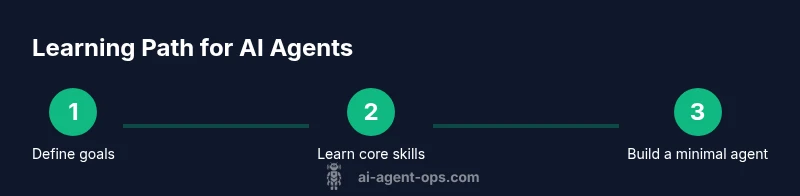
Define your learning goal and scope. Decide whether you want agents for data pipelines, customer support, or internal automation, and outline measurable outcomes. Why: clarity keeps you focused and helps you track progress.
-
Build foundational skills. Learn Python, basic ML concepts, and fundamentals of human–computer interaction. Why: these are the building blocks your agents will rely on.
-
Create a minimal agent in a sandbox. Implement perception, a simple planner, and an action executor for a toy task like answering questions from a static knowledge base. Why: hands-on practice cements concepts.
-
Experiment with tools and frameworks. Choose one open-source approach and implement variations to compare performance. Why: experimentation reveals trade-offs and accelerates learning.
-
Ship a small project and iterate. Deploy the agent in a safe environment, gather metrics, and refine its behavior based on feedback. Why: real-world testing solidifies skills.
Estimated total time: 6-8 weeks
Tools, datasets, and environments
Before you begin, assemble a minimal toolset to keep learning focused and manageable. A practical starting stack includes a laptop with adequate RAM, Python 3.10+, a code editor, and Git for version control. You should also have access to a sandboxed environment or cloud credits for experiments, plus non-sensitive datasets to test perception and reasoning; keep privacy and compliance in mind from day one. This setup helps you move from theory to hands-on prototyping quickly.
Common pitfalls and how to avoid them
- Overengineering early: start with a minimal viable agent and iterate; avoid adding features before core behaviors are solid.
- Data leakage and unsafe evaluation: use clean, sandboxed data and clear evaluation criteria to avoid misleading results.
- Poor documentation and reproducibility: version control experiments, record hyperparameters, and provide a readable rationale for design decisions.
- Lack of safety and governance: incorporate basic safety checks and human oversight in early pilots to prevent unintended actions.
Advanced topics and next steps
As you gain confidence, explore advanced topics like multi-agent coordination, memory management, and autonomy levels. Start integrating evaluation metrics for safety, reliability, and compliance. Consider contributing to open-source projects or building reusable agent templates to speed up future work. The goal is to move from small projects to scalable, maintainable agentic AI workflows.
Tools & Materials
- Laptop or workstation(at least 8 GB RAM; 16 GB+ preferred for ML workloads)
- Python 3.10+(with virtual environments (venv or conda))
- Code editor (e.g., VS Code)(Install Python extension and linting)
- Git(Version control and collaboration)
- Open-source AI agent framework(Choose a starting framework; avoid vendor lock-in)
- Cloud compute access (optional)(Use for larger experiments or scaling once comfortable)
- Test datasets and sample tasks(Non-sensitive datasets for safe experimentation)
Steps
Estimated time: 6-8 weeks
- 1
Define goal and scope
Clarify the task domain and success metrics. Align outcomes with real-world use cases to stay motivated.
Tip: Set 3 concrete milestones and their success criteria - 2
Build core skills
Learn Python basics, ML fundamentals, and how agents perceive and act. Practice with small, contained exercises.
Tip: Pick a single task and implement the entire loop - 3
Create a minimal sandbox agent
Implement perception, a simple planner, and an action executor for a toy task.
Tip: Keep the environment isolated to avoid side effects - 4
Experiment with tools
Demo variations using one framework and compare results. Learn trade-offs between speed, accuracy, and safety.
Tip: Document your experiments and results - 5
Ship and iterate
Deploy in a safe environment, collect feedback, and refine behavior based on metrics.
Tip: Aim for repeatable experiments and versioned experiments
Questions & Answers
What is an AI agent?
An AI agent perceives its environment, reasons about goals, and takes actions to achieve them, often with a feedback loop.
An AI agent perceives its environment, reasons about goals, and acts to achieve them.
Do I need a computer science background?
A programming background helps, but you can learn progressively through structured paths and hands-on practice.
A programming background helps, but you can learn with structured paths and hands-on practice.
What is a good first project?
Build a simple agent that queries a knowledge source and returns an answer, then gradually add validity checks.
Start with a simple agent that answers from a small knowledge base.
How long does it take to learn?
With consistent study and projects, you can reach a basic proficiency in a few months.
With steady practice, you can reach basic proficiency in a few months.
What tools should I start with?
Begin with Python, a code editor, and an open-source agent framework to build and test quickly.
Start with Python, a code editor, and an open-source agent framework.
Key Takeaways
- Define clear learning goals and milestones.
- Build hands-on experience with small agents.
- Experiment, measure, and iterate for real improvement.
- Document results to track progress and reproducibility.