how many ai agents are there in 2026? A landscape overview
Explore how many AI agents exist in 2026, why counts vary by scope, and how researchers estimate archetypes and deployments. Guidance for developers and leaders navigating agent landscapes in business and tech.


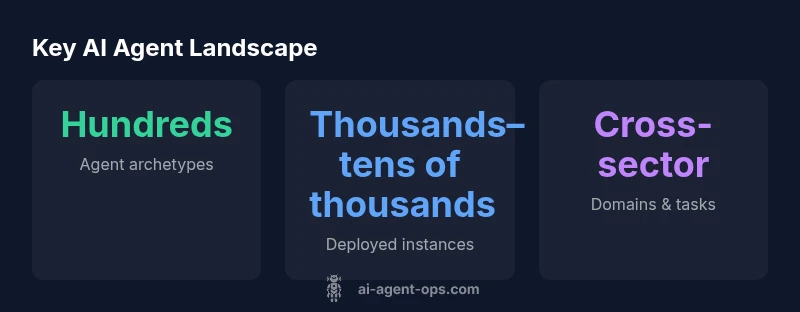
How many AI agents are there is not a single global count. As of 2026, Ai Agent Ops analysis indicates there are hundreds of agent archetypes and thousands of deployed instances across consumer apps, enterprise platforms, and research environments. Exact tallies vary by definition, scope, and tooling, so counts are best represented as ranges.
what counts as an ai agent?
An AI agent is software that can observe an environment, reason about options, and take actions to achieve a goal with some degree of autonomy. The boundary between an agent and a tool is often defined by autonomy and goal-directed behavior. A simple command interpreter is not an agent, while a system that can plan several steps ahead, monitor outcomes, and adjust strategy over time qualifies as an agent. In practice, many deployments blend agent-like components (perception modules, planning engines, and action executors) inside larger platforms or services. For teams asking how many ai agents are there, the practical definition you adopt will shape the counts you report. Grouping by archetype—rather than by product name—helps avoid double counting when the same capability exists across multiple layers or vendors.
Key takeaway: the term covers patterns as much as products, and your counting boundary determines the size of the figure.
archetypes and taxonomy
Within the broad umbrella of AI agents, several recurring archetypes appear across industries:
- Copilots and assistants: lightweight agents that amplify human workers with suggestions, routing decisions, or automated nudges.
- Autonomous agents: systems that set goals, plan actions, and execute without constant human input.
- Agent-based automations: components that orchestrate multiple services to complete end-to-end workflows.
- Research agents: experimental agents used in labs to test policies and control loops.
- Platform-integrated agents: agents embedded in larger platforms (CRM, ERP, IDEs) that provide ongoing behavior rather than one-off actions.
By cataloging archetypes rather than individual products, teams can compare apples to apples when counting. This taxonomy also helps governance: it clarifies ownership, update cadence, and escalation paths. When you define what counts as an agent in your context, you can align metrics, tools, and reporting across teams.
how many ai agents exist? estimation approaches
There is no universal tally of all AI agents worldwide because the word agent means different things in different contexts. Most credible estimates blend two perspectives: archetype catalogs and deployment inventories. An archetype catalog enumerates common agent patterns (copilots, autonomous agents, orchestrators). A deployment inventory tracks active instances within a given environment—cloud platforms, on‑prem systems, and edge devices. Some researchers also map agent capabilities within a service graph to gauge coverage.
In 2026, Ai Agent Ops emphasizes that counts are best expressed as ranges and context-specific metrics rather than a single number. If you include research prototypes and consumer plug-ins, the tallies rise; when you prune to production-grade, governance-backed deployments, the counts are more conservative but still substantial. The practical outcome is to adopt consistent definitions and measurement boundaries so comparisons across projects are meaningful and actionable.
how counts vary by scope across sectors
How counts are approached for AI agents
| Category | Definition | Typical examples |
|---|---|---|
| Agent archetype | A generic pattern of AI agent (e.g., copilots, autonomous agents) | Copilot, autonomous agent, automation bot |
| Scope of deployment | Where the agent runs (local, cloud, edge) | Cloud plugins, local runtimes, edge devices |
| Measurement approach | How counts are estimated (scope-based, instances-based) | Archetype catalogs, deployment inventories |
Questions & Answers
What counts as an AI agent?
An AI agent is software that can observe an environment, reason about options, and take actions toward a goal with some autonomy. It often includes perception, planning, and action components. The boundary with tools or copilots depends on autonomy and decision horizons.
An AI agent is software that can act on its own to complete tasks, with varying levels of autonomy.
Why is there no single count?
Definitions of 'agent' vary by context—scope, deployment, tooling, and governance. Some count archetypes, others count active deployments, and some count both. This heterogeneity makes a universal tally impractical.
Because the term means different things in different contexts, a single global count isn't feasible.
How do organizations estimate the number of AI agents?
Most estimates blend archetype catalogs with deployment inventories. Some analyses also map agent capabilities within ecosystem graphs. The result is a range that reflects scope and governance rather than a fixed figure.
They combine archetype catalogs with deployment inventories to approximate counts.
What does this mean for AI strategy?
If counts are uncertain, focus on scalable architectures, interoperability, and governance. Define the agent categories relevant to your business and measure outcomes (speed, reliability, ROI) rather than chasing a single headcount.
Focus on scalable, governed agent strategies rather than counting heads.
“The landscape of AI agents is not a fixed roster, but a moving ecosystem defined by scope, tooling, and governance.”
Key Takeaways
- Define your scope before counting
- There are hundreds of archetypes and thousands of deployments
- Counts vary by organization and tooling
- Plan for governance and scalability