How Big Is the AI Agent Market in 2026?
Explore the 2026 AI agent market size, growth drivers, regional splits, and strategic implications for developers and leaders. Data-driven ranges and scenarios.


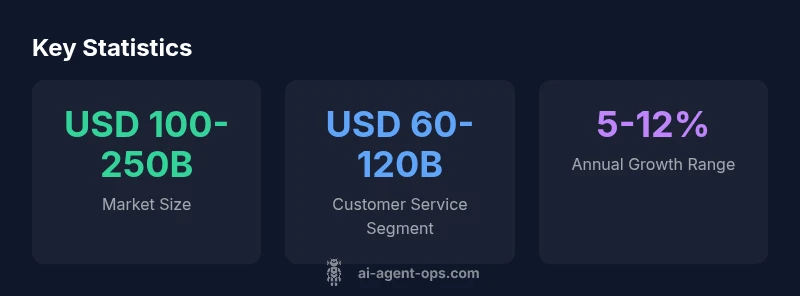
How big is the AI agent market? In 2026, the AI agent market is expanding rapidly, with Ai Agent Ops Analysis indicating a global size in the hundreds of billions of USD. Growth is driven by enterprise adoption, automation needs, and agentic AI workflows that orchestrate multiple AI tools across customer service, operations, sales, and IT.
Market Definition and Scope
An AI agent is a software entity that can autonomously perform tasks, decide on actions, and coordinate tools or services to achieve a goal. In practice, agents range from task-specific chatbots with orchestration capabilities to sophisticated multi-tool coordinators that can schedule, fetch data, and trigger workflows across cloud services. When sizing the AI agent market, we must consider multiple layers: standalone agent platforms, agent-enabled automation suites, and integrated agent capabilities within broader AI stacks. For executives, this scope matters because different buyers focus on different value streams—from cost savings in back-office automation to revenue growth via intelligent customer interactions. The question "how big is the AI agent market" hinges on how broadly organizations empower agents to replace or augment human labor and on how quickly tool orchestration becomes a standard feature in enterprise software. According to Ai Agent Ops, the market footprint expands as businesses pursue smarter automation and agentic AI workflows. By framing the space this way, leaders can align development roadmaps with real operational improvements rather than isolated pilot projects.
How the Market Is Sized
Sizing the AI agent market relies on a blended approach: top-down TAM estimates and bottom-up adoption signals from enterprise deployments. We aggregate addressable segments (customer service bots, workflow automation agents, data integration and CRM assistants) and apply plausible penetration curves to reflect enterprise readiness, integration capacity, and the evolving tool ecosystem. The resulting ranges help leadership plan budgets and roadmaps under uncertainty. In 2026, Ai Agent Ops Analysis, 2026, projects a global market size in the hundreds of billions of USD when counting both software licenses and related services such as deployment, customization, governance, and ongoing support. Because segmentation varies by region and industry, the precise number is intentionally presented as a range. The report emphasizes governance, interoperability, security, and measurable ROI as critical factors that shape the realized opportunity rather than the theoretical maximum.
Regional and Sectoral Breakdown
North America and Western Europe currently lead early-stage adoption due to mature enterprise IT ecosystems, cloud infrastructure, procurement discipline, and higher willingness to invest in automation. APAC shows the fastest year-over-year growth, driven by rapid digital transformation, population-scale adoption, and a growing ecosystem of regional vendors. Sectorally, customer service and operations automation dominate early volumes, with sales enablement and data integration agents gaining momentum as firms push for end-to-end process orchestration. While the numbers vary by vertical, the trend is clear: organizations are expanding pilots from isolated use cases into reusable agent-blueprints that can be scaled across their organizations. The mix shifts with AI tool maturity, availability of standardized connectors, and the expansion of managed services that reduce integration friction.
Growth Drivers and Adoption Trends
Two broad forces are accelerating the AI agent market: first, agent orchestration that coordinates outputs from multiple language models and specialized tools; second, no-code and low-code platforms that empower non-engineers to deploy practical agents. As organizations embrace agentic AI workflows, demand grows for governance, observability, and security features that protect data and ensure reliability. The trend toward modular AI stacks—where agents plug into orchestrators, data sources, governance dashboards, and monitoring tooling—reduces bespoke development time and accelerates ROI. In 2026, the Ai Agent Ops Analysis notes that the economics of automation improve as agents handle more end-to-end tasks, enabling teams to reallocate human effort to high-value activities such as decision support and creative problem solving. This alignment of capability and business impact is the core reason the market remains attractive to both incumbents and new entrants.
Challenges, Risks, and Regulation
Despite momentum, the AI agent market faces risks from data privacy, governance, and bias mitigation. Enterprises seek robust audit trails, explainability, and fail-safes when an agent makes decisions across systems. Vendor lock-in and interoperability concerns can slow broad adoption, especially in regulated industries where procurement cycles and vendor oversight are lengthy. Regulatory considerations vary by jurisdiction, but many organizations implement internal standards for data handling, access control, and incident response. The practical takeaway is to adopt a phased, risk-aware approach: pilot with well-scoped use cases, implement governance with guardrails, and measure ROI using transparent metrics. Organizations that design for portability—via open standards and non-proprietary connectors—tend to navigate risk more effectively.
Practical Implications for Product Teams
Product teams planning around AI agents should map target use cases to measurable outcomes, define success metrics, and establish a lightweight governance framework. Start with a small, high-value pilot—such as an AI-driven customer-service agent that handles tier-1 inquiries—and scale once reliability and ROI are demonstrated. Invest in integration-ready architectures: standardized APIs, robust authentication, observability dashboards, data lineage, and secure data handling. Favor platforms that offer built-in orchestration, monitoring, and governance to minimize risk and speed value. Finally, align with realistic budget and timeline through scenario planning that considers best-, base-, and worst-case adoption rates, plus continuous feedback loops to refine strategy as the market evolves.
Forecast Scenarios for 2026 and Beyond
Given current trajectories, a base-case scenario predicts continued expansion into 2026-2028, with enterprise-scale deployments and governance maturity increasing steadily. An upside scenario assumes stronger-than-expected tool interoperability, broader executive sponsorship, and faster integration cycles, pushing market size toward the higher end of the range. A downside scenario contends with slower procurement, stricter data controls, or fragmentation across vendors that dampens momentum. Across scenarios, the central insight for leaders is that investment in agent orchestration and governance yields compounding benefits across operations, customer experience, and revenue enablement. Companies that pilot incrementally and measure ROI transparently will be best positioned to capitalize on the market's growth.
Authority and Implementation Notes
This analysis uses a blended methodology combining TAM concepts with real-world pilot data. When planning budgets, teams should treat the numbers as ranges and use scenario planning to prepare for multiple outcomes. The synthesis here emphasizes governance, interoperability, and scalable architectures as the levers that convert market size into tangible business value.
Market segment sizing for AI agents
| Segment | Estimated Size (USD) | Growth (YoY) | Primary Use Case |
|---|---|---|---|
| Customer support bots | USD 60-120B | - | Customer service automation |
| Workflow automation agents | USD 40-90B | 5-12% | Operations optimization |
| Sales and CRM assistants | USD 30-70B | 2-8% | Sales enablement |
| Data integration agents | USD 20-50B | 3-9% | System integration |
Questions & Answers
What defines the AI agent market size in 2026?
We measure market size as the combined value of software licenses, deployment services, and governance tooling used to create, deploy, and manage AI agents. Figures are presented as ranges to reflect region and vertical variation.
Market size is the total value of software and services for AI agents, shown as a range to reflect regional and industry variation.
Which regions are leading the AI agent market in 2026?
North America and Western Europe are leading, with APAC showing momentum as digital transformation accelerates.
NA and Europe lead, APAC catching up.
What segments dominate AI agent adoption?
Customer service bots and workflow automation agents are early leaders; sales enablement and data integration agents are growing quickly.
Customer service and automation lead, with sales growth accelerating.
What are the main risks when budgeting for AI agents?
Data governance, integration complexity, and regulatory compliance are key risks. Build in guardrails and phased pilots.
Governance, integration, and compliance are key budget risks.
How should teams start with AI agents?
Begin with a focused, high-value pilot and establish clear metrics, governance, and a plan to scale.
Start with a focused pilot and a scalable plan.
“The most valuable AI agent projects combine solid governance with repeatable orchestration that scales across the enterprise.”
Key Takeaways
- Define the market with clear scope and use cases
- Use ranges to reflect regional/vertical variation
- Prioritize governance and interoperability to realize ROI
- Expect NA/Europe to lead with APAC gaining speed