Ai Agents Without Coding: A Practical No-Code Guide for Teams
Learn how ai agents without coding empower teams to automate workflows rapidly. This no-code guide covers platforms, design patterns, governance, and practical steps to deploy secure, scalable AI agents in real-world settings.


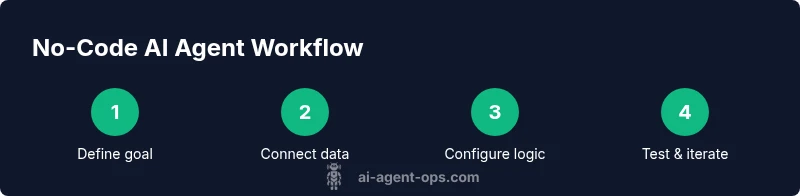
With no-code AI platforms, you can deploy functional AI agents without writing code. Define goals, connect data sources, and compose actions using visual builders and templates. This approach speeds prototyping, reduces risk, and enables cross-team collaboration. You’ll still need clean data, clear workflows, and governance to keep agents reliable and secure.
Why no-code ai agents matter for teams
According to Ai Agent Ops, the rise of no-code AI agents is reshaping how organizations prototype, test, and scale intelligent automation. No-code approaches let product teams, developers, and operators converge around shared workflows without waiting for specialized programming. The core value is speed: you can move from idea to working automation in days rather than months, while keeping governance and security in check. For many teams, the most compelling aspect is the ability to experiment with AI agents without becoming software engineers. This accelerates learning, reduces dependency on scarce skilled developers, and enables rapid iteration across business units.
To maximize impact, start with clearly scoped use cases and measurable outcomes. For example, an AI agent can triage customer inquiries, extract key data points from documents, or route tasks to the right team. The no-code tool acts as the orchestration layer, connecting data sources, AI models, and downstream actions. Crucially, the successful no-code approach relies on good data hygiene, explicit decision rules, and concise prompts that guide the AI’s behavior. This reduces ambiguity and helps agents behave predictably in production.
From a governance perspective, no-code does not erase risk. You still need access controls, auditing, versioning, and rollback capabilities. Ai Agent Ops recommends treating no-code AI agents as producible software: maintain a product backlog, track iterations, and establish acceptance criteria for each agent. When done well, no-code AI agents unlock faster experimentation cycles, improve cross-functional collaboration, and create tangible business value without writing code.
In practice, teams should map a simple end-to-end scenario first—define the input, the decision logic, and the output. Then, incrementally add data connectors, AI prompts, and business rules. This phased approach minimizes complexity and makes it easier to identify where improvements are needed. Remember to balance speed with discipline; the quickest route to value is a well-scoped pilot with clear success metrics and a plan for scaling.
Ai Agent Ops emphasizes that the most successful no-code initiatives blend human oversight with automation. Agents should escalate when confidence drops below a threshold, and humans should approve decisions for edge cases. This hybrid approach preserves quality while enabling automation at scale.
- (note)
Tools & Materials
- No-code AI platform account(Choose a platform that supports AI agents and integrations (e.g., visual workflow builders, templates, and data connectors).)
- Data sources and connectors(CRM, helpdesk, databases, cloud storage, APIs. Have your connectors’ credentials ready.)
- Authentication credentials(API keys or OAuth tokens for connected services; ensure least-privilege access.)
- Stable internet connection(Reliable connectivity with sufficient bandwidth for API calls and data transfer.)
- Sample data set for prototyping(A clean, representative data set to test inputs and outputs.)
- Documentation template(Capture goals, constraints, decision rules, and operator handoffs for governance.)
Steps
Estimated time: 4-6 hours
- 1
Define objective
Clarify the business problem the AI agent will solve, the expected outcomes, and how success will be measured. Write a one-page objective with SMART criteria and a clear handoff point for human agents when confidence is low.
Tip: Frame success in measurable terms (e.g., time saved, accuracy rate, or customer satisfaction). - 2
Connect data sources
Identify all data inputs the agent will need and wire them to your no-code platform via available connectors. Ensure data quality and establish access controls so only the agent can access required fields.
Tip: Check data freshness and privacy rules; document any data transformation steps. - 3
Create agent blueprint
Select a template or start from scratch to define inputs, outputs, and decision logic. Map prompts, models, and actions to the workflow without writing code.
Tip: Use a simple, modular design so you can swap components later without reworking the entire flow. - 4
Configure inputs, outputs, and rules
Define the data that goes into the AI model and the expected outputs. Add decision rules and fallback paths for uncertain results.
Tip: Set a confidence threshold for automatic decisions and specify escalation criteria. - 5
Test with real scenarios
Run end-to-end tests using representative data and edge cases. Validate outputs, latency, and error handling before production.
Tip: Simulate peak loads and failover to ensure reliability. - 6
Deploy and monitor governance
Publish the agent to production with access controls, audit trails, and monitoring dashboards. Establish alerts for anomalies or degraded performance.
Tip: Enable versioning and rollback to safeguard against unintended changes. - 7
Iterate and scale
Collect feedback, refine prompts and rules, and replicate the approach for additional use cases. Document learnings to accelerate future deployments.
Tip: Start with one pilot per quarter to maintain focus and quality.
Questions & Answers
What does it mean to build ai agents without coding?
No-code AI agents are built using visual interfaces, templates, and connectors instead of writing code. You define goals, data inputs, and actions, while the platform handles model calls and orchestration.
No-code AI agents use visual tools to set up goals and data flows, so you don’t need programming to create automated AI tasks.
What can I realistically build with no-code AI agents?
Common use cases include customer inquiry triage, document extraction, task routing, and simple decision automation. Start with a well-scoped problem and expand as you gain confidence.
You can start with things like triaging emails, routing tasks, or pulling data from documents, then grow complexity over time.
Which platforms support no-code AI agents?
Several platforms offer no-code capabilities, featuring visual builders, AI model access, and connectors to popular tools. Compare features like templates, governance options, and pricing before choosing.
Many platforms offer no-code AI agents with visual builders and integrations; compare templates and governance features to pick the right fit.
Is no-code always secure for enterprise use?
Security depends on platform capabilities and governance practices. Use access controls, data encryption, auditing, and versioning. Always review data handling policies before production.
Security depends on platform features and how you govern them; use controls, audits, and encryption to stay safe.
What are the limits of no-code AI agents?
No-code agents excel at rule-based automation and integration but may struggle with highly specialized or novel tasks without model customization. Plan for escalation when confidence is low.
No-code agents work well for common automation, but for niche tasks you may still need expert guidance or custom models.
Do no-code agents replace developers?
No-code tools reduce the need for hand-coding but still benefit from developers for platform selection, security reviews, and governance planning. They complement human engineering, not replace it.
They don’t replace developers; they take over routine wiring and orchestration, while experts handle security and architecture.
Watch Video
Key Takeaways
- No-code AI agents accelerate prototyping and deployment.
- Define clear goals and data flows before building.
- Choose platforms with strong governance and security features.
- Test with realistic scenarios and edge cases.
- Iterate and scale responsibly across teams.