ai agent x design: A practical guide for building agentic AI workflows
Explore a practical, step-by-step approach to ai agent x design. Learn architecture, prompts, governance, and implementation patterns to build reliable agentic AI workflows.


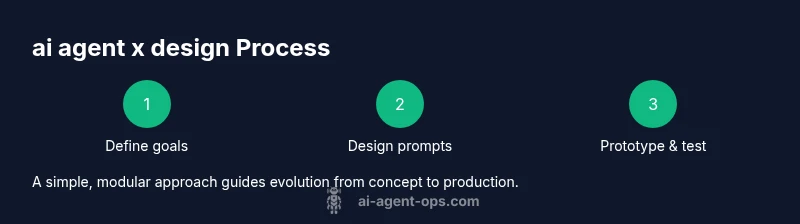
Goal: design an AI agent x design workflow that automates decision-making and task execution with clear roles, safety constraints, and measurable outcomes. You will define agent responsibilities, integration points, prompts, and evaluation criteria, then implement a ready-to-follow step-by-step blueprint to prototype and test in a real project. This quick guide helps teams avoid scope creep and align technical goals with business value.
Framing AI Agent X Design
According to Ai Agent Ops, the core of ai agent x design is to align technical capabilities with business goals while enforcing governance, privacy, and safety. Start by specifying what the agent should achieve, what decisions it can make, and what information it may access. Without clear goals, the system risks scope creep and misalignment. In practice, you’ll articulate a success criteria such as throughput, reliability, and user satisfaction, then translate that into concrete performance indicators that can be measured in a sandbox environment.
Next, map the agent's context: the tools it will use, the data it will consume, and the users who will interact with it. This includes defining input types (text, data feeds, or events), outputs (actions, summaries, or recommendations), and the timing of those outputs. Clarify constraints and guardrails—what the agent is allowed to do autonomously, and where human oversight is required. In many organizations, a single “orchestrator” agent coordinates specialized subagents: a data fetcher, a reasoning module, and an action executor. You can also designate an evaluator that checks results before delivery to humans or systems. These roles help separate concerns and improve maintainability. For ai agent x design, you want a modular architecture where components can be updated independently, reducing risk when you scale or re-train models.
Practical tip: start with a small, well-scoped workflow before expanding. A concrete example is a customer-support assistant that triages tickets, fetches order data, and suggests responses for human agents to approve. By constraining the initial scope and building with guardrails, you develop reusable patterns you can apply to more ambitious agentic workflows later.
Architecture of an Agentic System
An effective ai agent x design relies on a layered architecture that separates concerns and enables safe evolution. At the core is the agent, equipped with a decision policy, a toolset, and a memory layer. Surrounding it are subagents, which perform specialized tasks such as data retrieval, long-running reasoning, or action execution. The orchestrator coordinates the flow: perceive input, plan a sequence of actions, execute tools, and evaluate outcomes. A lightweight memory store captures context for the current session, while a persistent store preserves knowledge for audit and learning over time.
A robust design includes a feedback loop: the agent’s outputs are evaluated, adjusted, and re-entered into the system. This loop supports continuous improvement and helps detect drift or misalignment early. Tool integration is a critical design decision: consider adapters for databases, APIs, or internal services, and define clear contracts (input/output formats) to minimize coupling. Guardrails should be baked into the architecture: rate limits, data privacy rules, and escalation paths to human operators when confidence is low. Finally, plan for monitoring: traceability, error handling, and alerting enable rapid diagnosis of failures before they impact users.
For ai agent x design, adopt a modular approach where each component can be swapped or upgraded without rewriting the entire system. This makes it easier to adopt new models, integrate new tools, or adjust governance policies as requirements evolve. Ai Agent Ops analysis shows that teams that design modular architectures achieve faster iteration and clearer accountability.
Designing Prompts and Interfaces
The prompts you craft drive behavior. Start with goal-oriented prompts that define the task, success criteria, and constraints. Use system prompts to establish baseline behavior, and user prompts to capture context from operators or customers. To balance reliability with flexibility, combine deterministic prompts with flexible tool calls, so the agent can adapt to new data without breaking. When architectural decisions allow, implement a chain-of-thought pattern for complex tasks, but consider suppressing internal reasoning when not needed to protect privacy and reduce token usage.
Tool interfaces deserve special attention. Define crisp, versioned API contracts for each tool, including expected inputs, outputs, error handling, and retry logic. Build thin adapters so tools can be swapped with minimal disruption. Use structured data formats (JSON, XML) rather than free-form text when possible, which makes testing and auditing easier. Finally, design user interfaces and interaction patterns that ground the agent’s actions in a human-centric workflow: dashboards for monitoring, contextual prompts for operators, and clear visual cues when actions require human approval.
Evaluation, Governance, and Safety
Evaluation should blend quantitative metrics with qualitative feedback. For ai agent x design, measure objective indicators such as latency, accuracy, and failure rate, and collect user impressions through surveys and usability studies. Establish guardrails: define hard limits on what the agent can do autonomously, implement data minimization, and enforce access controls. Regular audits of decisions, prompts, and tool usage are essential for accountability. Incorporate a human-in-the-loop path for edge cases, security-sensitive tasks, and high-stakes decisions. Create an escalation protocol that triggers review when confidence dips below a defined threshold. Governance should cover model updates, data retention, and transparency about when and how AI is used. Finally, maintain an experiment log to document design choices, results, and lessons learned.
Implementation Roadmap and Best Practices
Begin with a minimal viable design that demonstrates the core ai agent x design pattern: a central orchestrator, a couple of specialized subagents, and a safe invocation wrapper around external tools. Then iteratively expand capabilities, guided by real-world feedback and governance constraints. Create a cross-functional team including engineers, product managers, data scientists, and compliance experts to ensure diverse perspectives. Use modular prompts, adapters, and guardrails so you can scale without rewriting large portions of code. Maintain a backlog of improvements, prioritize experiments based on impact, and schedule regular reviews of safety and performance. Finally, document decisions, measure impact against business value, and prepare for deployment with proper monitoring, rollback plans, and incident response.
Tools & Materials
- Development workstation with stable internet(Equipped for code, notebooks, and testing environments)
- Access to AI platform API(General-purpose model APIs or internal inference endpoints)
- Prompt design notebook or documentation tool(Versioned prompts, templates, and contract specs)
- Test datasets and sandbox environment(Composite data for edge cases and regression tests)
- Monitoring and logging tooling(Tracing, metrics, and alerting for agent behavior)
- Version control and CI/CD for agents(Automated tests and safe deployment pipelines)
- Security and privacy guidelines(Data handling standards and access controls)
Steps
Estimated time: 4-6 weeks for a functional prototype
- 1
Define objective and guardrails
Set a clear objective for the AI agent x design and establish guardrails for autonomy, data access, and escalation. Define success criteria and constraints to prevent scope creep.
Tip: Document decision boundaries and intended user outcomes up front. - 2
Map agent roles and interactions
Identify core roles (orchestrator, data fetcher, executor, evaluator) and how they communicate. Clarify data flow, responsibilities, and handoffs to maintain modularity.
Tip: Use a responsibility assignment matrix to avoid overlap. - 3
Design prompts and tool contracts
Create system, user, and role-specific prompts. Define tool interfaces with inputs/outputs, error handling, and retries to ensure robustness.
Tip: Version prompts and contracts; align with governance policy. - 4
Build a minimal prototype
Implement a small, scoped workflow to demonstrate core ai agent x design patterns. Include a guardrail for human approval when unsure.
Tip: Start with a single end-to-end scenario to validate end-to-end flow. - 5
Test with realistic scenarios
Run diverse scenarios, including edge cases, data privacy checks, and failure modes. Capture outcomes for iteration.
Tip: Automate regression tests to catch drift early. - 6
Governance, safety, and audits
Attach governance checks to updates, maintain audit trails, and ensure compliance with data handling rules.
Tip: Schedule periodic governance reviews with cross-functional stakeholders. - 7
Deploy, monitor, and iterate
Roll out to production with monitoring dashboards, alerting, and a rollback plan. Iterate based on real usage and feedback.
Tip: Keep an incident playbook ready for fast remediation.
Questions & Answers
What is ai agent x design?
Ai agent x design is a structured approach to building agentic AI workflows that align with business goals, ensure governance, and provide measurable outcomes. It emphasizes modular architecture, prompts, tool integrations, and safety guardrails.
Ai agent x design is a structured way to build agentic AI workflows with clear goals, modular components, and safety guardrails.
What are the essential design principles for ai agent x design?
Key principles include modular architecture, explicit guardrails, clear success criteria, well-defined prompts and interfaces, robust testing, and ongoing governance. These help ensure reliability, safety, and scalability.
Core principles are modular design, guardrails, clear goals, robust prompts, testing, and governance.
How do you measure success for an AI agent workflow?
Measure latency, accuracy, and failure rate alongside user satisfaction and task throughput. Use both quantitative metrics and qualitative feedback to guide improvements.
Measure performance with concrete metrics and user feedback to guide improvements.
What common pitfalls should teams avoid in ai agent x design?
Avoid scope creep, overfitting prompts, and insufficient guardrails. Failing to plan governance or to monitor drift can lead to unsafe or biased outcomes.
Watch for scope creep, weak guardrails, and drift without governance.
Which tools support ai agent x design?
Teams leverage model APIs, orchestration frameworks, monitoring dashboards, and governance tooling to design, test, and deploy agentic workflows.
Use model APIs, orchestration tools, and monitoring for scalable design.
Watch Video
Key Takeaways
- Define clear objectives and guardrails before building.
- Use modular components to enable safe scaling.
- Implement guards, audits, and human-in-the-loop pathways.
- Prototype, test with realistic data, and iterate based on feedback.