AI Agent for System Design: A Practical How-To Guide
Learn to apply AI agents to system design with a practical, step-by-step approach. Define roles, orchestrate workflows, and govern architectures safely and efficiently.


This guide shows how to use an AI agent for system design to automate architectural decisions, model interactions, and orchestrate cross-team workflows. By following the steps and safeguards, you'll implement a reliable agent-driven design process. In this guide, the ai agent for system design concept is treated as a tool to augment engineers, not replace them.
Foundations: What is an ai agent for system design?
An ai agent for system design is a software entity that perceives, reasons, and acts to propose, evaluate, and orchestrate architectural decisions. It can analyze requirements, constraints, and data flows, then suggest components, interfaces, and governance policies. According to Ai Agent Ops, the most effective deployments start with a clearly defined objective and explicit guardrails. The agent is not a black box; it's a tool to accelerate exploration, capture rationale, and support auditable decision-making.
In practice, you’ll use it to explore trade-offs between performance, cost, reliability, and security. You might combine a planning agent that maps data pipelines with a constraint solver that enforces invariants. You’ll integrate model catalogs, code templates, and governance checks. The design process becomes repeatable and trackable because experiments, decisions, and outcomes are recorded. This section defines the core ideas and vocabulary you’ll encounter as you design with AI agents.
Core capabilities and constraints
A well‑designed ai agent for system design can perform several core tasks: interpret requirements, negotiate interfaces, explore alternative architectures, simulate impact, and document decisions for governance. It can also monitor evolving data sources and adapt recommendations accordingly. However, constraints matter: budget, latency, privacy, explainability, and regulatory requirements set hard boundaries. Ai Agent Ops emphasizes guardrails, auditable rationale, and human oversight for high‑risk determinations. When used responsibly, agents enhance consistency and speed without replacing domain expertise.
Architectural patterns for agent-driven system design
Successful implementations typically combine multiple patterns. Planner-driven design uses the agent to outline architectures from goals; orchestration patterns connect several agents (planning, verification, optimization) to run in concert; and agent‑as‑a‑service provides modular capabilities (e.g., data mapping, cost forecasting). A governance loop ensures every proposal passes checks for reliability and security. Patterns should be chosen based on team maturity, data availability, and risk tolerance.
Data, models, and workflows
Effective AI agents rely on data quality and governance. Feed the agent with structured requirements, domain knowledge, and historical design decisions. Maintain model catalogs that describe capabilities, inputs, outputs, and confidence levels. Workflows should include exploration, evaluation, and approval stages with explicit decision records. Integrations with modeling tools, versioned templates, and audit trails help keep the design process transparent and reproducible.
Step-by-step workflow for initiating an AI agent project
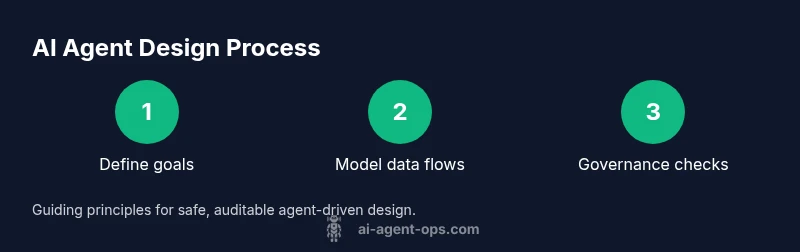
Start by aligning on the objective, scope, and governance. Then map system components, data flows, and decision points. Next, select an agent architecture and define interfaces (APIs, data schemas, and prompts). Build a sandbox prototype to simulate decisions before production use. Finally, establish monitoring, logging, and governance checks to sustain safety and accountability.
Governance, safety, and risk management
Governance is not a bolt-on—it's embedded. Define who owns decisions, which decisions require human approval, and what happens when data or models drift. Implement access controls, data provenance, and explainability requirements. Regularly audit agent outputs and maintain an up-to-date risk register. Ai Agent Ops highlights the importance of auditable rationale and guardrails to prevent unsafe or biased recommendations.
Common pitfalls and how to avoid them
Pitfalls include over‑reliance on automation, vague objectives, and misaligned incentives. Avoid brittle prompts; document decisions and justifications. Ensure data privacy and security are baked in from the start. Keep a healthy backlog of manual reviews for boundary cases and maintain a human-in-the-loop for critical system design choices.
Real-world examples and benchmarks
Real-world teams report faster exploration of architectural options and better coverage of edge cases when integrating AI agents into system design. Ai Agent Ops analysis shows that organizations see improved consistency and traceability in their architectures as design experiments are recorded and reviewed. While outcomes depend on maturity, disciplined adoption yields tangible benefits in collaboration and governance.
Next steps and checklist
Draft a design charter for your AI agent project, assemble the data sources, select tooling, and begin a sandbox experiment. Create a governance plan with roles, approvals, and audit requirements. Start with a minimal viable workflow and scale iteratively, measuring time to decision and quality of outcomes.
Tools & Materials
- Cloud development environment(Compute + storage for experiments; include isolation from prod data)
- Model catalog and repository(Curated list of agents, planners, evaluators with documentation)
- Diagramming and modeling tools(For visualizing architectures and data flows)
- Version control(Git/SVN for prompts, templates, and design decisions)
- Data governance and auditing tools(Provenance tracking, access controls, and lineage)
- Risk assessment checklist(Guidance to flag safety and compliance concerns)
- API keys for model endpoints(Secure storage and rotation practices)
- Monitoring and logging platform(Observability for agent decisions and performance)
Steps
Estimated time: 2-3 hours
- 1
Define objectives and guardrails
Articulate the design goals, success criteria, and risk tolerance. Establish decision boundaries and who approvals are required for different classes of changes.
Tip: Document thresholds for when human review is mandatory; this shapes prompt design and evaluation criteria. - 2
Map system components and data flows
Create a component inventory and data lineage map. Identify where AI recommendations interact with human decisions and production systems.
Tip: Use a visual diagram to align stakeholders on data inputs, outputs, and decision points. - 3
Choose AI agent architecture and interfaces
Select the planning, reasoning, and evaluation agents. Define API surfaces, data schemas, and prompt templates.
Tip: Prefer modular interfaces to enable independent testing and upgrades. - 4
Prototype in a sandbox
Build a minimal viable workflow to simulate decisions. Capture rationale, outcomes, and any deviations from expectations.
Tip: Limit scope to a representative design task to minimize noise during iteration. - 5
Establish governance and safety checks
Implement checks for explainability, bias detection, and security. Set up review cycles and audit trails.
Tip: Run periodic security and privacy reviews even in early prototypes. - 6
Deploy and monitor in production
Gradually roll out with phased monitoring, alerting, and rollback capabilities. Continuously collect feedback from engineers.
Tip: Monitor drift in data sources and model performance; update guardrails as needed.
Questions & Answers
What is an AI agent for system design?
An AI agent for system design is a software entity that analyzes requirements, constraints, and data flows to propose architecture decisions and facilitate governance through auditable reasoning.
An AI agent helps analyze requirements and propose architecture while keeping decisions auditable.
What benefits does it bring to a product team?
It speeds up exploration, improves consistency across designs, and broadens coverage of edge cases by systematically evaluating options.
It speeds up design exploration and improves consistency and coverage of edge cases.
What are the main risks and how can they be mitigated?
Risks include misalignment with goals, data privacy concerns, and over‑reliance on automation. Mitigate with guardrails, human review for critical decisions, and ongoing audits.
Risks include misalignment and privacy concerns; mitigate with guardrails and audits.
What skills are needed to implement?
Teams should blend system design expertise with AI/ML basics, software architecture, data governance, and DevOps practices for deployment and monitoring.
You need system design, AI basics, data governance, and DevOps skills.
How do you measure success?
Track design cycle time, decision quality, governance compliance, and the rate of beneficial design alternatives discovered.
Measure design velocity, quality of decisions, and governance adherence.
What tools support this approach?
APIs, agent orchestration frameworks, model catalogs, and auditing dashboards enable end-to-end design automation with governance.
APIs and agent frameworks plus catalogs and dashboards support this approach.
Watch Video
Key Takeaways
- Define clear objectives and guardrails before automation.
- Use modular, auditable workflows for agent-driven design.
- Governance and human oversight are essential for safety and quality.
- Prototype in a sandbox and measure impact before production.