AI Agent Scale: How to Scale AI Agents Effectively
A practical guide to scaling AI agents across workflows with architectures, governance, and best practices for sustainable, secure automation in 2026.


Scaling AI agents is essential for reliable automation across complex business processes. This guide covers practical architectures, guardrails, and governance needed to grow agent fleets while controlling cost, latency, and risk. By adopting proven patterns, you can orchestrate multiple agents across domains with confidence. Follow these steps to scope, pilot, and operationalize scale across teams.
What AI agent scale means in practice
AI agent scale describes expanding both the number of agents and their coordination so they can collectively handle more tasks with consistent quality. It is not only about adding more bots; it is about how you orchestrate, provide shared memory or context, enforce guardrails, and observe outcomes at scale. The Ai Agent Ops team emphasizes that sustainability comes from designing for governance, reliability, and cost containment from day one. In practical terms, scale means predictable throughput, bounded latency, robust fault tolerance, and auditable decision trails across a fleet of agents. When organizations adopt a scale mindset, they move from pilot programs to production-grade agent networks that can adapt to changing workloads and regulatory requirements while preserving user trust.
Core ideas that underpin scalable AI agents
- Orchestration is the nervous system: a central or distributed controller coordinates tasks, timing, and cooperation between agents.
- Shared context stores enable each agent to access relevant memories while avoiding leakage across unrelated conversations.
- Guardrails and policies reduce risk by constraining agent actions, improving safety and governance.
- Observability turns scale from a sprint into a controlled process with measurable outcomes.
- Cost discipline is essential: scale introduces new expenses from compute, data transfer, and storage, so budgeting and ROI modeling must evolve with scale.
Why scale patterns matter
Scale is not a single feature; it is a set of patterns and practices that determine how well agents cooperate. Sequential workflows suit simple, dependent tasks; parallel patterns accelerate throughput for independent jobs; hybrid patterns balance latency and cost. Choosing the right model depends on your use-case mix, data provenance, and tolerance for latency. Ai Agent Ops notes that successful scale requires clear ownership, well-defined interfaces, and a roadmap that aligns technical milestones with business value.
Data strategy for scale: context, memory, privacy
Context management becomes critical at scale. Agents need access to relevant data without overexposing sensitive information. A centralized context store with strict scoping rules helps keep memory bounded and auditable. Data governance should cover retention, deletion, privacy, and bias mitigation. Scaled agents rely on high-quality prompts and reusable memory templates to maintain consistency. A strong data strategy reduces drift, speeds up iterations, and builds trust with end users.
Architecture patterns for scaling agent orchestration
A scalable architecture often includes a centralized orchestrator with distributed agents or a fully decentralized mesh of agents. Key components include a routing layer, a context store, a policy engine, and a monitoring hub. Standard patterns include request queues, worker pools, and event-driven triggers. Clean separation of concerns and stateless agent handlers help with reliability and fault tolerance. The Ai Agent Ops perspective is that repeatable templates and modular components enable teams to grow capabilities without rebuilding core logic.
Observability, metrics, and reliability at scale
Observability is the backbone of scale. Track throughput, latency, success rate, error rate, and decision quality. Use traceable prompts, a centralized log store, and dashboards that highlight bottlenecks and safety incidents. Define Service Level Objectives (SLOs) and error budgets for each workflow. Regularly review incidents to identify root causes and prevent recurrence. Transparent reporting builds trust with stakeholders and accelerates organizational adoption.
Cost, governance, and policy when scaling
Scaling increases compute and data costs, so governance must evolve. Establish budgets, cost controls, and ROI tracking for agent fleets. Implement guardrails for sensitive actions, and document policies for data use, retention, and escalation. A formal governance board helps ensure alignment with legal and ethical standards. Ai Agent Ops warns that without governance, scale can become uncontrolled and risky.
Security, safety, and risk controls at scale
Security is non-negotiable when scaling AI agents. Implement least-privilege access, secrets management, and robust authentication. Enforce input validation, sandboxing of agent actions, and aggressive monitoring for anomalous behavior. Conduct regular security reviews and red-teaming exercises. Safety mechanisms should include fallback options and human-in-the-loop review for critical decisions.
Organizational readiness: teams, processes, and culture
Scale requires cross-functional collaboration between developers, data scientists, product managers, and operations teams. Establish shared playbooks, collaboration rituals, and a centralized artefact repository. Create a culture of experimentation with guardrails to keep teams aligned. Training and documentation reduce frictions, enabling teams to build, test, and scale AI agents with confidence.
Pilot programs and phased rollouts
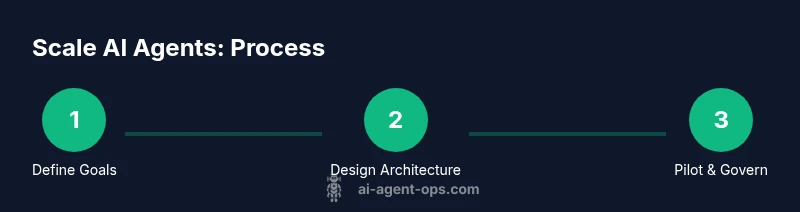
Before full deployment, run controlled pilots to validate performance, guardrails, and governance. Use a phased rollout: pilot, ramp, and production with staged access and staged data, ensuring metrics meet predefined thresholds. Use insights from pilots to refine architectures, prompts, and policies. A disciplined rollout reduces risk and accelerates time-to-value.
Tools & Materials
- Cloud compute credits (GPUs/TPUs)(Sufficient to run multiple agents in parallel during peak load)
- Workflow orchestration platform(Central control for task routing and timing)
- Central data catalog / context store(Shared memory for agents with strong access controls)
- Observability & monitoring stack(Prometheus, Grafana, and log aggregation)
- Policy and governance documentation(Guardrails, escalation paths, and compliance)
- Security and access controls (IAM)(Least-privilege access and secrets management)
- Test data and synthetic data generator(Support scale-testing scenarios)
- Cost budgeting/ROI model(Templates to justify scale investments)
- Documentation templates(Playbooks and runbooks for scale)
Steps
Estimated time: 2-6 weeks
- 1
Define scaling goals
Clarify what scale means for your organization: throughput targets, latency bounds, reliability requirements, and the set of use cases to cover. Align these goals with business outcomes and document measurable success criteria. Establish a governance boundary and champion to own the scaling effort.
Tip: Start with a narrow, high-impact use case to anchor definitions and measurements. - 2
Audit current agents and data boundaries
Inventory existing agents, their capabilities, data dependencies, and where they live in the workflow. Map data flows and identify privacy or security constraints. Define what context should be shared and what must stay isolated.
Tip: Create a visual map of data flows to reveal bottlenecks and leakage risks. - 3
Choose an orchestration pattern
Decide between centralized or distributed orchestration based on latency tolerance, team structure, and fault tolerance needs. Design interfaces (APIs, events) and define how agents will communicate and hand off work.
Tip: Prototype with a small, modular orchestration layer before expanding. - 4
Implement memory/context boundaries
Set explicit memory boundaries for each agent, including prompts, cached data, and historical context. Enforce privacy controls to prevent data bleed and maintain compliance.
Tip: Use versioned context templates to ensure reproducibility. - 5
Establish observability and risk controls
Instrument KPIs for scale, implement tracing across agents, and set alerting for policy violations. Create a rollback plan and a human-in-the-loop review for high-risk decisions.
Tip: Define a one-click rollback and escalation channel for safety incidents. - 6
Pilot, iterate, and prepare production rollout
Run a staged pilot, collect feedback, and iterate on architecture and guardrails. Expand gradually to production with controlled data, ensuring metrics meet thresholds before full deployment.
Tip: Document lessons learned and update playbooks for each iteration.
Questions & Answers
What is ai agent scale?
AI agent scale refers to expanding the number and coordination of AI agents across workflows while maintaining performance, safety, and cost controls. It requires governance, observability, and robust architecture.
AI agent scale means growing how many AI agents you run and how they work together while keeping control and safety.
Why is scalability important in AI agents?
Scalability enables handling rising task volumes, diverse use cases, and data growth without sacrificing reliability. It also supports faster iteration and broader organizational impact through automation.
Scalability lets you handle more tasks reliably and grow automation across the business.
What are common scaling patterns for AI agents?
Common patterns include sequential orchestration for dependent tasks, parallel orchestration for independent tasks, and hybrid models that blend both. Each pattern has trade-offs in latency, cost, and complexity.
Common patterns are sequential, parallel, and hybrid orchestrations.
What are key risks when scaling AI agents?
Risks include data privacy violations, unintended actions, bias, and security breaches. Implement guardrails, continuous monitoring, and human oversight for high-stakes decisions.
Major risks involve privacy, safety, and unintended actions; guardrails help.
How do you measure success in AI agent scale?
Measure throughput, latency, error rates, coverage, and total cost. Use ROI analysis and track governance adherence to ensure sustainable growth.
Key metrics include throughput, latency, errors, and cost, plus governance adherence.
Watch Video
Key Takeaways
- Define clear scale goals tied to business outcomes.
- Invest in orchestration, memory, and observability.
- Balance governance with speed to avoid risk.
- Pilot first; iterate before full production rollout.