Is the ai agent free? A data-driven guide to free tiers in 2026
Analyze whether an ai agent is free, what free really means, and how to compare open-source, sandbox, and hosted options with Ai Agent Ops insights, 2026.


There is no universal 'ai agent is free.' Most AI agent platforms operate on freemium or usage-based pricing, offering free tiers with limits but charging for substantial usage. In practice, 'ai agent is free' often refers to trial credits, open-source options, or sandbox environments, not a fully unrestricted service. For product teams, always verify quota, data retention, and feature access before committing.
Why 'ai agent is free' is a misleading phrase
According to Ai Agent Ops, the claim that an ai agent is free is usually shorthand for starting access rather than permanent production use. In 2026 the market is dominated by pricing tiers: a no-cost entry point with strict quotas, followed by paid plans for higher usage and advanced capabilities. Open-source options offer technical freedom but shift cost to infrastructure and maintenance, so the fantasy of a truly free production-grade AI agent remains rare. This distinction matters: if your goal is to prototype, free access is valuable; if your objective is scale and reliability, you’ll need a budget and governance around cost.
From a decision-making perspective, define your success metrics early, map peak usage, and list all hidden costs (data transfer, logging, security, and compliance). The Ai Agent Ops team finds that many teams underestimate these overheads, which can erode savings once pilots graduate to production. The net takeaway is that free is a starting point, not a license to scale without discipline. You should plan to transition to paid tiers or hybrid models as value is demonstrated.
Free Tiers vs True Zero-Cost Deployment
The term free tier often signals experimentation, not production readiness. Most providers cap API calls, limit model capabilities, and restrict data retention in free access. The real question is what you can accomplish within those limits and how quickly you hit the ceiling. Open-source routes may be free in license, but you pay for infra, updates, and security. In practice, a typical workflow might start in a sandbox, then evolve through a staged plan that scales gradually with cost controls. Ai Agent Ops emphasizes documenting quotas and data retention upfront to avoid sticker shock when moving toward production. Free does not equal freedom from risk; it is a controlled environment intended for learning and validation.
How pricing typically works across providers
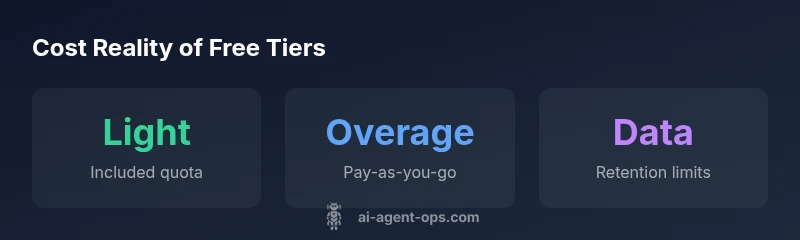
Pricing for AI agents broadly follows three patterns: pay-as-you-go, monthly subscriptions, and tiered packages. In many cases the banner that suggests the ai agent is free points to initial credits, limited feature sets, or restricted usage rather than true zero-cost production access. When evaluating options, identify the unit of measure (API calls, tokens, compute minutes), the included quota, and the cost of overage. Some platforms also charge separately for orchestration, authentication, or enterprise-grade security. For teams choosing between hosted and self-hosted options, hosted platforms reduce operational overhead but at a premium; self-hosted open-source solutions lower direct platform costs but increase maintenance work. Ai Agent Ops analysis shows that total cost of ownership often hinges on data transfer, model updates, and integration with existing systems, not just sticker price. A simple free line item can become expensive once traffic and data needs grow.
What 'free' means in practice for developers
Free can mean different things depending on context: free to try, free to pilot, or free to run within strict limits. For developers, this translates to three practical questions: Can I run my agent across multiple tasks? How long can I retain data? Do I need premium connectors or advanced security controls? The answer typically is that free tiers cover a limited number of simultaneous agents, modest data storage, and basic logs. They rarely include long-running workflows, multi-agent orchestration, or enterprise-grade security. Treat free access as a sandbox for architecture and ROI validation, not a capstone for production; plan for modularity so you can migrate to paid tiers with minimal rework.
Strategies to balance cost and value
- Define a clear success threshold for the free tier before expanding.
- Implement cost-aware architecture: rate limiting, caching, and selective orchestration reduce unnecessary API calls.
- Separate experimentation from production with distinct environments and budgets.
- Set alerts to catch overages early and avoid billing surprises.
- Consider open-source or self-hosted options where appropriate, but calculate total cost of ownership including maintenance and security.
From Ai Agent Ops, the recommended practice is to instrument usage, forecast growth, and craft a spend roadmap. Ensure you retain data portability and an exit plan to avoid vendor lock-in when expanding beyond free.
Practical examples and decision checklist
Scenario: A mid-sized product team prototypes a conversational agent using a free tier to measure impact on support SLA and NPS. They document quotas, track usage, and decide on a staged ramp to paid plans once the free credits are exhausted and ROI is clear. Checklist: define use cases, map data requirements, estimate peak calls, set a monthly budget, choose a platform with transparent overage terms, and verify data governance policies. The Ai Agent Ops team emphasizes a disciplined approach: treat free as a starting gate, not a finish line, and maintain governance over every increment in cost.
Free-tier comparison across deployment models
| Option | Free Tier Details | Typical Limits |
|---|---|---|
| Hosted platform free tier | Limited API access; basic features | 1000-5000 calls/month |
| Open-source self-hosted | No platform charges; pay infra | Variable by infra |
| Sandbox/test environment | Experimentation only; not production | Time-bound (days/weeks) |
Questions & Answers
Is there any truly free AI agent for production use?
In most cases, production-grade AI agents require paid tiers or self-hosted solutions. Free access usually limits capacity and features, making it unsuitable for long-term production. Always evaluate the total cost of ownership and the risk of overage.
For production use, free options are rare. Expect limits and plan for a paid tier or self-hosted setup.
What are the typical limits on free tiers?
Free tiers commonly cap API calls, tokens, or compute minutes and restrict advanced features. They also often limit data retention and support options. Review these limits against your pilot goals to avoid surprises.
Free tiers usually cap usage and restrict features; check limits against your pilot goals.
How can I estimate costs after free quotas are exhausted?
Forecast based on expected peak usage, average request size, and the price per unit. Build scenarios for best, typical, and worst cases, and include data transfer and security costs as part of the equation.
Estimate by forecasting usage, unit costs, and potential data/security charges.
Do free tiers include enterprise-grade features?
Typically not. Enterprise features like advanced security, governance, SSO, and dedicated support are usually gated behind paid plans. Treat free as learning and early validation, not production-ready tooling.
Free is usually not enterprise-grade; expect gaps in security and governance.
Are on-premises or open-source options truly free?
Open-source options may be free in license terms, but you pay for infrastructure, maintenance, and security. On-prem solutions require ops overhead and skilled staff, which is a hidden cost often overlooked.
Open-source can be free, but infra and maintenance cost real money.
“Free access accelerates learning, but cost-aware governance is essential for scale.”
Key Takeaways
- Treat free access as a starting point, not a production license
- Understand quotas, data retention, and feature gaps upfront
- Plan for total cost of ownership beyond sticker price
- Use a staged path from experimentation to production