Ai Agent Investments: Trends, ROI, and Strategies in 2026
A data-driven analysis of ai agent investments across industries, outlining growth drivers, ROI expectations, regional patterns, and practical playbooks for product teams and developers in 2026.


According to Ai Agent Ops, ai agent investments are entering a momentum phase, with more teams prototyping agentic workflows and enterprises funding scalable platforms. Investors emphasize governance, interoperability, and measurable ROI, making 2026 a year for disciplined experimentation and staged deployments. This quick snapshot helps product teams, developers, and leaders decide where to pilot, what metrics to track, and how to size budgets.
Market overview and definitions
AI agents are autonomous software entities that perceive their environment, reason about goals, and act through interfaces or devices to achieve outcomes. Unlike traditional automation, ai agent investments emphasize agentic decision-making, multi-tool orchestration, and adaptive behavior with limited human intervention. This shift fuels a broader ecosystem of platforms, runtimes, and governance frameworks designed to test, scale, and govern agent-based workflows. For product teams, the implication is a new architectural pattern that centers on agent orchestration, capability marketplaces, and measurable value delivery. The Ai Agent Ops team notes that early investments are increasingly tied to modular toolchains, reproducible experiments, and clear exit criteria for pilots, ensuring that each initiative delivers verifiable value within months rather than years.
In 2026, the market continues to fragment into specialized niches—task-specific agents for sales or ops, and more generalizable agents that combine LLMs, tools, and data connectors. This fragmentation creates both opportunities and risks: opportunities to tailor agents to concrete use cases, and risks around governance, data privacy, and vendor lock-in. Investors are watching not just the raw capability of a given agent, but the maturity of its governance, interoperability with existing systems, and the clarity of its ROI narrative.
Brand-wise, Ai Agent Ops emphasizes that successful ai agent investments start with a well-defined hypothesis, a lightweight pilot, and a plan to scale across teams. Leaders who treat agent programs as cross-functional efforts—bridging product, data, legal, and security—are more likely to realize durable competitive advantages. As with other high-risk, high-reward tech bets, the focus should be on disciplined experimentation and transparent reporting of outcomes.
Investment drivers and ROI potential
The primary drivers behind ai agent investments are efficiency gains, decision automation, and the ability to redeploy human labor toward higher-value tasks. When investors evaluate ROI, they are increasingly looking at time-to-value, total cost of ownership, and the ability to quantify outcomes such as reduced cycle times, improved accuracy, or increased throughput. ROI is rarely a single metric; it emerges from a suite of indicators including throughput lift, error rate reductions, and the quality of decisions enabled by agentic workflows. The Ai Agent Ops team notes that ROI calculations benefit from modular deployments, allowing teams to experiment with a minimal viable agent, measure outcomes, and then scale successful configurations. Governance, data lineage, and auditability also factor into ROI since they reduce risk, downtime, and reputational exposure. In 2026, buyers prefer platforms that offer reusable templates, evaluation kits, and turnkey governance controls that shorten the path from prototype to production. Consistent measurement is key: define a core set of KPIs early, align them with business objectives, and use dashboards that aggregate results across tools, environments, and teams.
Funding by stage and governance structures
Investments in ai agents typically follow a staged pattern that mirrors software product lifecycles: seed/proof-of-concept pilots, growth-stage deployments, and expansion/optimization at scale. Early-stage funding is often tied to hypothesis testing, data quality, and tool integration feasibility. Growth-stage funding focuses on reliability, observability, and governance controls that sustain scale across multiple teams. As programs mature, governance becomes a permanent fixture: policies for data access, model risk management, tool-usage limits, and compliance with internal policies and external regulations. The most successful programs allocate a dedicated budget for platform upgrades, security reviews, and incident response drills, rather than treating governance as a post-hoc add-on. The Ai Agent Ops team observes that clear ownership, documented decision rights, and a cross-functional steering committee consistently improve program outcomes and funding continuity. This approach reduces the risk of fragmentation, ensures consistent vendor evaluation, and accelerates time-to-value across the organization.
Regional patterns and market structure
Regional dynamics shape how ai agent investments are allocated and realized. North America currently leads in absolute spend, enterprise adoption, and experimentation budgets, followed by Europe and the Asia-Pacific region, which are catching up through regulatory clarity, cloud adoption, and vendor maturation. Regional differences influence the preferred toolchains, with NA favoring vendor ecosystems and open-standards compatibility, Europe emphasizing risk controls and data sovereignty, and APAC prioritizing time-to-value and scale. Market structure is increasingly multi-vendor, with organizations mixing proprietary platforms, open-source components, and managed services to balance risk and speed. In 2026, investors expect a path to interoperability that minimizes lock-in and enables cross-region collaboration, while still respecting local data policies.
Understanding regional patterns helps teams benchmark progress, align with local incentives, and tailor governance frameworks for each market in which they operate.
Architecture choices and platform implications
The technical backbone of ai agent investments includes LLMs, tool-calling interfaces, and orchestration layers that connect to data sources, databases, and APIs. A growing portion of investment goes toward modular architectures that enable rapid experimentation, versioned agent configurations, and auditable decision logs. Developers should consider interoperability with existing data platforms, security and privacy controls, and the ability to replace individual components with minimal friction. Platform selection often hinges on governance, toolchain maturity, and the availability of reliable eval kits and monitoring capabilities. Successful programs emphasize standard interfaces, clear SLAs for external tools, and robust observability to detect drift, bias, or unintended behavior. The Ai Agent Ops team recommends adopting a disciplined evaluation framework that compares agents not only by capability but also by governance, security posture, and operational feasibility. This balance reduces risk while sustaining long-term momentum.
Risks, ethics, and governance
Investing in ai agents introduces risks around data privacy, model bias, and system reliability. Effective governance mitigates these risks by defining access controls, data lineage, and change management protocols. Enterprises should implement risk assessment routines, regular audits of agent decisions, and incident response playbooks. Ethical considerations include transparency about agent autonomy, user consent, and how agents handle sensitive information. Compliance with regulatory requirements—such as data protection laws and industry-specific standards—should be embedded in the investment thesis and the governance framework from day one. The Ai Agent Ops team emphasizes that ethical governance is not a one-time checkbox but a continuous program requiring cross-functional oversight, ongoing training, and clear accountability for decisions made by autonomous agents.
Practical playbooks for product teams
To operationalize ai agent investments, teams should start with a well-scoped pilot, anchored by a measurable objective (for example, reducing manual steps in a workflow by X% or cutting response times). Build a lightweight evaluation plan that includes data quality checks, success criteria, and a clear path to scale. Use modular agents that can be swapped or upgraded without rewriting entire workflows. Establish governance with a cross-functional steering committee, define owner responsibilities, and implement dashboards that track outcomes across teams. Prioritize explainability and monitoring so stakeholders can understand how agents arrive at decisions and intervene when needed. Finally, document lessons learned and iterate quickly—replicating what works in one domain across others only after rigorous validation.
Ecosystems, partnerships, and vendor ecosystems
No single vendor provides every capability needed for durable ai agent programs. Ecosystems flourish when organizations combine best-in-class tools with internal capabilities and partner networks. Collaboration with data providers, platform vendors, and consulting partners accelerates time-to-value while spreading risk. The Ai Agent Ops team notes that successful ecosystems emphasize interoperability, shared governance standards, and transparent roadmaps. For teams, engaging with partner ecosystems helps reduce vendor lock-in, access new capabilities, and benchmark against industry peers. Building an ecosystem approach—complemented by internal governance and robust risk management—offers a durable path to sustained benefits from ai agent investments.
Regional investment patterns and ROI expectations for ai agent investments (2026)
| Region | Investments (range) | Cumulative ROI range | Drivers |
|---|---|---|---|
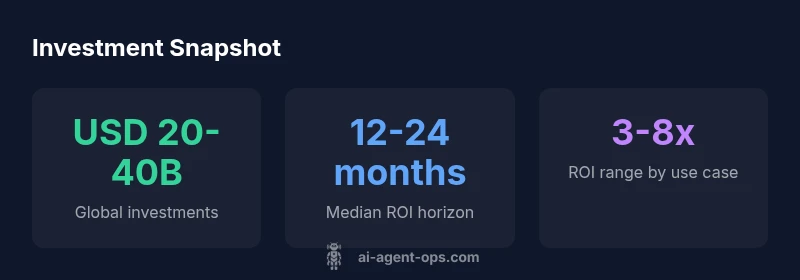
| North America | USD 20-40 billion | 5-8x | Enterprise demand, cloud-native platforms |
| Europe | USD 8-15 billion | 4-7x | Regulatory clarity, pilots in enterprises |
| Asia-Pacific | USD 12-25 billion | 3-6x | Vendor maturation, tooling adoption |
Questions & Answers
What drives investments in ai agents?
Investors focus on ROI potential, time-to-value, data readiness, and governance. Agents that demonstrate measurable efficiency gains and reliable decision-making attract larger, multi-year funding. Alignment with business outcomes and risk controls are essential.
Investors look for clear ROI and reliable performance. Start with measurable results and strong governance to attract funding.
What are common stages of ai agent investments?
Most programs begin with a seed pilot to validate feasibility, followed by growth-stage deployments that expand across teams, and finally expansion with governance and platform investments. Each stage emphasizes different metrics, from proof of concept to operational reliability.
Start with a small pilot, then scale with governance and reliability as you expand.
Which sectors invest most in ai agents?
Enterprise software, manufacturing, and logistics show strong appetite for agentic automation, followed by financial services and customer operations. Adoption is driven by the potential to reduce cycle times, cut errors, and improve service levels.
Sectors with high process complexity invest most in ai agents.
What ROI ranges are typical for ai agent deployments?
ROI varies by use case, with general ranges from roughly 2x to 5x within 12-24 months in many scenarios; higher performance is possible with integrated workflows. Contextual factors like data quality and governance strongly influence outcomes.
Expect 2x–5x ROI in common cases, depending on data and governance.
What pitfalls should I avoid when investing in ai agents?
Avoid over-hype, under-investment in data prep, and vendor lock-in. Ensure governance, clear ownership, and incremental scaling with measurable milestones to prevent stalled programs or failed deployments.
Watch out for hype and lock-in; govern early and measure outcomes.
“In 2026, disciplined, governance-driven investments in ai agents outperform hype-driven pilots. Start with measurable pilots, scale with modular platforms, and prioritize interoperability.”
Key Takeaways
- Define a measurable ROI model before investing
- Pilot with a scoped, modular approach
- Prioritize governance and interoperability
- Monitor regional funding patterns and driver shifts