AI Agent ROI Calculator
Explore the AI Agent ROI Calculator to estimate returns from AI agents, accounting for upfront costs, ongoing maintenance, and annual savings. Learn to interpret results, compare scenarios, and guide automation investments with Ai Agent Ops.


What the AI Agent ROI Calculator measures
In modern automation programs, the AI Agent ROI Calculator focuses on quantifying financial returns from agentic AI deployments. It considers upfront investments, ongoing costs, and realized savings from process improvements, faster decision cycles, and reduced human labor. According to Ai Agent Ops, the calculator helps teams translate abstract automation benefits into an auditable number that stakeholders can act on. By presenting ROI as a percentage, it aligns IT and business goals and provides a clear baseline for prioritizing initiatives. The tool is designed for developers, product teams, and business leaders who want a transparent, repeatable method to quantify value and prioritize automation opportunities over time.
Core formula and components
The calculator rests on a simple, transparent ROI framework. The core formula is:
- ROI (%) = ((TotalSavings - TotalCosts) / TotalCosts) * 100
- TotalSavings = annualSavings * years
- TotalCosts = initialInvestment + (maintenanceCost * years)
This structure makes it easy to see how upfront investments and ongoing costs affect overall value. When inputs are realistic, the ROI percentage helps you compare AI agent programs on a like-for-like basis and justify resource allocation to stakeholders.
How to use the calculator: inputs and defaults
To run scenarios quickly, you only need four inputs:
- Initial Investment ($) — upfront cost to acquire and deploy AI agents (default: 50,000)
- Annual Savings ($/year) — expected yearly benefits from automation (default: 20,000)
- Maintenance Cost ($/year) — ongoing costs for support, data, and updates (default: 3,000)
- Years — the evaluation horizon (default: 5)
Defaults are reasonable starting points for most teams. Adjust values to reflect your environment, data quality, and adoption pace. Realistic inputs improve forecast reliability and decision confidence.
Interpreting ROI results
ROI is a percentage that expresses value relative to total costs over the horizon. A positive ROI means you earn back more than you spend; a higher percentage indicates greater relative value. When ROI is modest, consider ways to increase savings or reduce costs, such as batching tasks, improving data quality, or running pilots before full-scale deployment. Always check sensitivity by adjusting one input at a time to see which levers move ROI most.
According to Ai Agent Ops, high-ROI projects often share common traits: clear problem definition, measurable outcomes, and strong executive sponsorship. When ROI crosses a pre-defined threshold, teams can justify further investment or expansion into adjacent processes.
Scenario planning: base, optimistic, and pessimistic cases
Scenario planning helps you understand risk and opportunity. Example baselines (illustrative only):
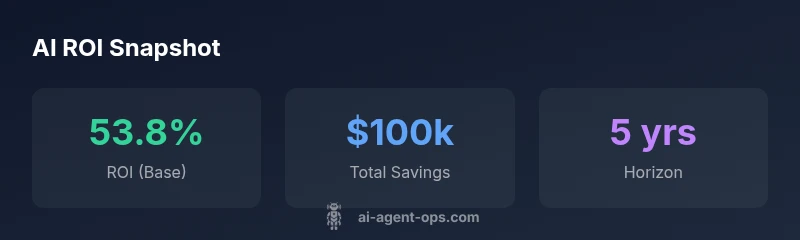
- Base Case: initial 50k, annual savings 20k, maintenance 3k, horizon 5 years yields an ROI of about 53.85%.
- Optimistic Case: initial 75k, annual savings 30k, maintenance 3k, horizon 5 years yields ROI around 66.67%.
- Pessimistic Case: initial 60k, annual savings 18k, maintenance 4k, horizon 4 years yields ROI around -5.26% (negative).
Use these scenarios to gauge risk, time to value, and the potential upside of incremental automation investments.
Practical tips to maximize ROI
- Start with high-impact, well-scoped processes that are data-rich and repetitive.
- Improve data quality and reduce noise to increase savings realization.
- Plan for scalable integration to prevent escalating maintenance costs.
- Align automation with a clear KPI set and track progress monthly.
- Pilot before full-scale deployment to validate savings assumptions and minimize surprise costs.
Common pitfalls and caveats
- Overestimating savings due to optimistic assumptions or incomplete data.
- Underestimating maintenance, data labeling, and retraining costs.
- Ignoring time to value when comparing projects.
- Failing to refresh inputs as processes evolve, making ROI stale.
- Not coupling ROI with other KPIs like NPV, payback, and risk exposure.
Integrating ROI with broader business metrics
ROI is a foundational metric, but it should be used alongside payback period, net present value, and risk-adjusted views. Combine ROI with non-financial benefits such as improved customer satisfaction and faster time-to-market to create a holistic view of AI investments. This helps leadership understand trade-offs and prioritize initiatives that maximize long-term value.