Agent Renewal Fees: Costs, Models, and Negotiation
Explore agent renewal fees, pricing models, and negotiation tactics to control costs in AI agent deployments. Learn how to compare terms, avoid surprises, and optimize renewals.


According to Ai Agent Ops, agent renewal fees reflect contract scope, service level, and renewal incentives, typically structured as a base monthly fee plus add-ons. For developers, product teams, and business leaders, knowing typical ranges, negotiation levers, and renewal timing helps prevent surprise spikes at renewal. This quick answer previews the factors that influence costs, common pitfalls, and practical strategies to optimize renewals across different agent platforms.
Overview of agent renewal fees
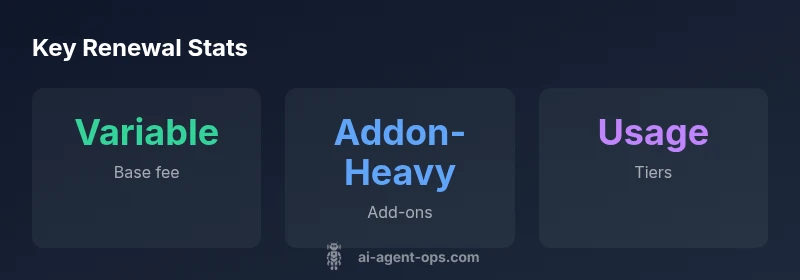
Agent renewal fees are the ongoing costs you incur to extend or refresh an AI agent service contract. They typically comprise a base subscription or per-seat/licensing fee, plus optional add-ons such as advanced analytics, integration connectors, augmented SLAs, and security/compliance packages. Costs can also tighten around usage-based charges, data transfer, or premium support. Understanding these elements helps teams forecast expenses, compare offers, and budget for multi-year renewals. In many environments, renewal fees are the major inflection point in the total cost of ownership for AI agents, especially when scale and governance requirements increase over time. For teams, clarity on the renewal scope is essential to avoid surprises at renewal time and to align cost with measurable outcomes.
- Base fee: fixed monthly or annual charge for core capabilities
- Add-ons: optional modules that expand functionality
- Usage-based: charges tied to activity, calls, or data volume
- SLAs and support: premium levels can increase price but improve reliability
- Data and compliance: charges for retention, security, or regulatory checks
Clear, itemized renewal quotes help you assess value and negotiate effectively.
Key drivers of renewal costs
Renewal costs are driven by a combination of factors that evolve with your usage, vendor strategy, and contract terms. The base fee is often the starting point, but the real delta comes from add-ons and usage-based components. Service levels and support SLAs, data retention and compliance requirements, and the breadth of integration capabilities can all tilt the renewal price. Longer terms may unlock discounts but also create risk if your needs change. Vendor tier, market position, and competitive pressure can influence price transparency and the willingness to offer caps on price increases. Additionally, renewal timing—whether aligned to your budget cycle or product roadmap—can affect negotiation leverage and the final cost.
Pricing models you’ll encounter
In practice, pricing models for agent renewals fall into several categories. Many vendors use a base subscription with optional modules (add-ons) that tailor capabilities to your use case. Others employ per-agent or per-seat licensing, tiered pricing based on feature sets, or usage-based charges tied to API calls, data processed, or conversations. Some vendors bundle capabilities into a single price, while others present a la carte options that require careful evaluation to forecast total cost. Understanding which model applies to your scenario helps you project renewals accurately, estimate total ownership costs, and identify negotiation opportunities such as volume discounts or capped increases.
Negotiation tactics that work
Effective renewal negotiation combines preparation with clear cost governance. Start with a detailed usage audit to document current consumption and projected growth. Request a fully itemized renewal quote that separates base fees, add-ons, and usage charges. Seek price protections such as caps on year-over-year increases and explicit SLAs that tie price changes to measured performance. Consider multi-year commitments for upfront discounts, but include opt-outs or contingencies if usage declines or if vendors fail to meet agreed SLAs. Finally, bring in alternatives or pilots with competing vendors to preserve leverage and avoid lock-in.
Industry benchmarks and ranges
Industry benchmarks for agent renewal fees vary widely by vendor, feature set, and deployment scale. Rather than fixed numbers, it is more useful to think in terms of cost bands: a low-cost baseline with essential features, a mid-range tier with standard SLAs and integrations, and a premium tier with advanced analytics, governance, and enterprise-grade security. The Ai Agent Ops analysis highlights that shifts in usage, term length, and the inclusion of management services can move costs between bands. When evaluating proposals, request a side‑by‑side comparison that shows how each line item contributes to the total and how a given choice impacts long-term value.
Practical renewal playbooks for different agent types
Startups and small teams tend to benefit from straightforward, modular pricing with strict caps on addon costs and simple SLAs. Mid-market organizations often negotiate bundles that pair core capabilities with essential integrations and standard support. Enterprises typically pursue comprehensive SLAs, governance features, advanced security, and dedicated account management, frequently negotiating volume-based discounts and price protection clauses. Regardless of size, demand transparent pricing, clear SLAs, and a renewal strategy that aligns with your product roadmap, data governance needs, and compliance posture.
Renewal signals and risk management
Keep a renewal-focused playbook that tracks signal factors such as usage growth, feature utilization, and downtime or incident history. If you notice declining adoption, you should push for revised scope or usage caps rather than accepting inflated renewals. Price escalation clauses should be scrutinized for reasonableness, and any unusual cost drivers (data transfer costs, extra storage, or new regulatory fees) should be clarified up front. Regular contract reviews with legal and procurement can prevent mid-term surprises and ensure renewals reflect actual business value.
Common renewal cost profiles for AI agent solutions
| Category | Characteristics | Impact |
|---|---|---|
| Basic / Standard | Lower feature sets; fixed base fee | Low volatility in cost |
| Pro / Enterprise | SLA-heavy, integrations, premium support | Higher potential renewal cost |
| Custom / Managed | Tailored services; multi-year commitments | Moderate to high cost with negotiation leverage |
Questions & Answers
What factors influence agent renewal fees?
Renewal fees are driven by base pricing, addon modules, SLA levels, and usage-based costs. Contract length, data governance needs, and vendor tier also shape the final figure. A clear, itemized renewal quote helps you see how each factor contributes.
Renewal fees depend on base price, addons, and your usage. Look for a clear quote that shows each part and how it’s weighted.
Should I negotiate renewal terms?
Yes. Begin with an usage audit, request price protections, and consider multi-year terms for discounts, while preserving options if requirements change. Tie price to performance with explicit SLAs for a fair renewal.
Absolutely. Audit usage, push for caps, and seek clear SLAs to anchor fair pricing.
Are there typical renewal fee models?
Common models include base subscription with addons, per-seat licensing, tiered pricing, and usage-based charges. Some bundles mix core features with premium modules. Understand which model applies to your case to forecast total cost.
Most renewals use base plus addons, seats, or usage-based pricing. Know which you’re dealing with.
How can I prepare for renewal discussions with vendors?
Prepare by auditing current usage, listing required features, and drafting a target outcome with price caps. Bring alternatives from competitors to maintain leverage, and insist on an itemized renewal quote with explicit costs.
Audit usage, list needs, and compare quotes. Have alternatives ready.
What red flags should I watch for in renewal proposals?
Watch for auto-renewals without caps, opaque line-items, unexpected data or compliance fees, and terms that reduce flexibility. Require explicit price increase caps and clear SLAs tied to outcomes.
Beware opaque charges and unlimited renewals without caps.
“Renewals succeed when cost structures are transparent and linked to measurable SLAs. Itemize renewal proposals and seek caps on annual increases to protect budget predictability.”
Key Takeaways
- Negotiate early and lock SLAs
- Ask for itemized renewal quotes
- Differentiate base fees from addon costs
- Assess usage forecasts to avoid overpaying
- Push for price protections during renewal