Protect AI Agents: A Practical Guide for Safer Agentic AI
Learn practical, actionable steps to defend AI agents from governance gaps, security threats, and data risks. This guide blends policy, architecture, and testing to build safer, compliant agentic AI.


Protecting AI agents means implementing governance, secure architecture, and continuous monitoring to prevent unauthorized actions, data leaks, and policy violations. This guide outlines practical steps, required tools, and verification practices to reduce risk across development, deployment, and operation. By following these steps, teams can build safer, compliant agentic AI systems that behave as intended in real-world environments.
Why Protect AI Agents Matters
According to Ai Agent Ops, protecting AI agents is not only a technical problem but a governance challenge. As agentic systems intersect decision‑making, data flows, and real‑world consequences, organizations must design defenses that scale with capabilities. This protection matters across governance, security, and safety, because gaps in any one area can enable harmful actions, data exposure, or policy violations that erode trust and invite regulatory scrutiny. Early investment in a protective baseline pays off through fewer incidents, clearer audits, and smoother deployment cycles. The Ai Agent Ops team emphasizes that protection is not a one‑time checkbox but an ongoing discipline that evolves with your agents’ capabilities, data footprints, and orchestration patterns. In practice, protection means well‑defined roles, auditable policies, and layered security across every stage of the agent lifecycle—from design to retirement.
In this block, you’ll see how people, processes, and technology come together to guard agentic systems. We’ll connect governance with concrete security controls, data handling practices, and performance monitoring so you can defend against drift, misbehavior, and external manipulation. The goal is to make protection an intrinsic part of how you build and operate agents, not an afterthought added after a failure.
Core Principles of Agent Protection
Protecting AI agents rests on a small handful of enduring principles that scale with capability. First is defense in depth: combine policy enforcement, identity governance, secure communication, and runtime protections so a single weak link cannot cause a cascade. Second is least privilege: agents should operate with minimal access, refreshed continuously as needs evolve. Third is transparency and observability: traceable decisions and auditable logs let you verify that agents follow policy and detect drift quickly. Fourth is data hygiene: classify data, minimize exposure, and encrypt data at rest and in transit to limit what a compromised agent can reveal or misuse. Fifth is continuous validation: test guardrails, run simulations, and rehearse incident response to ensure controls hold under real‑world stress. Ai Agent Ops notes that these principles must align with business goals and risk appetite, otherwise protection becomes overly burdensome or poorly adopted. Implementing them builds resilient agents that behave predictably under pressure.
Practical protection also means preparing for the unknown: you should design for explainability where feasible, provide fallback behaviors, and ensure fail‑safe mechanisms trigger when policy constraints are violated. By combining governance with engineering discipline, teams can prevent catastrophic outcomes while maintaining innovation velocity.
Governance and Policy Design for Agent Safety
Effective protection begins with clear governance that translates risk into actionable policy. Start by inventorying assets, data flows, and decision points your agents touch. Next, establish a policy baseline that covers access controls, data handling, retention, and escalation paths when agent actions could cause harm. Use a risk register to document potential failure modes and attach concrete acceptance criteria for safe operation. The goal is auditable governance that is enforceable in code and in procedures. Cross‑functional collaboration is essential: product, legal, security, and ethics teams must agree on what constitutes safe behavior and acceptable risk. Periodic reviews and updates to policies ensure the guardrails evolve with agent capabilities. Ai Agent Ops analysis shows that risk often concentrates in governance gaps—policy ambiguity, ambiguous ownership, or misaligned incentives—so codify decisions where possible and automate enforcement where feasible.
As you design policies, make room for policy-as-code and automated testing. This lets you verify that guardrails apply consistently across environments, from development to production. Consider release gates that require successful policy validation before an agent can operate in a live setting. The outcome is a governance framework that makes safety repeatable rather than aspirational.
Secure Architecture and Identity Management
Security starts at the architecture and identity layer. Enforce strong authentication for all agent interactions, using multi‑factor authentication and mutual TLS where appropriate. Implement least‑privilege access via role‑based or attribute‑based access controls, and rotate credentials on a defined cadence with automated renewal. Ensure all inter‑agent communications are encrypted in transit and that sensitive data is encrypted at rest with tight key management practices. Use signed code and reproducible environments so agents run only trusted code, and maintain a secure software supply chain with image scanning, SBOMs, and vulnerability management. For runtime protection, deploy policy enforcement points, sandboxed execution, and anomaly detectors that can block unsafe actions in real time. Regularly review dependencies and ensure your CI/CD pipelines include security checks, automated testing, and rollback capabilities. These measures reduce the blast radius of any compromise and support rapid recovery.
A subtle but critical aspect is documenting ownership and accountability for each guardrail. Clear accountability helps prevent policy drift and ensures that security decisions remain aligned with business objectives. In practice, treat identity and authentication as first‑class citizens in your agent architecture, not afterthoughts.
Monitoring, Logging, and Anomaly Detection
Observability sits at the heart of protection. Instrument agents with structured logging, traceability, and end‑to‑end monitoring so you can detect unusual behavior quickly. Establish a centralized logging and alerting platform with defined SLOs for detection latency and false positives. Use anomaly detection to flag deviations from baseline behavior, and implement guardrails that can trigger automatic containment if an action risks policy violation, data exposure, or user harm. Regularly review logs for privacy compliance and to identify patterns that indicate misconfigurations or insider risk. A good monitoring setup includes synthetic transactions, red team simulations, and regular audits to ensure detection capabilities stay ahead of evolving threats. The outcome is a live, auditable picture of how agents are acting in production and how you would respond if something goes wrong.
Red Teaming and Incident Response for AI Agents
Proactive defense relies on adversarial testing. Run red‑team exercises that mimic real attackers attempting to override guardrails or extract sensitive data. Combine with tabletop drills to walk through incident response playbooks and refine escalation paths. Develop runbooks that specify containment, notification, forensics, and recovery steps for different incident scenarios. Ensure your incident response is coordinated with legal, compliance, and engineering teams, and rehearse communications with stakeholders. After drills, capture lessons learned and update guardrails, policies, and monitoring rules accordingly. Remember that every exercise strengthens your resilience by surfacing edge cases you hadn’t considered in design. Continuous iteration is the cornerstone of durable protection.
Data Privacy, Confidentiality, and Compliance
Protecting AI agents also means protecting data. Classify data by sensitivity, apply data minimization principles, and enforce access controls that limit who can view or modify data used by or generated by agents. Use encryption for data in transit and at rest, and ensure that data handling aligns with relevant regulations and company policies. Anonymization and pseudonymization should be applied where feasible to reduce exposure risk. Maintain records of data lineage to support audits and accountability. The combination of policy, architecture, and operational controls reduces the risk that agents will expose or misuse sensitive information, while preserving the value of data for training and improvement. Ongoing training on data handling practices helps sustain a culture of privacy‑by‑design across the organization.
Practical Implementation Checklist
To translate protection from theory to practice, use this practical checklist:
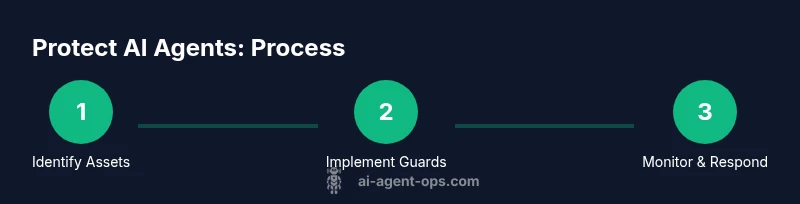
- Identify assets, data flows, and risk zones for each agent.
- Define a policy baseline for access, data handling, and escalation.
- Implement strong authentication, least privilege, and secure channels.
- Enforce policy at runtime with guardrails and signed components.
- Establish comprehensive logging, monitoring, and anomaly detection.
- Conduct regular red‑team and tabletop exercises with defined runbooks.
- Classify data, minimize exposure, and enforce privacy controls.
- Test, audit, and iterate guardrails based on findings.
- Align governance with business goals and document decisions for accountability.
Following this checklist helps you move from intent to repeatable protection that scales with agent capabilities.
Pitfalls and Common Mistakes
Even well‑intentioned protections can fail if you overlook practical realities. Common mistakes include treating protection as a checkbox rather than a continuous process, underestimating data sensitivity, and relying on a single technology to solve all risks. Overly complex guardrails can slow innovation and frustrate teams if they’re not clearly justified and automated. Missing guardrails in the CI/CD pipeline, poorly defined ownership, and insufficient incident response rehearsals are frequent failure points. Finally, neglecting privacy and regulatory considerations can create downstream risk and erode trust. Address these by keeping guardrails lean yet robust, fostering a culture of shared responsibility, and investing in automation that makes safety a natural part of daily work.
The path to resilience is iterative: start with a minimal viable protection set, measure outcomes, and expand guardrails as your agents’ capabilities grow. The key is not perfection at launch but continuous improvement over time.
Authority Sources
- NIST AI RMF: https://www.nist.gov/itl/ai
- Stanford AI Lab: https://ai.stanford.edu
- Stanford HAI: https://hai.stanford.edu
Tools & Materials
- Threat modeling document(Include asset inventory, threat scenarios, and risk ratings.)
- IAM tool(Enforce MFA and least privilege; integrate with access reviews.)
- Secure runtime environment(Signed images, trusted registries, and container hardening.)
- Audit logging system(Centralized logs; ensure tamper-evidence and retention.)
- Policy templates(Agent governance, safety policies, escalation rules.)
- Data handling guidelines(Data minimization, encryption at rest/in transit.)
- Threat intelligence feeds (optional)(Enhance detection with external indicators.)
- Incident response runbooks(Containment, recovery, and post‑mortem steps.)
Steps
Estimated time: 2-4 hours
- 1
Identify assets and risk scope
Catalog all agents, data inputs/outputs, and decision points. Map interactions between agents and external systems, noting potential harm paths. Establish the scope for protection so later controls are targeted and effective.
Tip: Start with a simple asset registry; expand only after you have a baseline. - 2
Define governance and policy baseline
Draft policies for access, data handling, retention, and escalation. Translate policies into machine‑readable rules that can be automated and audited.
Tip: Link each policy to a owner and a concrete validation method. - 3
Establish authenticated channels and access control
Implement MFA, role‑based or attribute‑based access controls, and secure authentication for all agent communications. Enforce least privilege and regular credential rotation.
Tip: Use short‑lived credentials and automated rotation where possible. - 4
Enforce guardrails at runtime
Deploy runtime policy enforcement points and sandboxing to prevent unsafe actions. Validate actions against policy before execution and provide safe fallbacks.
Tip: Test guardrails with simulated agent drift to ensure resilience. - 5
Secure data handling and encryption
Classify data, minimize exposure, and encrypt data in transit and at rest. Apply strict data retention rules and access auditing for sensitive information.
Tip: Regularly review encryption keys and rotate them per policy. - 6
Implement monitoring and observability
Instrument agents with structured logs, traces, and alerts. Establish baselines and anomaly detection to flag deviations quickly.
Tip: Set alert thresholds to minimize false positives and ensure actionable signals. - 7
Run red team and tabletop exercises
Conduct controlled adversarial tests to reveal gaps in guardrails and incident response. Refine runbooks based on findings and document lessons learned.
Tip: Rotate red team scenarios to cover new capabilities. - 8
Plan incident response and recovery
Create and rehearse runbooks for containment, notification, forensics, and recovery. Align with legal, compliance, and PR teams for coordinated action.
Tip: Include a post‑incident review to close gaps. - 9
Verify, audit, and iterate
Regularly audit protections, update guardrails, and re‑validate policies against evolving agent capabilities. Treat safety as an iterative process rather than a one‑time project.
Tip: Schedule quarterly reviews and annual policy refreshes.
Questions & Answers
What does protecting AI agents entail?
Protection encompasses governance, secure architecture, data privacy, and continuous monitoring. It means designing guardrails, enforcing access controls, and testing defenses regularly to prevent misbehavior and data leakage.
Protection includes governance, secure design, privacy, and ongoing monitoring. Regular testing helps ensure agents stay within safe bounds.
Why is governance critical for agent safety?
Governance translates risk into enforceable rules and accountability. Clear ownership and auditable policies prevent drift, ensure compliance, and provide a foundation for scalable protection across agent lifecycles.
Clear governance is essential to keep agent behavior aligned with policy and regulation.
What are common risks for AI agents in production?
Common risks include policy drift, data leakage, unauthorized actions, and adversarial manipulation. Robust controls, monitoring, and incident response reduce the likelihood and impact of these risks.
Agent risks are drift, leaks, and misuse; strong guardrails and monitoring help reduce them.
How do I start implementing protection today?
Begin with a governance baseline, implement identity controls, enable runtime guardrails, and set up observability. Iterate through small, testable improvements and expand protections as agents scale.
Start with governance, then add authentication, guardrails, and monitoring, iterating as you grow.
What metrics indicate protection effectiveness?
Look for measurable indicators like guardrail activation rates, incident containment time, policy compliance in deployments, and reduction in unauthorized actions. Use audits to validate these metrics regularly.
Watch guardrail coverage, time to containment, and audit pass rates to gauge protection strength.
Which tools are recommended for agent protection?
Choose tools for identity management, runtime policy enforcement, logging/monitoring, and incident response. Ensure integrations support automation and auditable trails across environments.
Use identity, policy enforcement, monitoring, and IR tools that work well together and provide logs you can audit.
Watch Video
Key Takeaways
- Protect AI agents with defense‑in‑depth, least privilege, and observability.
- Governance and policy must be codified and automated to stay current with agents.
- Regular testing, including red team drills, improves resilience over time.
- Ai Agent Ops’s verdict: adopt layered protections and continuous iteration for safer agentic AI.