Easiest Way to Create AI Agents: A Practical Guide
Discover the easiest way to create AI agents with a practical, step-by-step approach. No-code templates, modular design, and safe orchestration to accelerate automation for developers and leaders.


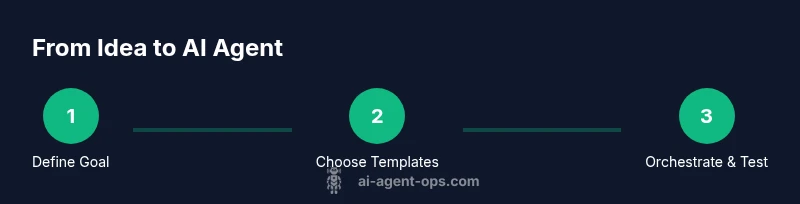
To achieve the easiest way to create ai agents, follow a modular, template-driven path: define a clear goal, choose a platform with prebuilt agent templates, assemble reusable components, and validate with simple tests. According to Ai Agent Ops, this approach reduces setup time and friction for developers and product teams. Start with a minimal viable agent and iterate with real tasks to improve reliability.
Why the easiest path favors modular templates
The challenge of building AI agents quickly isn’t about rushing code. It’s about reusing proven components, stitching them into reliable workflows, and avoiding reinventing the wheel for every new task. A modular template approach lets teams drop in ready-made prompts, tools, and data connectors, then adapt them to new domains with minimal effort. According to Ai Agent Ops, organizations that emphasize templates see faster onboarding, fewer integration hiccups, and clearer ownership of each component. This isn’t about a single magic tool; it’s about a design pattern that stays stable as your automation needs grow.
Prime advantages include lower cognitive load for developers, better governance through standardized blocks, and faster experimentation cycles. When you start with well-scoped templates, you can validate assumptions early, capture learnings, and reuse those insights across teams. The result is a more predictable path from idea to a working AI agent that can handle real tasks with minimal customization.
Key takeaways: template-driven design brings consistency, speed, and maintainable growth to AI agent initiatives. This approach also supports easier auditing and security reviews as your agent fleet expands.
Defining scope: what counts as an AI agent
Not every automation qualifies as an AI agent. A practical definition centers on perception, decision, and action across one or more tools. A useful agent should recognize inputs, make decisions within defined constraints, and execute tasks through connected services. Scope decisions should cover data sources, allowable prompts, tool access, and the intended outcome. When you define the mission clearly, you prevent scope creep and align stakeholders from day one.
In this framing, an AI agent might draft emails using calendar data, retrieve information from a corporate API, or trigger a support ticket workflow. The boundaries matter: specify which tools are included, what data may be read, and what actions are permitted. A tight scope reduces risk and accelerates testing, so you can iterate with confidence.
Reality check: keep the initial scope intentionally small but meaningful. That lets you demonstrate value quickly while building toward broader capability.
Choosing the right platform and templates
There are two axes to consider: platform capability and template quality. A platform with strong orchestration, security controls, and a robust marketplace of templates is your best bet for the fastest path. Look for templates that match your target domain (customer support, data analysis, procurement, etc.) and offer easy data integration points.
Compare templates on three dimensions: (1) reusability of prompts and tools, (2) transparency of decision logic and logging, and (3) flexibility to slot in new data sources. If possible, opt for templates that support guardrails and auditing by design. This reduces the effort required to meet governance standards later in production.
Practical tip: favor platforms that provide a sandbox testing mode and straightforward credential management. Clear separation between development, staging, and production environments speeds up safe experimentation.
Building blocks: reusable components
AI agents rely on four core building blocks: prompts (instruction templates), tools (APIs and actions the agent can perform), data connectors (sources the agent reads from or writes to), and orchestration logic (the wiring that sequences steps). By designing each block as a standalone, reusable component, you can assemble multiple agents using the same foundation.
Document each block with its inputs, outputs, constraints, and failure modes. Use versioning so changes don’t unexpectedly break dependent agents. Establish a small, shared library of prompts and tool adapters that teams can contribute to over time. This approach creates a sustainable growth path for your agent ecosystem.
Operational note: ensure each component has a clear owner and a test case that demonstrates its expected behavior before you reuse it in production workflows.
Connect tools and data sources
Once blocks exist, you need to connect them to the real world. Provision tool access through scoped credentials, and connect data sources via read or write permissions that match your mission. Prefer adapters that log usage and errors, so you can trace incidents back to a specific component.
Prioritize data minimization and data governance. Only give agents access to the data they absolutely need, and implement encryption and access controls where appropriate. Maintain a changelog of tool integrations to support audits and future migrations.
Pro tip: start with sandboxed credentials and switch to production-grade keys only after successful testing and security reviews.
Test with safe tasks
Testing is where most projects stumble. Use a controlled set of tasks that resemble real operations but stay within a safe boundary. Start with synthetic data and simulated environments to surface edge cases without impacting customers or systems. Capture logs that show input prompts, decision points, tool calls, and outcomes.
Define concrete exit criteria for tests, such as achieving a defined success rate on tasks, maintaining response latencies within thresholds, and avoiding disallowed actions. If failures occur, classify them, reproduce in the sandbox, and adjust templates or guards before next runs.
Avoid common trap: testing that only covers happy paths. Include failure scenarios, ambiguous inputs, and degraded tool responses to strengthen resilience.
Deploy and monitor
Production deployment should be deliberate and observable. Move your agent into a monitored environment with dashboards for latency, success rate, and tool usage. Establish alert rules for failures, data access anomalies, or security events. Plan for rollbacks if metrics deteriorate after deployment.
A gradual rollout—start with a small user group or limited tasks—helps catch issues before a broader impact. Maintain a change-management process that requires review for schema or policy changes, and ensure audit trails exist for every decision the agent makes.
Tip: automate post-deployment checks that compare real outcomes to your success criteria and trigger a rollback if gaps exceed tolerances.
Scaling from MVP to production
After validating the MVP, you’ll face questions about scale: increasing task complexity, handling concurrent requests, and expanding tool coverage. Use a staged approach: broaden the templates first, then graft in new data connectors, and finally extend governance controls as you scale. Keep a central registry of approved components and standardized prompts to maintain quality.
As you scale, leverage telemetry to compare performance across agents and domains. This helps identify which templates and adapters generalize well and which require domain specialization. A disciplined approach keeps the system predictable and easier to maintain.
Important: scale with guardrails, not ad hoc growth. Guardrails protect you from security risks and service outages as your automation footprint expands.
The role of AI governance and ethics
Governance isn’t a box-ticking exercise; it’s a design discipline that informs every build decision. Define access controls, data handling policies, and auditability from day one. Establish incident response playbooks, data lineage, and model drift monitoring to catch unexpected behavior early. These practices are essential as you move from pilot projects to production.
Ai Agent Ops's verdict is to prioritize governance and transparency when you scale AI agents. That means clear responsibility for each component, documented decision logs, and the ability to explain how an agent arrived at its actions. By weaving ethics and governance into the development lifecycle, teams build trust with users and stakeholders.
Tools & Materials
- No-code/low-code AI platform with agent templates(Choose a platform that supports templates and secure orchestration.)
- Template repository of reusable components(Prompts, tools, and adapters stored for reuse.)
- Clear goals and success criteria(Define mission, success metrics, and failure modes.)
- Sandbox/testing environment(Isolated space for safe experimentation.)
- Credentials and access controls(Scoped tokens, least privilege, revocation plan.)
- Monitoring and logging tooling(Observability for performance and safety.)
- Security and governance policies(Data handling, privacy, and auditability.)
- Optional: visual designer or IDE(If available, for rapid component customization.)
Steps
Estimated time: 1-2 hours
- 1
Define the agent’s mission
Begin with a clear, actionable goal: what task will the agent perform, what data sources will it use, and what counts as success? Write a one-sentence mission and a short list of constraints to anchor the project.
Tip: Write a measurable success criterion and keep it in plain language. - 2
Choose a platform and templates
Evaluate platforms that offer templates aligned with your domain. Check data sources, security controls, and the ease of integrating new tools.
Tip: Prioritize platforms with sandbox testing and clear credential management. - 3
Assemble modular components
Identify prompts, tools, and data connectors as independent blocks. Reuse these components across multiple agents to accelerate delivery.
Tip: Document inputs/outputs for each component and version them. - 4
Connect tools and data sources
Provide scoped access to APIs and datasets. Keep data access minimal and auditable, with secure storage of credentials.
Tip: Use sandbox credentials first; only switch to production keys after testing. - 5
Test with safe tasks
Run realistic tasks in a controlled environment using synthetic data. Capture logs to trace decisions and outcomes.
Tip: Include edge cases and guard against command misuse. - 6
Deploy and monitor
Move to production with dashboards for latency, success, and tool usage. Establish alerting and a rollback plan.
Tip: Automate post-deploy checks to detect deviation from targets.
Questions & Answers
What is an AI agent?
An AI agent is a software entity that perceives its environment, makes decisions, and executes tasks across tools or services to achieve a goal.
An AI agent perceives, decides, and acts to complete tasks.
Do I need to code to create AI agents?
You can build AI agents with no-code or low-code platforms using templates, while traditional coding offers deeper customization.
No-code platforms let you build agents with templates; coding gives more control.
Which platforms support template-based AI agents?
Most platforms offer templates and orchestration features; choose one that fits your data sources, security, and governance needs.
Many platforms provide templates and orchestration tools; pick one that matches data and safeguards.
How do I test AI agents safely?
Test in a sandbox with safe data and guardrails. Use synthetic data and staged environments to avoid unintended actions.
Test in a sandbox with safe data and guardrails.
What governance considerations matter?
Set up access controls, auditing, data governance, and monitoring before production.
Establish access controls, auditing, and monitoring before going live.
How should I scale AI agents in production?
Scale gradually with observability, rate limits, and incident response plans to handle real workloads.
Scale gradually with monitoring and incident plans.
Watch Video
Key Takeaways
- Define a clear mission and success criteria.
- Use templates to accelerate delivery.
- Test in a sandbox before production.
- Monitor, observe, and iterate constantly.
- Scale with governance and responsible practices.