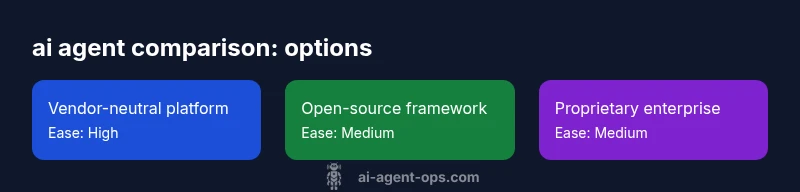
ai agent comparison: options, tradeoffs, and framework
A rigorous, analyst-level comparison of ai agent options, including governance, cost, deployment, and integration considerations for modern teams.


ai agent comparison boils down to aligning use case requirements with capabilities, governance, and cost. This TL;DR highlights three core dimensions: (1) capability and reliability, (2) data governance and privacy controls, and (3) total cost of ownership and vendor support. For teams, a structured framework accelerates decisions while reducing risk. This article provides a deep dive into those dimensions and a practical decision model.
ai agent comparison: Framing the decision
Choosing the right AI agent is more than picking a feature list or a single vendor. In the landscape Ai Agent Ops analyzes, an effective ai agent comparison requires a disciplined approach that maps an organization’s goals to concrete evaluation criteria. The phrase ai agent comparison captures a multi-dimensional decision process: you must weigh capabilities like reasoning, planning, and execution; governance aspects such as data locality, privacy, and compliance; and practical concerns including deployment speed, maintenance burden, and total cost of ownership. The Ai Agent Ops team emphasizes starting with a clear problem statement, identifying constraints, and then building a scoring rubric that can be revisited as requirements evolve. This mindset helps teams avoid missteps that derail timelines and inflate risk, while setting a foundation for scalable, responsible automation across functions.
Key dimensions in ai agent comparison
When you compare ai agents, you should anchor the discussion around several core dimensions:
- Capability and reliability: task coverage, reasoning quality, failure modes, and monitoring.
- Governance and compliance: data locality, access controls, auditing capabilities, and regulatory alignment.
- Integration and deployment: existing tech stack compatibility, APIs, and time-to-value.
- Cost and ROI: upfront vs ongoing costs, licensing models, maintenance, and support.
- Ecosystem and support: community strength, vendor responsiveness, and roadmap visibility.
- Security and safety: risk controls, guardrails, and containment strategies. These dimensions apply across use cases from assistants to autonomous agents, and they should be weighted by relevance to your business context. A balanced view across these factors helps prevent over-optimizing one area at the expense of another.
Benchmarking methods for ai agents
Benchmarking ai agents requires both quantitative metrics and qualitative assessments. Key quantitative metrics include latency (response time), throughput, accuracy of task execution, and error rates under realistic workloads. Qualitative signals cover explainability, audibility of decisions, and the ability to recover gracefully from failures. A practical benchmarking plan should include:
- A representative test suite that mirrors real workloads and edge cases.
- Reproducible evaluation scripts and data sets with version control.
- Stress tests that reveal breaking points in latency or reliability.
- Governance checks, including data lineage, access logs, and audit trails.
- End-to-end user impact analysis showing how agents affect decision quality and speed. In addition, conducting a pilot program with a controlled production environment can surface integration frictions and operational risks before full-scale adoption. Ai Agent Ops recommends documenting results with a clear rubric to compare options side-by-side over time.
Cost, ROI, and total cost of ownership
Cost considerations are central to ai agent comparison. You should distinguish between upfront licensing or development costs, ongoing support and maintenance, and hidden costs such as data transfer, hosting, and incident response. A robust TCO model includes:
- Initial investment: trial licenses, pilot deployment, and onboarding.
- Recurring expenses: hosting, SLAs, platform upgrades, and support.
- Operational costs: in-house engineering time for integration, monitoring, and governance tooling.
- Change management and training: user adoption and governance workflow implementation.
- Exit or migration costs: potential switching costs if requirements evolve. Ai Agent Ops analysis shows that ROI varies widely by use case, data sensitivity, and the level of in-house expertise. Teams should quantify time-to-value, error reduction, and scalability potential to determine the best fit, while avoiding hype-driven selections that promise speed at the expense of governance or long-term maintainability.
Reliability, governance, and safety considerations
Reliability hinges on fault tolerance, graceful degradation, and robust monitoring. Governance and safety require explicit guardrails, data access controls, and clear ownership of decision outcomes. In ai agent comparison, key considerations include:
- Redundancy and fallback strategies when an agent cannot complete a task.
- Observability: comprehensive logging, tracing, and alerting for traceable decisions.
- Guardrails: constraints that prevent unsafe actions or data leakage.
- Compliance posture: alignment with privacy laws, industry standards, and internal policies.
- Lifecycles: patching cadence, versioning, and safe rollbacks. A rigorous evaluation should simulate real-world failure scenarios and measure the system’s resilience under load. The result should be a governance blueprint that scales with the organization while maintaining accountability for automated decisions.
Data, privacy, and compliance implications
Data handling is a central axis in ai agent comparison. Teams must assess data localization requirements, encryption at rest and in transit, access controls, and data retention policies. Privacy-by-design principles should be embedded in every stage of development and operations. Compliance considerations include industry-specific regulations (e.g., healthcare, finance) and broader standards like ISO 27001 or NIST guidelines. Additionally, ensure clear data lineage and auditable decision trails so that stakeholders can review agent behavior when needed. The evaluation framework should score each option on data handling capabilities, risk exposure, and the strength of governance features, since these factors often determine the feasibility of scaling automation across departments.
Integration, deployment, and maintenance patterns
Successful ai agent deployment depends on how well the chosen solution integrates with existing systems and workflows. Factors include API compatibility, authentication schemes, data schemas, and event-driven orchestration. Deployment models vary from cloud-hosted agents to on-premises or hybrid configurations. Maintenance patterns should cover update frequency, backward compatibility, and monitoring requirements. A strong option provides a clear upgrade path, robust testing environments, and a plan for incident response. Organizations should also consider how agents will be coordinated with human-in-the-loop processes to preserve accountability and ensure safety when automation runs autonomously.
Open-source vs vendor solutions in ai agent comparison
The choice between open-source and vendor-provided solutions often dominates discussions about ai agent comparison. Open-source options offer transparency, customization potential, and lower upfront costs but require in-house expertise and governance discipline. Vendor solutions bring SLAs, integrated support, and easier onboarding, yet can introduce lock-in and higher ongoing costs. In evaluating these options, teams should compare community activity, roadmap clarity, data governance controls, and ease of integration. A pragmatic stance is to adopt open-source components for core capabilities while layering vendor services for reliability and enterprise-grade governance where needed.
Use-case driven selection: from copilots to autonomous agents
Different use cases demand different agent profiles. Lightweight copilots for knowledge work require fast setup, good UX, and strong documentation. Autonomous agents for operations and orchestration demand robust safety nets, auditability, and predictable performance under diverse inputs. In ai agent comparison, map each use case to a target capability set, latency and reliability requirements, and governance constraints. Draft a scoring rubric that weights factors most critical to the use case, then run a paired comparison of candidate solutions. This approach reduces bias and helps stakeholders converge on a well-justified choice.
Real-world patterns: success and failure modes
Real-world deployments reveal patterns that theory often overlooks. Success usually comes from early governance work, incremental rollouts, and clear ownership. Common failure modes include underestimating data governance needs, over-optimizing for speed at the expense of safety, and neglecting continuity planning. Organizations that succeed tend to establish cross-functional guardrails, invest in observability, and maintain a living playbook for updates and rollback procedures. Ai Agent Ops has observed that structured pilots, consistent measurement, and adaptive governance drive durable outcomes rather than one-off wins.
A practical decision framework: step-by-step
A practical framework begins with defining the use case, success metrics, and constraints. Next, select a core set of candidate options and run a standardized evaluation using a shared rubric. After benchmarking, conduct a governance and security review, then pilot in a controlled environment. Finally, perform a cost-benefit analysis, outline migration plans, and secure executive sponsorship. Throughout, document decisions, maintain versioned evaluation criteria, and plan for iterative improvement. This structured workflow is designed to scale across teams and adapt to changing requirements.
Common pitfalls and how to avoid them
Common pitfalls include chasing novelty, ignoring data governance, and underestimating integration complexity. To avoid these, anchor decisions in clearly defined use cases, insist on end-to-end governance visibility, and require demonstrable ROI from pilots before broader rollout. Avoid siloed evaluations by including stakeholders from security, compliance, IT, and product. Finally, parameterize decisions so you can re-run comparisons as new information becomes available, preventing stagnation and enabling continuous improvement.
The path forward: future-proofing your ai agents
Future-proofing involves embracing modular architectures, avoiding vendor lock-in where possible, and designing for change. Prioritize interoperability, open standards, and a governance framework that scales with data and regulatory evolutions. Invest in talent development, create repeatable playbooks for evaluation, and build a culture of responsible experimentation. By combining a strong decision framework with ongoing adaption, organizations can sustain value from ai agents as technology and business needs evolve.
Feature Comparison
| Feature | Vendor-neutral platform | Open-source framework | Proprietary enterprise solution |
|---|---|---|---|
| Ease of integration | High | Medium | Medium |
| Total cost of ownership | Medium-High | Low | High |
| Data governance and privacy | Strong | Moderate | Excellent |
| Customization depth | High | Medium | High |
| Community and ecosystem | Vibrant | Growing | Partial |
| Support and accountability | Community + paid options | Community-driven | Dedicated enterprise support |
Positives
- Clear tradeoffs across cost, control, and speed
- Structured decision framework reduces risk
- Supports both rapid prototyping and production scale
- Highlights gaps between open-source and vendor solutions
What's Bad
- No one-size-fits-all; must map to use case
- Vendor lock-in risk with proprietary stacks
- Open-source may require more in-house expertise
Vendor-neutral, open frameworks offer best balance for long-term flexibility; for governance-heavy contexts, enterprise-grade proprietary options may be preferable
Open ecosystems typically deliver adaptability and control, enabling ongoing iteration. Enterprise-grade options excel in governance, support, and reliability when risk and compliance are prioritized.
Questions & Answers
What is ai agent comparison and why is it important?
Ai agent comparison is the structured process of evaluating different AI agent solutions across capabilities, cost, governance, and deployment options to identify best-fit for a given use case. It helps teams manage risk and accelerate adoption.
ai agent comparison helps teams choose the right agent by weighing capabilities and governance.
Which factors should drive a comparison?
Key factors include capability alignment with use case, data governance, integration effort, total cost of ownership, and vendor support. Also consider security, latency, and scalability.
Focus on use-case fit, governance, and total cost.
Open-source vs vendor solutions: tradeoffs?
Open-source offers flexibility, transparency, and potentially lower upfront costs but requires in-house expertise. Vendor solutions provide SLAs and easier onboarding but may incur lock-in and ongoing costs.
Open-source gives control; vendor options simplify deployment.
How is ROI measured for ai agents?
ROI is measured by time savings, decision quality, reduced error rates, and automation of repetitive tasks. Use baseline metrics and track improvements over time.
Measure ROI with time saved and accuracy improvements.
What deployment considerations matter most?
Consider data locality, privacy, latency, and governance. Plan for version control, rollback strategies, and monitoring.
Plan for data locality, latency, and governance.
Key Takeaways
- Define your use case before choosing a framework
- Balance cost, control, and time-to-value
- Prioritize governance and data handling from day one
- Plan for future migrations to avoid lock-in