AI Agent Certification Course: How to Choose and Succeed
A practical guide to AI agent certification courses for developers and business leaders, covering criteria, modules, costs, outcomes, and credibility in 2026.


An ai agent certification course is a formal program that validates the ability to design, deploy, and govern autonomous agents in business workflows. It covers agent architectures, safety practices, tooling, and governance. Completing such a course signals credible, hands-on competence for building agentic systems. According to Ai Agent Ops, these certifications help teams standardize skills and reduce integration risk across projects.
What is an ai agent certification course
According to Ai Agent Ops, an ai agent certification course validates the ability to design, deploy, and govern autonomous agents in business workflows. The programs blend theory with hands-on practice, emphasizing practical outcomes over purely academic knowledge. Learners typically explore agent architectures, decision-making loops, and governance models that ensure safety and reliability in real-world environments. Throughout 2026, the market for these courses has evolved to include modular tracks, capstone projects, and employer-aligned assessments. The phrase ai agent certification course is widely used by providers to describe credentials that attest to a learner's competence in building automated agents that operate within enterprise software stacks. Expect a mix of lectures, lab exercises, case studies, and peer reviews, all designed to translate concepts into deployable agentic workflows. The core goal is to equip you with the ability to design, test, and monitor agents that can operate with limited human oversight while adhering to compliance standards. In short, this credential signals you can contribute to an agent-first operating model and help teams automate routine decision-making at scale. This mirrors the growing demand Ai Agent Ops has observed in 2026 as organizations seek faster automation with governance baked in.
Who should enroll in an ai agent certification course
This kind of certification is especially valuable for software engineers, data scientists, product managers, platform leads, and operations executives who want to systematize agentic workflows. Early-career professionals gain a structured pathway to apply AI agents to real problems, while seasoned technologists use the credential to formalize their experience. Teams adopting agentic approaches can benefit from a common language, shared best practices, and a credentialed baseline when recruiting or upskilling staff. For business leaders, the course can clarify ROI considerations, risk management, and governance requirements needed to scale agent deployments across departments. As Ai Agent Ops notes, a certification can help align cross-functional teams around a standardized toolkit and process, reducing rework and speeding implementation when time-to-value is critical in 2026.
Core competencies covered in an ai agent certification course
A robust program covers foundational theories and practical disciplines. You should expect sections on agent design patterns, state management, and orchestration across services. Key modules typically include: 1) agent architectures and interaction models; 2) decision-making under uncertainty and safe autonomy; 3) integration with APIs, databases, and event streams; 4) testing strategies, observability, and monitoring; 5) governance, compliance, and ethics; 6) risk assessment, failure modes, and containment strategies; 7) deployment pipelines and versioning; 8) performance metrics and business impact analysis. Many programs pair lectures with hands-on labs and a capstone project that demonstrates end-to-end agent workflows. The best tracks require a project that underlines measurable outcomes—speed improvements, error reductions, or better decision accuracy—rather than theoretical claims alone. For practitioners, applying these competencies to real workloads yields tangible benefits in automation maturity and reliability.
How to choose the right ai agent certification course
Selecting the right program depends on your goals, background, and constraints. Start by mapping your target outcomes: is the aim to validate practical skills, advance a career track, or facilitate a specific transformation project? Verify credibility by reviewing the provider's credentials, faculty or mentors, industry partnerships, and published outcomes. Look for programs with hands-on projects, real-world datasets, and a clear assessment rubric. Examine the curriculum for coverage of safety, governance, and risk management, not just architecture. Check delivery format compatibility with your schedule—online, hybrid, or in-person—and ensure there are opportunities for peer collaboration and mentorship. Finally, compare costs and time commitments, favoring programs that offer transparent pricing and a syllabus that aligns with your organization's technology stack. This approach helps you choose a course that delivers value in 2026 and beyond.
Implementing learnings in real-world agentic workflows
After completing the certification, the next step is to translate knowledge into action. Begin with a pilot project that uses a defined problem, such as automating a repetitive data-processing task or coordinating a multi-system workflow. Establish governance, version control, and rollback plans so the agent can be safely updated over time. Build a small cross-functional team that includes developers, domain experts, and operations staff to shepherd the implementation. Create metrics to quantify impact—cycle time reductions, error rates, and user satisfaction—and tie improvements to business outcomes. Use the certification as a basis for standard operating procedures, code templates, and playbooks so your organization benefits from repeatable success. For many teams, the key is to scale incrementally: pilot, evaluate, institutionalize, and then expand to additional use cases. The Ai Agent Ops team emphasizes that credentialed practitioners are more likely to execute with discipline and governance, reducing risk as you scale agentic AI across the enterprise.
Common pitfalls and how to avoid them
Common missteps include treating certification as a checkbox rather than a learning journey, underestimating the governance and risk aspects, and adopting tools that outpace your organization’s readiness. To avoid these issues, start with a clear skills map that links course outcomes to real projects, ensure your team has access to mentors, and set up a lightweight governance framework early on. Avoid vendor lock-in by prioritizing platforms and standards that support interoperable agent ecosystems. Finally, allocate time for hands-on practice and peer feedback; the most valuable learning often comes from solving domain-specific challenges in a collaborative environment. By focusing on practical application, you’ll maximize the value of your ai agent certification course and accelerate adoption in 2026.
AI Agent Certification Course Overview
| Aspect | Description | Typical Range | Notes |
|---|---|---|---|
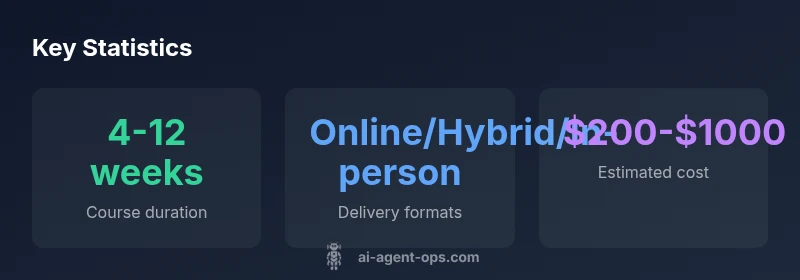
| Course Type | Certificate program, module-based | 4-12 weeks | Modular tracks favored |
| Delivery Mode | Online, Hybrid, In-person | Online/Hybrid/In-person | Labs and projects vary by format |
| Assessment | Exam, capstone, portfolio | Capstone-based | Practical demonstration required |
| Prerequisites | Background in AI or software engineering | None to moderate | Depends on track |
Questions & Answers
What prerequisites are common for ai agent certification courses?
Most programs expect a basic background in programming or data science, with some tracks designed for non-technical practitioners. Some courses offer introductory modules to bring everyone to a common baseline. If you’re uncertain, check the prerequisites section and consider a preparatory short course.
Many courses expect some coding or data basics, but several tracks provide an intro to bring you up to speed.
How long does a typical ai agent certification course take?
Typical durations range from four to twelve weeks, depending on the depth of modules and the pace of the cohort. Some programs offer condensed versions or extended tracks. Be sure to review the time commitment before enrolling.
Most programs run four to twelve weeks with varying intensity.
Are ai agent certifications recognized by employers?
Recognition varies by program and industry. Look for programs with transparent outcomes, partnerships, and outcomes data. Certifications tied to practical projects and governance topics tend to translate better to employer expectations.
Employer recognition depends on credibility and hands-on outcomes.
Should I choose online or in-person formats for an ai agent certification course?
Online formats offer flexibility and broad access, while in-person formats can enhance collaboration and hands-on lab experiences. Hybrid options are common and often provide the best balance. Consider your learning style and schedule when deciding.
Hybrid formats often give the best balance of flexibility and hands-on practice.
How can I verify the credibility of a program?
Check the provider’s track record, faculty, peer reviews, and published outcomes. Look for third-party endorsements, real-world case studies, and clear assessment rubrics. Validate with alumni feedback when possible.
Look for credible faculty, outcomes, and alumni feedback.
“A well-structured ai agent certification course should combine theoretical foundations with practical, hands-on projects to translate learning into real-world agentic workflows.”
Key Takeaways
- Define learning outcomes before enrolling.
- Balance theory with hands-on projects to improve credibility.
- Vet programs for credibility and industry alignment.
- Plan time and budget around your schedule.
- Leverage certification to scale agentic AI adoption.