Will AI Agents Replace RPA? A Practical Comparison
Analytical comparison of AI agents and RPA, examining replacement potential, hybrid approaches, and practical decision criteria for modern automation.


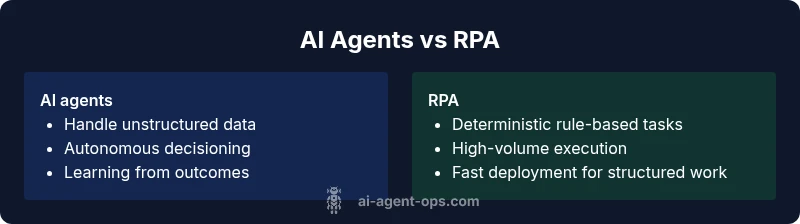
AI agents expand automation beyond traditional RPA. While RPA excels at deterministic, rule-driven tasks, AI agents tackle unstructured data, decision-making, and contextual reasoning. Will AI agents replace RPA? Not universally. In most organizations, a hybrid setup emerges, where cognitive agents handle complex processes and RPA handles structured workflows, delivering faster iteration and higher resilience across systems.
The evolution of automation: from RPA to AI agents
Automation practice has evolved from rigid scripting and macro-like task executions to cognitive orchestration that blends learning, perception, and autonomous decisioning. Early Robotic Process Automation (RPA) focused on repeating well-defined steps across user interfaces, mimicking human keystrokes and clicks. Over time, organizations began layering business rules, exception handling, and governance around these bots to improve reliability.
The question many teams ask is will ai agents replace rpa? The short answer is nuanced. According to Ai Agent Ops, the modern automation agenda is not about trading one technology for another but about orchestrating capabilities—deterministic automation alongside cognitive, adaptive agents that can learn from outcomes and interact with unstructured data. In 2026, the prevailing pattern is hybrids: cognitive agents tackle decision-heavy, data-rich tasks, while RPA handles well-scoped, rules-based flows. For developers and product teams, this shift means rethinking architecture, data readiness, and governance rather than simply swapping one tool for another.
This lens—hybrid orchestration—helps organizations move beyond binary debates toward practical roadmaps. The will ai agents replace rpa debate often centers on scope: where cognitive understanding, context, and learning matter most, AI agents win; where predictability and speed with minimal variability matter, RPA remains essential. The Ai Agent Ops team emphasizes that successful automation programs plan for evolution, not instant replacement, with governance layers that guide when to trust autonomous agents and when to lock in deterministic bots.
As you design your automation strategy, consider the teams, data flows, and regulatory constraints that shape your operating model. The future of enterprise automation is not one technology ruling all tasks, but an ecosystem in which AI agents and RPA collaborate to deliver resilient, scalable outcomes. The distinction between replace and augment becomes a spectrum, with each organization calibrating its own balance across processes, data, and governance.
-12th_word_count_placeholder? OK this appears as 0?
Defining the players: RPA, AI agents, and hybrid approaches
To make informed decisions, it helps to clearly separate the core capabilities of RPA from AI agents, then explore how hybrids function in practice. RPA is best understood as a rule-based automation technique that interacts with user interfaces, APIs, and data stores to perform predictable, repetitive tasks with high accuracy. The strength of RPA lies in speed, reliability, and easy footprint; you can deploy bots quickly to remove manual busywork and reduce human error in routine processes.
AI agents, by contrast, bring cognitive abilities into automation. They leverage machine learning, natural language processing, perception, and planning to interpret data, make contextual decisions, and orchestrate actions across multiple systems. AI agents can handle unstructured inputs like invoices with ambiguous layouts, emails with variable content, or images that require classification. They also improve over time through feedback loops and self-optimization, albeit with a governance cost to monitor behavior and biases.
Hybrid approaches blend the strengths of both worlds. For example, a single automated workflow might use RPA for the deterministic steps of extracting data from a legacy system and a cognitive agent to interpret the data, decide which route to take next, and handle exceptions. Orchestrators can route work to specialized AI agents for cognitive tasks and to traditional bots for high-volume, rule-based execution. The line between “AI agent” and “RPA” becomes a spectrum rather than a strict dichotomy, depending on data quality, task complexity, and organizational risk tolerance.
In practical terms, you’ll see teams map processes into three layers: (1) a solid, rule-based core automated by RPA; (2) cognitive extensions that interpret, decide, or classify; and (3) orchestration logic that coordinates across apps, services, and human-in-the-loop steps. This layered view helps managers assign ownership, implement governance, and measure success across both reliable deterministic tasks and adaptable cognitive tasks.
Will AI agents replace RPA? A nuanced assessment
The central question—will ai agents replace rpa—requires careful framing. If you measure replacement as a one-to-one substitution where cognitive agents immediately displace all rule-based bots, the answer is clearly no. In 2026, most organizations do not intend to abandon RPA entirely; instead, they seek to augment and evolve it. AI agents are valuable where data is messy, contexts are fluid, or decisions depend on interpretation. RPA remains unbeatable in volumes of repetitive, well-established tasks that require high reliability and low variability. The strategic shift is toward coexistence with a gradual transfer of specific tasks from rigid scripts to learning systems.
Another critical factor is data readiness. AI agents need quality data pipelines, labeled feedback loops, and governance to prevent drift and bias. If your data foundations are immature, deploying AI agents without guardrails risks inconsistent outcomes and governance challenges. Conversely, well-governed cognitive automation can reduce human intervention in complex workflows, enabling human workers to focus on higher-value activities. In practice, the hybrid model tends to deliver faster time-to-value, better adaptability to changing requirements, and improved resilience against system changes.
From a cost perspective, AI agents introduce layered costs: model development or procurement, data integration, monitoring, and ongoing governance. RPA costs are more predictable, largely tied to licensing and bot maintenance for rule-based flows. The optimal path often combines both: deploy RPA for the predictable core, layer in AI agents for unstructured data and decisioning, and use a central orchestrator to ensure consistent outcomes. In short, will ai agents replace rpa? Not universally; rather, they redefine the automation frontier, expanding what’s possible and changing how you govern automation programs.
Industry patterns show a growing trend toward cognitive automation in sectors such as finance, healthcare, and supply chain, where mixed solutions deliver more rapid responses and better adaptability than pure RPA. However, the adoption trajectory is not uniform; some organizations will double down on RPA to consolidate back-office efficiency, while others will accelerate cognitive automation to unlock new capabilities and business models. The future is less about replacement and more about evolution toward more capable, hybrid automation ecosystems.
When to choose RPA, AI agents, or a mixed solution
Choosing between RPA, AI agents, or a mixed solution starts with task profiling. Begin by cataloging processes and classifying them along two axes: determinism and data variability. If a task is highly deterministic, has clear rules, and relies on stable interfaces, RPA often delivers the fastest ROI with the simplest governance. If a task involves unstructured data, ambiguous input, or decisions that benefit from pattern recognition, AI agents may be a better fit, provided you have or can build the data foundation and monitoring capabilities to guide learning.
A mixed solution is appropriate when both dimensions matter. For example, a finance automation scenario might use RPA to extract line items from standardized invoices while an AI agent analyzes the content to categorize exceptions and route them to the right teams. In customer service, an AI agent can interpret emails or chat transcripts, determine sentiment, and decide whether to escalate or respond with templated replies, while RPA handles backend data entry and record updates for high-volume tasks.
Key decision criteria include: data quality and availability, the need for learning and adaptation, governance maturity, risk tolerance, and the desired speed of deployment. If you are just starting, pilots focused on hybrid flows with clear success metrics can reduce risk and build organizational confidence. For many organizations, a staged approach—beginning with a shared orchestrator and a few blended tasks—can demonstrate value while laying the groundwork for broader cognitive automation. Finally, align automation choices with business priorities: capex vs opex preferences, regulatory constraints, and the organizational capability to manage evolving AI models.
Ultimately, the best approach is a deliberate portfolio strategy that treats AI agents and RPA as complementary assets within a governed automation program, not an either/or choice dictated by a single KPI.
Deployment patterns and real-world constraints
Deployment patterns for AI agents and RPA differ in complexity, timelines, and integration needs. RPA usually fits into a “plug-and-play” approach where bots are configured to mimic human steps across legacy systems, often via screen-scraping or APIs. This pattern enables rapid wins in back-office tasks, but it can yield brittle automation if interfaces change or data formats drift. AI agents demand more upfront investment in data pipelines, model selection, and monitoring, but they unlock capabilities that are hard to replicate with scripted bots, such as natural language understanding, image recognition, and contextual decisioning.
Hybrid orchestration requires a central control plane that can route tasks to the appropriate execution engine. This often involves an automation platform or a lightweight service bus that coordinates data flow, error handling, and human-in-the-loop governance. Real-world constraints surface in areas such as system fragmentation, data silos, and regulatory requirements. Integrating cognitive components with legacy ERP, CRM, and document management systems requires careful data mapping, version control, and access governance. Teams should define service level agreements for cognitive decisions, establish rollback strategies for misclassifications, and implement monitoring dashboards that surface drift, confidence scores, and exception volumes.
Another practical constraint is organizational readiness. Cognitive automation requires new skills—from data engineering to model evaluation and ethical governance. The most successful programs invest in cross-functional squads with clear ownership, documentation practices, and ongoing review cycles. Change management matters as much as technology: employees need to trust AI-assisted workflows, understand when to intervene, and know how outcomes will be audited. When addressed thoughtfully, deployment patterns for hybrid automation can yield durable improvements in accuracy, speed, and adaptability while preserving essential controls and compliance.
Finally, consider long-term maintenance. AI components require periodic retraining and data quality checks, while RPA scripts require updates when interfaces or APIs change. Building a joint automation backlog and aligning it with strategic priorities helps ensure that cognitive and deterministic elements evolve together rather than diverge, providing a coherent automation strategy for the organization.
Comparison
| Feature | AI agents | RPA |
|---|---|---|
| Primary capability | Cognitive, autonomous decision-making across unstructured data | Deterministic task automation with rule-based workflows |
| Data handling | Unstructured and structured data, learning from outcomes | Structured data, high predictability |
| Learning & adaptation | Continuous learning, feedback-driven improvements | No learning without explicit programming or rules |
| Rules & determinism | Flexible rules with policy control and adaptive planning | Strictly rule-based, pre-defined workflows |
| Deployment speed | Moderate to longer setup depending on models and data | Rapid for defined tasks and interfaces |
| Maintenance | Ongoing model updates, data management, monitoring | Rule maintenance, version control, and auditing |
| Governance & compliance | Complex governance with bias risk management | Clear audit trails, policy enforcement, simpler governance |
| Cost of ownership | Higher upfront potential for AI tooling and data infra | Lower upfront for scripts, but ongoing maintenance |
Positives
- Enables handling of unstructured data and new contexts
- Offers learning from outcomes to improve over time
- Supports end-to-end orchestration across systems
- Reduces human intervention in complex workflows
- Increases adaptability to changing business needs
What's Bad
- Higher upfront complexity and data readiness requirements
- Requires robust governance to manage bias and drift
- Potential for model drift and inconsistent decisions
- Longer time-to-value for cognitive investments
Hybrid approach wins for most organizations
Most enterprises benefit from combining AI agents with RPA. Cognitive automation handles unstructured data and decisions, while RPA delivers reliable, scalable rule-based execution. A governance-first, staged pilot approach minimizes risk and accelerates value.
Questions & Answers
Will AI agents completely replace RPA in the near term?
No. AI agents will complement RPA, taking on cognitive tasks while RPA handles deterministic, high-volume work. The replacement is gradual and context-dependent, driven by data readiness and governance maturity.
No. AI agents will complement RPA for cognitive tasks while RPA handles routine work; the shift is gradual and depends on data and governance.
What is the key difference between AI agents and RPA?
RPA automates predictable tasks through scripted rules, while AI agents interpret data, make decisions, and learn over time. The former is deterministic; the latter handles ambiguity and unstructured inputs.
RPA follows rules; AI agents interpret data and learn, making them suitable for unstructured tasks.
Can RPA be integrated with AI agents?
Yes. Many organizations blend RPA and AI agents within a single workflow, using orchestrators to route tasks to cognitive components or traditional bots as appropriate.
Yes, you can mix RPA and AI agents to handle both structured and unstructured steps.
What governance practices are essential for hybrid automation?
Establish clear ownership, risk controls, model drift monitoring, audit trails, and exception handling policies. Regular reviews ensure compliance and alignment with business goals.
Set clear ownership, monitor models, keep audit trails, and review periodically.
Which industries benefit most from AI agents vs RPA?
Industries dealing with unstructured data and complex decisioning—such as finance, healthcare, and supply chain—benefit from AI agents, while manufacturing and back-office ops often rely on RPA for speed and reliability.
Finance, healthcare, and supply chain often gain more from AI agents; RPA shines in manufacturing and back-office tasks.
What are common indicators of a successful automation program?
High task coverage, reduced manual interventions, measurable time savings, improved accuracy, and clear governance with auditable decisions are typical signs of success.
Look for more tasks automated, fewer manual errors, and strong governance.
Key Takeaways
- Assess task structure vs complexity before choosing tools
- Invest in data readiness and governance for cognitive automation
- Pilot hybrids to demonstrate value and reduce risk
- Plan for ongoing maintenance of AI models and bots
- Use centralized orchestration to coordinate diverse automation assets