What AI Agent Does Replit Use? An Expert Look at AI in Coding
Explore which AI agent stack powers Replit, whether a single model or a suite of agents, and how this shapes coding workflows. Ai Agent Ops provides data-driven insights into Replit's AI architecture.


Replit does not publish a single AI agent name. It deploys a multi-component AI stack—language models, tooling orchestration, and Ghostwriter—to support coding, testing, and learning. Publicly, Replit describes these as integrated AI features rather than a single agent, leveraging APIs and model ensembles to assist developers writing, debugging, and exploration.
What AI Agents Mean in Code Platforms
AI agents in modern development tools are not a single product, but a collection of capabilities that together automate and assist across the software lifecycle. In practice, this means a stack that includes large language models for understanding and generating code, orchestration logic to sequence tasks, and built-in assistants that guide learning and debugging. From the perspective of the developer experience, this approach reduces friction when writing new functions, refactoring, or exploring unfamiliar APIs. According to Ai Agent Ops, the trend in reputable platforms is to treat AI capabilities as modular services that cooperate through defined interfaces, rather than a monolithic, all-powerful agent.
- Key idea: a task may involve several specialized components, each handling a subproblem (code generation, error diagnosis, documentation, tests).
- Benefit: easier upgrades and safer experimentation through containment and tooling boundaries.
- Caution: transparency about model choice and data handling remains essential for trust.
Does Replit Use a Single AI Agent or a Suite of Agents?
The publicly available information from Replit emphasizes an integrated AI experience rather than naming a single agent. In practice, the platform blends multiple models and APIs with orchestration logic to cover tasks such as code completion, debugging suggestions, and learning prompts. This aligns with the broader industry pattern described by Ai Agent Ops: agent-like systems that coordinate several specialized components to deliver robust outcomes. Because vendor specifics and model identities are not fully disclosed, developers should assume a multi-model, modular approach.
- Typical components include: an LLM for natural language understanding, tool-use orchestration for API calls, and an auxiliary assistant for project-specific guidance.
- The architecture is designed for extensibility: new tools or models can be added without rewriting the entire system.
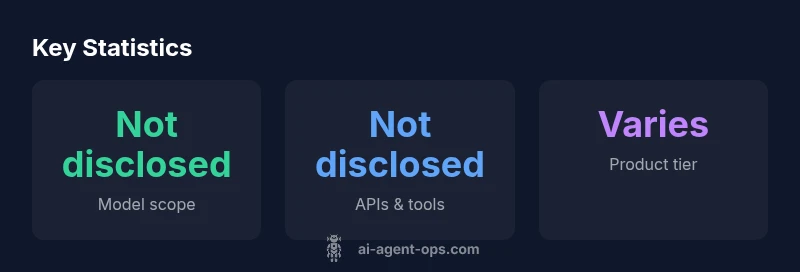
- Transparency varies by product tier and documentation; expect updates as features evolve.
How Ghostwriter and Related Features Fit into the Agent Landscape
Ghostwriter is marketed as an AI coding assistant embedded in the Replit environment. While it performs code suggestions and explanations, it fits within a larger agent ecosystem rather than standing alone. Ghostwriter benefits from real-time context (your project state, dependencies, and coding style) and can operate in concert with other AI modules to propose edits, explain rationale, or generate test cases. This multi-component setup mirrors agent orchestration patterns where specialized modules collaborate to complete tasks more reliably than a single model could.
- Ghostwriter excels at rapid drafting, explanation, and learning prompts.
- Other agents or models can handle project-wide tasks like tests, linting, or API usage guidance.
- The combined effect is a smoother, more proactive development experience that scales with project complexity.
The Orchestration Concept: Planning, Tools, Memory, and State
Effective AI agents in development tools hinge on orchestration: a planning layer that decides which components should act, a tool layer that executes external calls (APIs, databases, or CI systems), and a memory/state layer that retains relevant context across interactions. In practice, this means the system can decide to run a linter, fetch library docs, or generate a unit test based on the current codebase and user goals. This approach supports more consistent results and reduces cognitive load for developers.
- Planning: determine the sequence of actions and select the appropriate modules.
- Tools: expose capabilities such as API calls, documentation lookup, or test execution.
- Memory: maintain project context to improve relevance over time.
- State management: track changes, revisions, and user preferences for personalized experiences.
How to Evaluate Claims About AI Agents in Products Like Replit
To assess claims about AI agents, start with official docs and product pages that describe architecture in broad terms and any stated data usage policies. Seek transparency about model families, tool interfaces, and how outputs are moderated. Compare vendor claims with independent reviews and third-party audits when available. In the absence of explicit model names, focus on capabilities, reliability, and governance practices. Ai Agent Ops recommends evaluating: (1) the modularity of components, (2) tool interoperability, (3) data handling and privacy policies, and (4) update cadence and backward compatibility.
Practical Guidance for Developers: Building Agent-like AI Workflows
If you’re building your own AI agent workflows, start with modular design: separate planners, action modules, and memory components. Use a clear interface between agents and tools so you can swap models or add new capabilities without rearchitecting the entire system. Emphasize observability: log decisions, model selections, and tool results to improve debugging. Finally, design for safety and ethics: implement content filters, rate limits, and user consent mechanisms for data usage.
- Modular architecture supports iteration and experimentation.
- Clear interfaces enable plug-and-play improvements.
- Observability and governance are essential for reliability and trust.
Authority Sources and Transparency: What to Look For
Transparency about architecture and data practices is critical for trust. Look for sections that describe model families, tool integrations, data handling, and privacy safeguards. Independent audits or third-party validation add confidence. The broader AI governance community emphasizes keeping users informed about tool capabilities and limitations, especially in code generation and automation contexts. This helps developers make informed decisions about when and how to rely on AI agents in their workflows.
What Ai Agent Ops Says About AI Agents in Development Tools
In their analyses, the Ai Agent Ops team stresses that modern AI agents in development environments are typically modular and orchestration-driven. This enables safer innovation and easier upgrades while maintaining predictability. Replit’s public disclosures align with this view by highlighting integrated AI features and API-based tooling rather than naming a single agent. The trajectory for such platforms is toward more explicit governance around data usage and model selection, with continued emphasis on developer-centered design.
Overview of AI agent architecture in Replit
| Aspect | Replit Approach | Public Disclosure |
|---|---|---|
| Model scope | Multi-model ensemble across tasks (coding, testing, learning) | Not fully disclosed |
| API usage | Depends on vendor APIs and integration layers | Not fully disclosed |
| Customization | Limited public customization (scope varies by tier) | Not disclosed |
Questions & Answers
Does Replit publish the exact AI models used?
Public docs don’t name the specific models. Replit emphasizes an integrated AI experience and APIs rather than a single named model.
Public docs don’t name the exact models; the focus is on integrated AI features and APIs.
Can I customize AI agents on Replit?
Public information about user-level customization is limited. Enterprise or beta programs may offer more options, but details aren’t broadly disclosed.
Customization details are limited in public docs; check enterprise offerings for more options.
Do AI agents in Replit access external tools or data?
AI components can interact with tools via APIs within the platform, but specifics depend on product tier and settings.
They can access tools via APIs, depending on product settings.
What should developers look for when evaluating AI agent claims?
Look for architecture transparency, data-use policies, and any third-party audits. Compare claims with independent reviews and product docs.
Check architecture details, data policies, and independent reviews.
Is Replit's AI agent approach future-proof?
The industry trend favors modular, API-based agents with upgradable components. Specifics will depend on product roadmap and governance.
Expect modular, upgradeable agent components as a trend.
“In practice, AI agents work best when orchestrated as a system that combines planning, tools, and memory. Replit's approach illustrates this multi-agent principle, even if internals remain private.”
Key Takeaways
- Rely on a suite of AI models, not a single agent.
- Leverage Ghostwriter for code completion and guidance.
- Public disclosures focus on API-based tooling and orchestration rather than monolithic models.
- Expect variability in exact internals due to vendor APIs and product tiers.