How AI Agents Use LLMs in Practice
Explore how AI agents leverage large language models to plan, reason, and act. Learn architectures, use cases, safety practices, and practical design tips for reliable, scalable agentic AI workflows.


How do ai agents use llms? AI agents leverage large language models to understand user goals, reason about tasks, and orchestrate actions across tools. By incorporating planning, retrieval, and execution loops, agents translate natural language into concrete steps and safe retries. This quick definition introduces the core idea and sets up the deeper guidance to come.
What are LLMs and AI Agents?
At a high level, a large language model (LLM) is a trained, text-based predictor that can generate coherent language outputs given a context. An AI agent, in practical terms, is a software component that takes user intents, makes decisions, and runs actions by combining several capabilities: language understanding, reasoning, memory, and tool integration. When you ask, for example, how do ai agents use llms, you’re asking about a system that marries natural language prowess with dynamic behavior. According to Ai Agent Ops, the most reliable agentic systems start with a clear boundary between what the agent should do and how it should be done, focusing on prompt design, tool schemas, and safety rails. This framing helps teams structure experiments, avoid scope creep, and steadily improve performance as models and tools evolve. In short, LLMs are the cognitive engine; agents are the orchestrators that translate that cognition into action across services, databases, and devices.
- Definitions: LLMs provide predictive text capabilities and contextual reasoning.
- Role of agents: agents interpret prompts, plan steps, and call tools or APIs.
- Core challenge: balancing flexibility with safety and predictability.
- Ai Agent Ops takeaway: start with a narrow, testable task and expand scope gradually.
noteType":"paragraph"},{
How LLMs Fit Into Agent Architectures
In practice, you’ll see architectures that pair an LLM with a planning module, a memory layer, and a set of tools or APIs. The LLM handles interpretation and generation, while the planner maps intent to concrete actions and checks feasibility against constraints. A memory component preserves context across turns, enabling ongoing dialogs and multi-step workflows. From Ai Agent Ops analysis, teams that align prompts with a stable memory schema tend to see fewer unexpected outputs and more reliable orchestration of tools. This is where the question "how do ai agents use llms" becomes tangible: the model informs decisions, but execution depends on structured prompts, tool interfaces, and safety checks. The result is a loop: perceive, decide, act, reflect, repeat.
- Planner role: converts goals into actionable plans.
- Memory role: preserves context for continuity across steps.
- Tool layering: integrates external services, databases, and agents.
- Design principle: strict tool schemas reduce ambiguity and improve auditability.
noteType":"paragraph"},{
Decision Making: Planning, Reasoning, and Action Execution
Effective agent behavior hinges on robust decision-making pipelines. The LLM suggests possible next steps, while a planner evaluates feasibility and prioritizes actions. Reasoning modules apply domain constraints, safety policies, and fallback strategies. The action executor then carries out API calls or tool invocations, and results are fed back to the model for reasoning adjustments. This triad—planning, execution, and feedback—enables complex workflows such as multi-step data gathering, synthesis, and decision support. When teams ask how do ai agents use llms in practice, they discover that the model supplies logical candidates rather than final commands; the system then validates and enacts them within safe boundaries. Designing this loop with clear prompts and guardrails reduces drift and improves reliability.
- Examples: scheduling tasks, data extraction, and intelligent search.
- Guardrails: turn-by-turn validation, rate limits, and risk checks.
- Ai Agent Ops guidance: emphasize deterministic retries and auditable outcomes.
noteType":"paragraph"},{
Tool Use and Integration Patterns
A core strength of AI agents is their ability to call external tools—think web services, databases, and productivity apps. The LLM crafts requests and interprets responses, while a tool adapter translates between natural language intents and API parameters. Patterns vary: some teams embed a tool catalog with strict schemas; others employ dynamic tools discovered at runtime. The key is to ensure prompts describe tool capabilities, required inputs, and expected outputs. When introducing how do ai agents use llms, design for fail-safety: include timeouts, retries, and explicit error messages. A well-structured prompt can guide the model to ask for missing inputs instead of guessing, reducing errors and speeding recovery from partial failures. Include a tool-usage brief in every prompt to minimize ambiguity.
- Tool contracts: inputs, outputs, and error semantics.
- Discovery: maintain a registry to support scalable tool addition.
- Ai Agent Ops tip: keep tool schemas versioned and auditable.
noteType":"paragraph"},{
State Management and Memory for Context Retention
Context is critical for multi-turn interactions. A memory layer stores past prompts, decisions, tool outputs, and user preferences, enabling the agent to refer back without re-solving the same problem. Effective memory design uses structured records, not raw chat history alone. This improves efficiency and safety by enabling targeted checks and deterministic retries. When answering how do ai agents use llms, you’ll see that memory acts as the long-term context provided to the LLM, while the active prompt remains within a bounded context window. Balancing memory depth with latency is essential; you want enough history for coherence without bloating prompts.
- Structured memory: key-value stores, embeddings, and summaries.
- Context window management: prune old items, retain essential intents.
- Ai Agent Ops observation: memory quality correlates with planning accuracy and trustworthiness.
noteType":"paragraph"},{
Safety, Ethics, and Governance Considerations
Safety cannot be an afterthought when deploying AI agents. Key concerns include data privacy, model bias, decision traceability, and the potential for tool misuse. Implement guardrails such as prompt constraints, enforced permission checks, and audit logs for every action. Regularly test for edge cases and ensure humans can intervene when needed. The question of how do ai agents use llms becomes a governance issue as you define when the model should predict, when it should ask, and when it should defer to a human. Ethics pipelines should include bias assessment, data provenance, and compliance with relevant regulations. By building these controls into the design from day one, teams can achieve safer, more transparent agent-driven workflows.
- Privacy and consent: protect user data and sensitive outputs.
- Auditing: maintain interpretable traces of model decisions.
- Human-in-the-loop: ensure safe escalation paths when confidence is low.
noteType":"paragraph"},{
Practical Design Patterns and Implementation Tips
To implement robust AI agents, start with a minimal viable architecture: an LLM, a planner, a memory module, and a small toolset. Use intent schemas and constrained prompts to reduce variability. Use planning templates that map goals to concrete actions, and pair them with strict validation before execution. Consider modular prompts that can be swapped without changing the rest of the system. A practical tip for beginners: prototype with synthetic tasks that cover the full decision cycle, then incrementally introduce real-world data and tools. This approach helps you answer the core question of how do ai agents use llms by validating the end-to-end loop early and iteratively.
- Start small, scale gradually.
- Separate model, planner, and memory concerns.
- Maintain versioned prompts and tool schemas for audits.
- Ai Agent Ops recommendation: emphasize observable outcomes and safety checks at every stage.
noteType":"paragraph"},{
Real-World Use Cases Across Industries
From customer support assistants that triage issues to enterprise automation bots that coordinate procurement, LLM-powered agents are already enhancing productivity. In healthcare, agents can retrieve patient data and summarize consult notes with safety constraints. In finance, agents can draft reports, check compliance, and trigger workflows. Across industries, the pattern remains consistent: the LLM provides high-level reasoning and natural language interaction, while the orchestrator enforces policies, tool use, and data governance. As you design these systems, keep in mind the need for observability and explainability; stakeholders want to understand how decisions were reached and what data influenced the outcome. Ai Agent Ops notes that practical deployments thrive when you align business goals with a clear decision pipeline and reliable auditing.
- Key domains: customer support, procurement, data synthesis.
- Success factors: measurable outcomes, safety checks, and governance.
- Example outcome: a reproducible, auditable workflow from intent to action.
noteType":"paragraph"},{
Getting Started: A Design Checklist
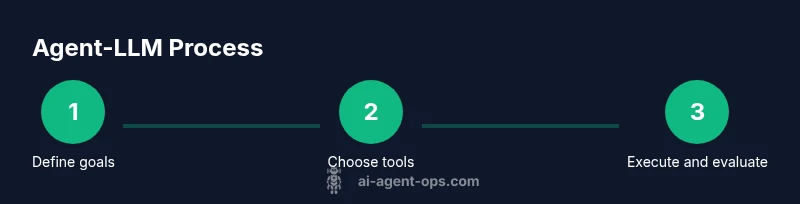
This final block in the middle section offers a ready-to-use checklist that teams can adapt. Define the agent’s mission and success criteria. Build a small tool set with stable interfaces. Design prompts that are explicit about inputs, outputs, and constraints. Implement memory with a clear schema and retention policy. Add safety controls, monitoring dashboards, and a rollback path. Finally, validate with a staged rollout and gather feedback to iterate. The Ai Agent Ops team recommends starting with a minimal, safe prototype and expanding capabilities as you gain confidence and evidence of value. This approach keeps how do ai agents use llms grounded in real, verifiable outcomes.
- Mission and success criteria clearly stated.
- Stable tool interfaces and memory schema.
- Safety, monitoring, and auditability baked in from day one.
- Start small; validate and scale with discipline.
noteType":"paragraph"],
Tools & Materials
- LLM access (API with rate limits and latency guarantees)(Choose a service with reliable uptime and clear usage policies.)
- Task management/orchestrator(Examples: a planner module or workflow engine with clear action schema.)
- Memory layer (context store)(Structure prompts and history for efficient retrieval.)
- Tool adapters (APIs)(Well-documented adapters for required tools.)
- Security & auditing tooling(Logging, access controls, and compliance checks.)
- Testing dataset(Synthetic and real-world tasks to validate the loop.)
Steps
Estimated time: 90-120 minutes
- 1
Define tasks and success criteria
Clearly state the problem you want the agent to solve and the measurable outcomes you expect. Include constraints, safety rules, and performance targets to guide development.
Tip: Write test cases that cover happy paths and edge cases. - 2
Choose an LLM and configure prompts
Select an appropriate model and craft prompts that elicit planning, reasoning, and action without leaking sensitive data. Include tool invocation instructions and error handling prompts.
Tip: Use deterministic prompts and keep a separate tool-usage section in each prompt. - 3
Design memory and context handling
Implement a memory module to retain relevant context across steps. Decide what to store, how long to keep it, and how to summarize history.
Tip: Use summaries to control prompt length while preserving essential context. - 4
Implement planning and action loop
Connect the LLM to a planner that maps goals to concrete actions, then execute via tool adapters. Validate outputs before performing real actions.
Tip: Include a validation stage before any tool call. - 5
Add safety, monitoring, and auditing
Embed guardrails, rate limits, and explicit escalation paths. Log decisions for auditability and post-hoc analysis.
Tip: Audit logs should cover inputs, model outputs, tool results, and decisions. - 6
Test, iterate, and deploy
Run phased tests with synthetic data, gradually expanding to real users. Iterate prompts, schemas, and safety controls based on feedback.
Tip: Use a canary rollout and rollback plan if issues arise.
Questions & Answers
What is an AI agent and how does it differ from a simple chatbot?
An AI agent combines language understanding with decision making, planning, and tool use to achieve goals, whereas a chatbot primarily holds conversational exchanges. Agents act autonomously to complete tasks and coordinate actions beyond dialogue.
An AI agent uses language understanding to plan and act, not just chat.
How do LLMs interact with tools in an agent workflow?
The LLM generates intent and parameters, then a planner or adapter converts that into structured tool calls. Tool responses are fed back to the model for further reasoning or action.
LLMs propose actions; tools execute them and the results guide next steps.
What safety measures should be in place for LLM-powered agents?
Include strict prompts, permission checks, auditing, and human-in-the-loop escalation. Monitor for edge cases and enable rollback if actions lead to unsafe outcomes.
Safety is built with prompts, audits, and human oversight.
Do I need a memory layer for my agent?
A memory layer helps maintain context across steps, improving coherence and enabling longer workflows without repeating inputs.
Memory makes agents feel consistent and capable over time.
How can I evaluate AI agent performance?
Use end-to-end tests, success rates for tasks, and audit logs to measure accuracy, reliability, and safety; iterate prompts and tooling based on results.
Evaluate by running tasks end-to-end and reviewing logs.
What is a minimal viable agent design?
Start with an LLM, a planner, a memory module, and a small set of tools. Validate core flows before expanding capabilities.
Begin small, validate core flows, then add tools.
Watch Video
Key Takeaways
- Define goals and success criteria first
- Pair LLMs with memory and tool access
- Prioritize safety, auditability, and governance
- Prototype, test, and iterate with real feedback
- Adopt a scalable, modular design for agent workflows