Comparison of AI Agents: Standalone, Collaborative, and Orchestrated
An analytical guide to comparing AI agents—from standalone models to orchestration platforms—covering criteria, use cases, costs, and deployment patterns.


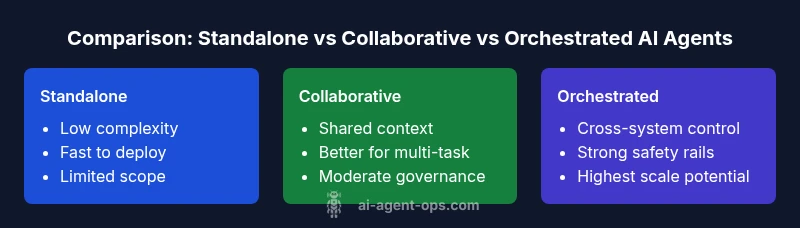
For most teams, a hybrid approach using agent orchestration beats standalone agents for versatility, governance, and scale. When choosing between standalone AI agents, collaborative agent networks, or orchestration platforms, focus on complexity, governance needs, and integration goals. This comparison ai agents guide helps you pick the best fit.
What are AI agents and why compare them?
AI agents are autonomous software components that perform tasks, reason about their goals, and interact with other systems to achieve outcomes. In practice, you can deploy them as standalone executables, as part of multi-agent networks, or within orchestrated platforms that coordinate many agents under shared governance. When we talk about comparison ai agents, we’re examining three core archetypes: simple stand-alone agents tailored to a narrow task; collaborative networks where many agents share context and capabilities; and agentic platforms that provide governance, routing, and safety rails across the ecosystem. According to Ai Agent Ops, the value of a well-chosen model and architecture increases with clarity about who controls data, where decisions occur, and how failures propagate. The goal of this guide is not to declare a single winner but to map the tradeoffs so product teams can align architecture with business goals. You’ll frequently hear that the strongest choices come from hybrid patterns: start with a lightweight stand-alone agent to prove value, then layer in coordination and governance as needs scale. In any case, the success of an automation program rests on selecting the right tool for the job, understanding the limits of automation, and designing safe, observable workflows that stakeholders can trust.
Brand note: The Ai Agent Ops team emphasizes that decisions should be data-driven and risk-aware, especially when data flows cross organizational boundaries.
wordCount":null
bodyBlocks2SubtitleDoesNotApplyForThisFieldOverwritten":null ,
Feature Comparison
| Feature | Standalone AI Agent | Collaborative AI Agent Network | Agent Orchestrator Platform |
|---|---|---|---|
| Capability scope | Narrow, task-specific | Multi-agent coordination with shared context | Cross-system orchestration with policy enforcement |
| Governance & safety | Minimal controls | Moderate controls via agent-to-agent policies | Central governance with safety rails and audit trails |
| Data locality & privacy | Local or cloud, task-bound | Cross-network data sharing with scoped isolation | Unified data governance across systems |
| Latency & throughput | Low to moderate latency | Higher due to coordination overhead | Optimized routing and parallelization for scale |
| Cost & total value | Low upfront cost, pay-as-you-go options | Medium cost with collaboration features | Higher infra and governance costs but greater ROI potential |
| Best for | Simple, fast wins | Complex, multi-task workflows | Large-scale automation with cross-domain integration |
Positives
- Faster time-to-value for simple tasks
- Lower upfront complexity with standalone agents
- Scalability through formal orchestration and governance
- Easier cross-system integration when using an orchestrator
- Flexibility to mix approaches as needs evolve
What's Bad
- Higher total cost and complexity with orchestration
- Potential latency from coordination across agents
- Maintenance burden for complex setups
- Risk of governance fragmentation without clear ownership
Adopt a hybrid approach: start with standalone agents for quick wins, then layer in orchestration to scale governance and cross-system workflows.
Standalone agents deliver speed; orchestration platforms unlock scale and governance. A staged, hybrid path reduces risk while maximizing ROI and adaptability.
Questions & Answers
What is the difference between a standalone AI agent and a collaborative AI network?
A standalone AI agent operates in isolation for a specific task, while a collaborative network connects multiple agents to share context and capabilities. Collaboration enables more complex workflows but requires governance and data-sharing controls.
A standalone agent handles one task, but a network links several agents to cooperate on bigger problems.
What is agent orchestration?
Agent orchestration coordinates multiple agents, policies, and data flows to achieve shared goals. It provides governance, routing, and safety rails, making large-scale automation more reliable.
Orchestration wires agents together under common rules to work as a team.
Which approach saves the most time in early stages?
Standalone agents typically deliver quickest time-to-value for simple tasks. As needs grow, orchestration increases efficiency by reducing manual handoffs and improving reusability across teams.
For quick wins, go with standalone agents; for big workflows, orchestration saves time later.
How do I measure ROI for AI agents?
ROI is evaluated by task success rate, time saved, error reduction, and maintenance cost. Compare pre- and post-deployment baselines and track observability metrics over time.
Look at time saved, fewer errors, and maintenance costs to judge ROI.
What governance considerations matter most?
Data ownership, access controls, auditability, and safety constraints should be baked into the design. Cross-border data flows require clear policies to prevent leakage and ensure compliance.
Make sure data stays protected and decisions are auditable.
What are common pitfalls in agent deployment?
Over-reliance on automation without observability, underestimating data privacy needs, and failing to align with business objectives can impede success. Start with measurable pilots and evolve governance gradually.
Watch for hidden data gaps and lack of visibility as you scale.
Key Takeaways
- Prioritize governance early for scalable AI automation
- Use standalone agents for rapid validation of value
- Layer orchestration to coordinate cross-domain tasks
- Plan data flows and privacy before scaling
- Measure outcomes with clear KPIs and observability