Chatbot vs AI Agent vs Agentic AI: A Thorough Side-by-Side
A rigorous side-by-side on chatbot, AI agent, and agentic AI—definitions, architectures, use cases, risks, and deployment guidance for teams.


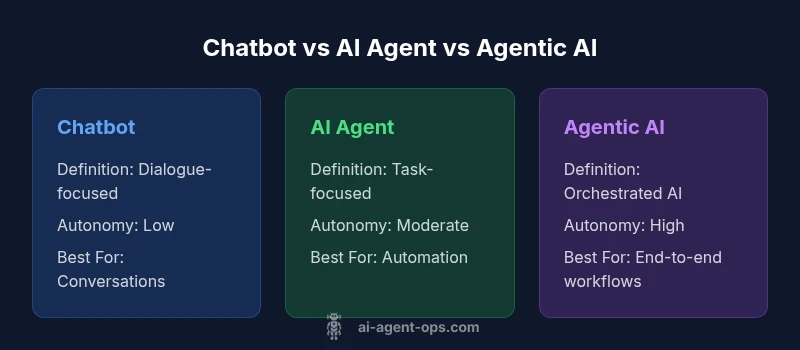
Chatbots are conversation-focused interfaces, AI agents are autonomous task executors, and agentic AI blends planning with multi-step orchestration. In practice, the chatbot vs ai agent vs agentic ai decision comes down to scope, autonomy, and governance: use chatbots for dialogue, AI agents for automation, and agentic AI for end-to-end, orchestrated workflows.
Definitions and Core Concepts
According to Ai Agent Ops, the landscape of conversational and autonomous AI can be distilled into three core categories: chatbot, AI agent, and agentic AI. A chatbot is primarily a dialog-driven interface designed to understand user input, retrieve information, and provide guided responses within a limited scope. In contrast, an AI agent refers to a software component that can perceive its environment, plan a sequence of actions, and execute tasks with a degree of autonomy. Agentic AI sits atop these foundations, enabling advanced autonomy by combining strategic planning, memory, and governance to carry out complex, multi-step workflows across disparate tools. When you see the phrase chatbot vs ai agent vs agentic ai, it signals a progression from surface-level conversation to deep automation with orchestration. For development teams, this distinction matters because architecture, data flows, and risk profiles shift with each tier. The Ai Agent Ops team emphasizes that choosing among these options is less about labeling and more about aligning capabilities with business goals and governance requirements.
Architecture and Capabilities
Chatbots usually operate on prompt-driven LLMs with a lightweight dialog manager. They excel at natural language understanding, intent recognition, and user-facing responses, but their decision space is largely constrained to conversation. An AI agent extends that boundary by embedding a planning loop: it can select actions from a set of tools or APIs, monitor outcomes, and adapt goals based on feedback. Agentic AI adds orchestration, memory, and policy controls that enable end-to-end workflows spanning multiple systems. The core difference here is autonomy: chatbot architectures optimize for conversational UX, AI agent architectures optimize for task-level automation, and agentic AI architectures optimize for end-to-end process execution with governance and safety rails. Across all three, robust state management and traceability are essential for reliability and auditability.
Use Cases by Class
In customer support, chatbots are ideal for handling FAQs, routing tickets, and providing scripted guidance. For back-office automation, AI agents can execute defined tasks—pull data from systems, trigger workflows, and report outcomes without human prompts. Agentic AI is best for complex, multi-app processes such as onboarding new employees, cross-system data reconciliation, or end-to-end order processing where planning, memory, and policy constraints are required. The chatbot vs ai agent vs agentic ai spectrum shows a clear path from simple interactions to autonomous orchestration, and ultimately to integrated, auditable automation across an organization. When teams consider these options, they should map business problems to the appropriate level of autonomy and control.
Evaluation Metrics and ROI
Evaluating a chatbot focuses on dialogue quality, user satisfaction, and response latency. AI agents demand success metrics like task completion rate, action accuracy, and time-to-value for end-to-end automation. Agentic AI introduces ROI metrics that blend dialogue quality with process efficiency: cycle time reduction, error rates across steps, and governance compliance scores. The chatbot vs ai agent vs agentic ai comparison becomes a framework for selecting KPIs aligned with scope: conversational UX, task-level automation, or orchestrated workflows. Ai Agent Ops emphasizes that ROI calculations should include governance costs and integration effort to avoid overstating the value of autonomy without proper controls.
Data, Privacy, and Governance
Chatbots gather conversational data, which raises privacy and data-use considerations, especially with PII. AI agents must access external data sources and tools, raising security and compliance complexities. Agentic AI compounds these concerns by requiring cross-system data flows, audit trails, and policy enforcement across the automation stack. The chatbot vs ai agent vs agentic ai debate highlights the importance of governance: you need clear ownership, access controls, and monitoring to prevent cascading failures or policy breaches. Ai Agent Ops recommends a guardrail approach—start with a narrow scope, implement instrumentation, and iteratively increase autonomy with formal reviews and risk assessments.
Integration and Deployment Patterns
Chatbots typically live at the user interface layer and integrate with knowledge bases or CRM systems. AI agents require orchestration layers that connect to APIs, data stores, and event streams, plus a lightweight memory component for context. Agentic AI relies on a governance layer, decision memory, and policy modules that govern how plans are formed, revised, and executed. Deployment often follows a staircase: pilot chatbot capabilities, add agent-level automation, then layer agentic AI for end-to-end processes. The chatbot vs ai agent vs agentic ai pathway often correlates with increasing integration complexity, require more robust monitoring, and demand stronger security models.
Challenges, Risks, and Mitigation
Common risks in the chatbot realm include superficial dialogue, data leakage, and misrouted conversations. AI agents introduce risk of cascading failures if planning or tool access is flawed. Agentic AI adds governance risk—unchecked autonomy, black-box decision-making, and compliance gaps. Mitigation strategies include modular testing, end-to-end tracing, sandboxed environments, explicit timeout controls, and ongoing auditing. The chatbot vs ai agent vs agentic ai framework helps teams identify risk at the right layer and apply targeted controls, from conversational safety checks to policy enforcement for multi-step workflows. Ai Agent Ops emphasizes documenting failure modes and implementing rollback plans to preserve system integrity.
Roadmap: When to Choose Which
Choosing between chatbot, AI agent, and agentic AI depends on business outcomes and risk tolerance. For high interaction quality with limited automation, start with chatbot capabilities. If the goal is reliable task execution with integrated tools, adopt AI agents with structured workflows. If you require end-to-end automation across multiple systems with governance, invest in agentic AI with a formal orchestration layer. The chatbot vs ai agent vs agentic ai decision should reflect where value is fastest, without sacrificing safety or control. Ai Agent Ops suggests a staged rollout: validate constraints, monitor outcomes, and progressively expand autonomy with guardrails.
Practical Implementation Checklist
Before you build, define your success criteria and scope. Choose a baseline architecture (dialogue-first vs action-first) and identify the primary tools and APIs involved. Implement observability with tracing, metrics, and anomaly detection. Establish governance policies, access controls, and data handling rules. Finally, pilot in a controlled environment, gather feedback, and iterate. The chatbot vs ai agent vs agentic ai framework is a practical guide for progressive enhancement, ensuring you gain value at each stage while maintaining safety and compliance. The Ai Agent Ops team notes that real-world deployments succeed when teams align capabilities with clear governance and measurable outcomes.
Feature Comparison
| Feature | chatbot | ai agent | agentic AI |
|---|---|---|---|
| Definition | Dialog-focused interface for user interaction | Autonomous component that executes tasks via tools/APIs | Orchestrated, goal-directed system with planning, memory, and governance |
| Control & Autonomy | Low autonomy; user-driven interactions | Moderate autonomy; autonomous task execution within defined scopes | High autonomy with policy, memory, and cross-system coordination |
| Decision Scope | Conversations and scripted guidance | Task-level decisions within toolset boundaries | End-to-end decisions spanning multiple apps and data sources |
| Data Needs | Dialogue data and knowledge bases | Environment data, tools, and API responses | Cross-system data, memory, and policy state |
| Environment Integration | Frontend interfaces (chat windows, voice UI) | APIs, databases, and automation endpoints | Orchestration layers with governance rails |
| Performance Metrics | Dialogue quality, user satisfaction, latency | Task completion rate, action accuracy, time-to-value | Process efficiency, cycle time reduction, auditability |
| Best For | Customer-facing conversations and FAQs | Automated back-office tasks and workflows | End-to-end automation with governance across tools |
| Cost & Risk | Lower upfront complexity | Moderate cost; higher integration needs | Higher upfront investment; strongest governance requirements |
Positives
- Clear delineation between conversation and automation
- Modular deployment across layers for safer rollouts
- Flexible integration paths with APIs and tools
- Scalable from chat to end-to-end automation
What's Bad
- Increased complexity with layering autonomy
- Longer time-to-value for agentic capabilities
- Higher security and governance demands for orchestration
Agentic AI provides the strongest path to end-to-end automation with governance; use chatbot for simple dialogue and AI agents for targeted automation.
If your priority is end-to-end automation with controls, agentic AI is the best fit. For lightweight dialogue or simple task automation, chatbots or AI agents may be quicker to deploy and easier to govern.
Questions & Answers
What is the main difference between a chatbot and an AI agent?
A chatbot focuses on dialogue and user interaction, while an AI agent can act autonomously to perform tasks using tools and data. The distinction becomes important when you shift from conversation to automation.
A chatbot is for talking with users; an AI agent actually does things for you using tools and data.
What is agentic AI?
Agentic AI combines planning, memory, and policy controls to orchestrate complex workflows across multiple systems. It aims for end-to-end automation with governance and safety rails.
Agentic AI is AI that plans, remembers, and coordinates across systems to automate end-to-end tasks with safeguards.
When should I choose a chatbot over an AI agent?
Choose a chatbot when the primary goal is user-facing dialogue, rapid deployment, and limited automation. It is ideal for FAQs, guidance, and routing rather than multi-step task execution.
Choose a chatbot when you need quick, clear conversations and routing, not heavy automation.
What are the biggest risks of agentic AI?
Key risks include unintended autonomous actions, data privacy concerns, governance gaps, and potential policy violations. Mitigate with guardrails, auditing, and controlled rollouts.
Autonomy without guardrails can cause mistakes; governance and audits help prevent that.
How do you measure success across these paradigms?
Define KPIs per paradigm: chat satisfaction for chatbots, task completion for AI agents, and end-to-end ROI for agentic AI. Use end-to-end tracing and impact analysis for governance-relevant metrics.
Measure dialogue quality for chatbots, task success for agents, and ROI for agentic AI.
What is a practical path to implement these technologies?
Start with a narrow use case, add tooling and APIs, implement observability, then gradually increase autonomy with governance checks. Iterate based on feedback and measurable outcomes.
Begin small, observe, then expand with governance in place.
Are there common integration patterns for these approaches?
Common patterns include API-driven orchestration for AI agents and agentic AI, with a separate front-end chatbot layer. Use middleware to unify data models and ensure traceability across steps.
Use API-driven orchestration for agents, plus a chatbot layer for UX.
Key Takeaways
- Define scope before choosing technology: chat, automate, or orchestrate
- Plan governance and data flows early to avoid later rework
- Invest in observability and audit trails for all three approaches
- Progressively increase autonomy with guarded rollout
- Align metrics to business outcomes and ROI