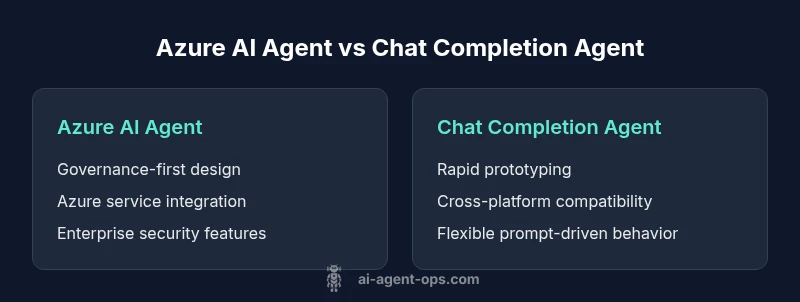
Azure AI Agent vs Chat Completion Agent: An Analytical Comparison
An analytical comparison of Azure AI Agent and Chat Completion Agent, covering scope, architecture, governance, cost, and integration for developers and business leaders.


According to Ai Agent Ops, Azure AI Agent excels at enterprise governance, security, and scalable orchestration within Microsoft ecosystems, while a chat completion agent offers flexible, rapid prototyping and broad language-model access. For teams delivering production workflows with strict compliance, Azure AI Agent is typically the safer choice; for quick experiments, cross-platform experiments, or prototyping, a chat completion agent provides speed and versatility.
Scope and Definitions
Azure AI Agent denotes a managed, enterprise-grade framework integrated into the Azure ecosystem. It coordinates tasks, maintains state, and enforces governance across data sources and services. A chat completion agent, by contrast, describes a stateless or minimally stateful pattern that leverages a language model to interpret prompts and generate actions. The practical difference hinges on control surfaces and lifecycle management: Azure AI Agent emphasizes policy, memory, and connectors, while a chat completion agent emphasizes prompt design, model capabilities, and external tooling. For organizations, the path often starts with a chat-based prototype and transitions toward Azure AI Agent when scaling, security, and compliance demands rise.
Core capabilities and architecture
Azure AI Agent typically comprises an orchestrator, a memory/state store, policy rules, connectors to enterprise data sources, and an execution engine that runs steps as tasks. This setup enables persistent state across sessions, audit trails, role-based access control, and policy-driven routing. A chat completion agent emphasizes prompt-driven reasoning, tool use via APIs, and flexible orchestration built with external services. The trade-off is clear: Azure AI Agent embeds infrastructure for governance and reliability, whereas a chat-based agent prioritizes adaptability and speed of experimentation. The decision point is often where you want to invest in infrastructure: memory, memory governance, and connectors (Azure) versus prompt engineering, tool selection, and stateless orchestration (chat-based).
Use-case alignment and best-fit scenarios
Azure AI Agent shines in production environments with strict governance, regulatory compliance, and multi-tenant data management. It is well-suited for automated workflows that require traceability, auditable decisions, and centralized policy enforcement. A chat completion agent is ideal for rapid prototyping, sandbox experiments, and cross-platform tasks that benefit from language-model flexibility. For organizations piloting AI-powered workflows across departments, starting with a chat completion agent enables fast feedback loops; when requirements evolve toward enterprise-grade automation, migrating to Azure AI Agent often yields better control, scalability, and security.
Performance, cost, and governance considerations
In performance terms, Azure AI Agent can exhibit more predictable latency due to structured orchestration and caching, but it may incur longer initial setup times and ongoing governance overhead. Chat completion agents can respond quickly in development environments, yet performance can vary with model choice and network conditions. From a cost perspective, Azure AI Agent typically aligns with enterprise licensing and Azure consumption models, while chat completion setups vary by provider and usage patterns. Governance overhead—data residency, access controls, and auditability—is a central differentiator supporting compliance requirements in Azure, which Ai Agent Ops emphasizes for enterprise teams.
Data handling and security posture
Azure AI Agent provides built-in security controls, data classification, and residency options that align with enterprise requirements. This includes role-based access, audit trails, and secure connectors to Azure data lakes, databases, and Power Platform apps. A chat completion agent, unless augmented with external controls, relies on the provider’s data handling policies and can require additional safeguards like data masking, on-prem connectors, and private endpoints. Organizations should map data flow end-to-end and implement leakage controls, especially when handling sensitive customer data in cross-provider workflows.
Integration patterns with Microsoft stack
Azure AI Agent integrates deeply with the Microsoft stack, enabling seamless access to Azure OpenAI, Data Factory, Logic Apps, Power Automate, and Defender for Cloud. Such integration simplifies onboarding, governance, and monitoring for enterprise teams already invested in Microsoft tooling. Conversely, a chat completion agent offers broad API access and plugin ecosystems, making it adaptable across platforms (AWS, Google Cloud, on-prem). The best approach may be to prototype in a chat-based pattern and then channel critical workflows into an Azure AI Agent implementation for governance and scale.
Developer experience and tooling
For developers, Azure AI Agent provides structured tooling around connectors, memory schemas, security policies, and observability dashboards. This can reduce risk but demands more upfront design. Chat completion agents typically offer faster setup, versatile tooling, and rapid iteration through prompts, plugins, and external tools. Teams should balance the need for speed in early stages with the long-term reliability and maintainability that Azure AI Agent offers for production-stage automation. The overall experience hinges on how well each path aligns with your team's skill set and organizational priorities.
Migration and upgrade paths
A typical path starts with chat-based prototyping to validate use cases and user acceptance. When a workflow demonstrates maturity and governance needs, organizations should plan a migration to Azure AI Agent modules, completing a controlled transition with data mapping, connector onboarding, and policy deployment. Migration requires careful planning for data residency, access control, and versioned orchestration logic. Ai Agent Ops notes that a staged migration—prototype, pilot, scale—often results in smoother adoption and clearer performance metrics.
Evaluation framework and KPIs
Evaluate both options using a framework that covers governance coverage, data security, time-to-value, and total cost of ownership. Align metrics with business goals: operational reliability, compliance posture, and velocity of feature delivery. Establish pilot projects that measure latency, throughput, and error rates under representative workloads. Use a decision rubric that scores each option on policy coverage, integration depth, developer experience, and long-term maintainability. This structured approach reduces risk and clarifies when to switch from prototyping to production-grade orchestration.
Real-world scenarios and examples
Consider a financial services firm piloting a customer-query automation flow. A chat completion agent can rapidly prototype responses and tool use, delivering quick insights to customers while reducing manual workload. After validating the workflow, the firm may migrate critical paths to Azure AI Agent to enforce compliance, enable persistent state, and integrate with the firm’s data lake and identity management. In a manufacturing setting, Azure AI Agent can coordinate multiple systems—ERP, MES, and inventory—across a secure, auditable process, while a chat-based pattern may suffice for non-critical tasks like internal Q&A or lightweight automation.
Future trends and keeping aligned with AI agent theory
Industry shifts point toward hybrid patterns that combine the strengths of both approaches. Expect more standardized governance layers across cloud providers, improved memory/models interfaces, and enhanced tooling to facilitate smooth transitions from chat-based prototyping to Azure AI Agent deployments. Organizations should stay current with AI agent literature, maintain a clear runtime policy library, and invest in observability and explainability to ensure responsible deployment across all environments.
Comparison
| Feature | Azure AI Agent | Chat Completion Agent |
|---|---|---|
| Definition | Managed, enterprise-grade agent framework with orchestration, memory, and governance within Azure. | Prompt-driven agent pattern leveraging a language model; typically stateless or minimally stateful. |
| Core capabilities | Orchestrator, memory store, policy rules, secure connectors, and execution engine. | Prompt engineering, API tool use, external plugins, and flexible orchestration. |
| Best for | Production workflows in Azure with compliance and audit requirements. | Rapid prototyping, cross-platform tasks, and exploratory projects. |
| Governance & security | RBAC, audit logs, data residency, centralized policy enforcement. | Depends on provider; may require additional controls for data and privacy. |
| Pricing model | Azure-based consumption with enterprise licensing; predictable governance costs. | Usage-based and provider-dependent; can vary by platform and region. |
| Integration ecosystem | Deep integration with Azure services (OpenAI, Data Factory, Power Platform, Defender). | Broad API access and plugins; cross-cloud compatibility. |
| Customization | Policy-driven behavior, memory schemas, and connectors; strong enterprise customization. | Prompt templates, few-shot prompts, and tool selection for tasks. |
| Time-to-value | Longer ramp due to setup, governance, and integration requirements. | Shorter ramp for prototyping and experimentation. |
| Data handling | Explicit data governance, residency options, and auditing. | Depends on provider; may require additional data handling controls. |
Positives
- Strong governance and compliance support for enterprise deployments
- Tight integration with Microsoft ecosystem and Azure services
- Predictable licensing and scalable, auditable operations
- Centralized observability and policy enforcement
- Robust data residency options and security controls
What's Bad
- Higher initial setup complexity and longer time-to-value
- Potential vendor lock-in within the Azure ecosystem
- Requires dedicated cloud architecture, governance, and security resources
- Less flexibility for non-Microsoft data sources without connectors
Azure AI Agent is the recommended choice for enterprise-grade automation in Azure; Chat Completion Agent is best for rapid prototyping and cross-platform experimentation.
If governance, data security, and Azure integration are critical, prefer Azure AI Agent. If you need speed, flexibility, and platform-agnostic prototyping, choose a chat completion agent. The Ai Agent Ops team supports a phased approach that validates use cases with a chat-based prototype before migrating to a governed Azure AI Agent deployment.
Questions & Answers
What is the key difference between Azure AI Agent and a chat completion agent?
Azure AI Agent provides managed orchestration, memory, and governance within the Azure ecosystem, suitable for production-scale automation. A chat completion agent relies on a language model for prompt-based reasoning and is ideal for rapid prototyping. Both patterns can be valuable, depending on the stage of the project and governance requirements.
Azure AI Agent is built for enterprise-grade automation with governance; chat completion is great for quick prototypes.
Is Azure AI Agent only suitable for Microsoft customers?
While optimized for Azure environments, Azure AI Agent can connect to compatible external systems via connectors. However, the strongest benefits—security, data residency, and centralized policy—are realized when operating within Microsoft’s stack.
It's strongest in Azure, but some cross-platform integration is possible.
Can I mix both approaches in a single workflow?
Yes. Teams often prototype with a chat completion pattern and gradually route production-critical paths into Azure AI Agent components. A hybrid approach lets you validate use cases quickly while maintaining governance for scale.
You can start fast with a chat-based prototype and move critical parts to Azure AI Agent later.
What are the main cost considerations?
Costs depend on usage, licensing, and data-transfer requirements. Azure AI Agent costs align with Azure consumption and enterprise licensing, while chat completion costs vary by provider and usage patterns. Plan for total cost of ownership over the project lifecycle.
Costs depend on usage and licensing; plan for total cost over time.
How do I migrate from a chat-based prototype to Azure AI Agent?
Migration involves mapping data flows, onboarding connectors, implementing policy and security controls, and re-architecting orchestration to a stateful, governed framework. A staged approach—prototype, pilot, scale—helps minimize risk and maintain traceability.
Plan a phased shift with data mapping and governance first.
Key Takeaways
- Assess governance needs before choosing an approach
- Prioritize Azure AI Agent for enterprise-scale automation
- Use chat completion agents for rapid prototyping and cross-platform work
- Plan migration paths with policy, data mapping, and connectors
- Balance cost, speed, and security when evaluating options