Anthropic Guide to AI Agents: Practical Agent Workflows
A comprehensive guide to designing, deploying, and governing AI agents using Anthropic-inspired principles for safer, more reliable automation. Learn frameworks, guardrails, and governance for scalable agentic AI systems.


This guide explains how to design, deploy, and govern AI agents following Anthropics-inspired principles. You’ll learn how to frame agent objectives, implement safety guardrails, and monitor behavior across teams. Key steps include defining tasks, selecting agent components, enforcing governance, and planning ongoing auditing. By the end, you’ll have a practical blueprint for reliable agentic workflows.
Foundations of AI agents in an Anthropics context
Anthropic's philosophy toward AI agents centers on building task-oriented systems that behave safely and predictably within clearly defined boundaries. An effective AI agent operates as a modular ensemble: a planning component, an action handler, a feedback loop, and an audit trail. For teams adopting this approach, success hinges on a shared understanding of goals, constraints, and the role of human oversight. According to Ai Agent Ops, grounding AI agents in safety-first design is essential for scalable automation. The anthropic mindset emphasizes aligning agent intents with user objectives while constraining unintended side effects through robust guardrails and transparent decision-making. By integrating governance into the design from day one, organizations reduce risk and improve collaboration between humans and machines.
Key takeaways from this foundational view include: separate planning from action, maintain explicit intent signals, and log decisions for traceability. This structure supports rapid experimentation without sacrificing safety, a balance that is central to responsible agent development across industries.
Governance and safety guardrails for AI agents
Effective agent governance starts with a formal policy catalog that defines permitted tasks, data handling rules, and escalation paths. Guardrails should be layered: input sanitization, constraint checks before actions, and automatic rollback if outcomes drift from expectations. Safety also means bias detection, adversarial testing, and continuous monitoring of latency and resource usage to catch anomalies early. In practice, teams implement guardrails as configurable policies that can be updated without code changes, enabling rapid adaptation to evolving risk landscapes. The Ai Agent Ops framework emphasizes auditable decisions and clear ownership for every agent deployment. Implementing governance as a living, document-driven process helps align technical teams with business priorities while maintaining regulatory compliance where applicable.
Pro-tip: start with a lightweight policy set and expand as you observe real-world interactions. Regularly review and update guardrails to keep pace with new capabilities and threats.
Architecting robust agent systems: components and interfaces
A robust AI agent comprises several interlocking components: a task planner, a skill library, an action executor, a memory/context module, and a monitoring/auditing layer. Interfaces between components should be explicit, with well-defined input/output schemas to minimize miscommunication across modules. Modular design supports reusability and safer experimentation, as you can swap or extend individual capabilities without destabilizing the entire system. An effective agent also includes bias checks, telemetry, and explainability hooks to help operators understand why an agent chose a given action.
From a practical standpoint, you should design components around real user needs: what problem is solved, who will supervise, and how success is measured. Documentation should capture the decision boundaries, assumed norms, and fallback behaviors so future engineers can reason about the agent’s behavior.
Lifecycle of an AI agent: planning, execution, and learning loops
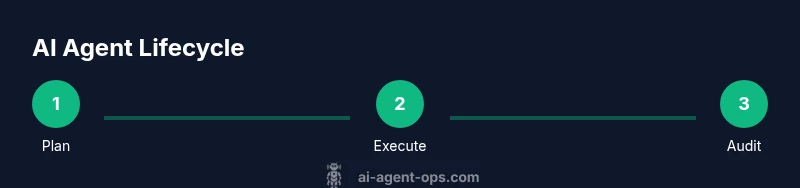
Agent lifecycles combine planning, execution, and iterative improvement. Begin with a clear problem statement and success criteria, then implement a plan that maps tasks to actions. During execution, monitor outcomes, collect feedback, and adjust the plan as needed. Learning loops—whether through offline refinement, human-in-the-loop corrections, or simulated environments—provide gradual improvements while preserving safety controls. The Anthropics-informed approach stresses evaluation at every stage: metrics should reflect impact on user goals, not just technical performance. At scale, versioning and rollback capabilities are essential to protect live workflows.
Practical advice: run pilot programs with synthetic data first, then transition to real data under tight governance. Use guardrails to prevent risky behaviors during early experimentation while you iterate.
Practical deployment patterns and guardrails for real-world use
Deployment patterns should balance speed, safety, and operability. Start with a controlled sandbox, then move to a shadow deployment that observes actions without affecting live users. Progressive rollout allows teams to verify reliability and detect regressions in a low-risk environment. Guardrails include input validation, action-rate limiting, anomaly detection, and an auditable decision log. Operators should establish an escalation protocol to re-task or shut down agents when safety thresholds are exceeded. The guide from Ai Agent Ops emphasizes that governance and observability are not afterthoughts but integral parts of the deployment plan.
In production, maintain a living risk register, schedule regular red-teaming exercises, and keep a change-log that documents policy updates and agent behavior shifts. These practices reduce outage risks and improve trust with stakeholders.
Case patterns and common pitfalls in agent design
Common pitfalls include over-automation without adequate oversight, poorly defined objectives, and hidden feedback loops that amplify errors. Other issues include data leakage from training to deployment, and brittle interfaces that break when inputs shift. To avoid these, design with explicit boundaries, simulate a wide range of scenarios, and keep a clear separation between training data and live data. Monitoring should catch drift in agent behavior, such as unexpected policy violations or degraded performance. TheAnthropic-informed perspective recommends regular audits of agent decisions and a transparent explanation of why certain actions were taken.
Proactive design and continuous improvement reduce the risk of catastrophic failures in complex agent systems. Planning for failure modes and recovery is as important as ambitious capability development.
How to evaluate agent performance and iteration cycles
Evaluation should combine objective metrics with qualitative insights. Define success in terms of user impact, reliability, and safety. Use A/B testing to compare agent variants, and implement a robust feedback loop to capture user corrections and incident reports. Iteration cycles should be timeboxed to maintain momentum, with governance reviews at each major release. A key practice is to document hypotheses, update plans based on results, and trace changes to outcomes. The Anthropics-inspired approach emphasizes reproducibility, auditable decisions, and continuous improvement across the agent lifecycle.
By instituting a repeatable evaluation framework, teams can demonstrate improvement to stakeholders and accelerate responsible automation. Regular retrospectives help translate lessons learned into better designs in subsequent iterations.
AUTHORITY SOURCES
- NIST AI RMF: https://www.nist.gov/topics/artificial-intelligence
- OECD AI Principles: https://oecd.ai/en/responsible-innovation/artificial-intelligence
- Stanford Encyclopedia of Philosophy – Ethics of AI: https://plato.stanford.edu/entries/ethics-ai/
Tools & Materials
- Access to an AI agent platform or API (e.g., Claude, GPT-4-like provider)(Ensure you have appropriate access rights and service terms.)
- Development environment(IDE, version control, and local testing sandbox.)
- Data governance and privacy checklist(Include data handling rules, consent, and retention policies.)
- Policy catalog template(Documented guardrails and per-task constraints.)
- Logging and observability stack(Telemetry, auditing, and explainability hooks.)
- Safety and risk assessment guide(Optional but recommended for advanced teams.)
Steps
Estimated time: Total time: 4-6 hours
- 1
Define goals and constraints
Clarify the problem the agent will solve and the measurable success criteria. Identify non-negotiable constraints (privacy, safety, regulatory requirements) before any development starts.
Tip: Document success metrics and failure modes upfront to guide later testing. - 2
Map agent roles and interfaces
Outline each component’s responsibilities and define clean interfaces between planning, execution, and memory. Ensure human oversight touchpoints are clear.
Tip: Use interface contracts to prevent silent interface drift. - 3
Implement guardrails and safety checks
Add input sanitization, action gating, and escalation rules. Set up automatic rollback if a task violates policies or safety thresholds.
Tip: Start with conservative guardrails and expand gradually as confidence grows. - 4
Assemble capabilities and test in isolation
Plug in planning, action, and memory modules in a sandbox. Run unit and integration tests with synthetic data.
Tip: Test edge cases and adversarial inputs to expose weaknesses. - 5
Pilot, monitor, and gather feedback
Release to a limited audience and collect usage data, error signals, and user corrections. Iterate based on feedback.
Tip: Establish rapid feedback loops for continuous improvement. - 6
Scale with governance and auditing
Move from pilot to production with formal governance, versioning, and explainability artifacts. Maintain an auditable decision trail across releases.
Tip: Update governance documents with every major change.
Questions & Answers
What is an AI agent in the Anthropics sense?
An AI agent is a software system that can perceive a problem, plan a sequence of actions, execute those actions, and adapt based on feedback. Anthropics-inspired design emphasizes safety, alignment, and human oversight to ensure agents act within defined boundaries.
An AI agent is a smart system that plans, acts, and learns while staying within safety rules. It combines perception, decision-making, and control with oversight.
How does Anthropics influence AI agent design?
Anthropic-influenced design stresses guardrails, transparency, and contestable decision-making. It advocates aligning agent goals with user intent and providing auditable traces of how decisions were reached.
Anthropic-influenced design focuses on safety, transparency, and clear tracing of decisions.
What are common safety concerns with AI agents?
Common concerns include data leakage, unintended optimization for unsafe objectives, and cascading failures. Mitigation involves strict input validation, restricted action sets, and continuous monitoring.
Key safety concerns are data leakage and unexpected agent behavior; guardrails and monitoring help prevent them.
How can teams govern AI agents effectively?
Effective governance uses a formal policy catalog, audit trails, versioned deployments, and regular risk assessments. Clear ownership and escalation paths improve accountability.
Governance means clear policies, auditable decisions, and accountable ownership for every agent deployment.
What are typical pitfalls when building AI agents?
Pitfalls include over-automation without oversight, vague objectives, and brittle interfaces that break with input drift. Mitigation relies on modular design and continuous testing.
Common pitfalls are automation without oversight and unclear goals; modular design helps avoid them.
Watch Video
Key Takeaways
- Define clear agent objectives and constraints
- Architect modular components with explicit interfaces
- Guardrails and auditing are essential for safe scale
- Pilot before production, with strong feedback loops
- Governance should evolve with every deployment