ai agent or assistant: A Practical Comparison
A rigorous, two-option comparison of AI agents and AI assistants. Learn how autonomy, governance, and integration shape outcomes for developers and leaders in real-world workflows.


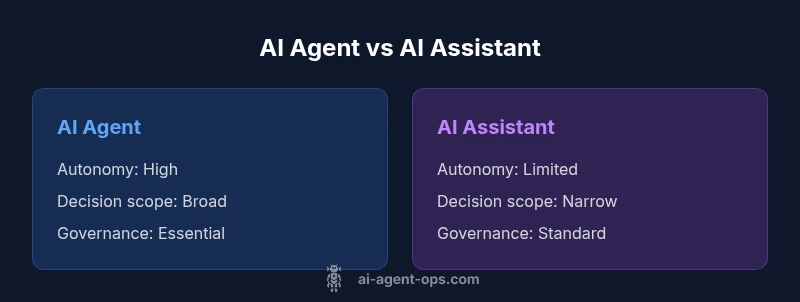
Comparing an AI agent (autonomous, decision-making system) to an AI assistant (guided helper) shows that agents offer higher autonomy but require stronger governance, while assistants prioritize safety and control. This guide outlines the core differences, benefits, and trade-offs for developers and leaders.
Core distinction: autonomy vs guided interaction
The phrase ai agent or assistant describes two ends of a spectrum in modern software automation. An AI agent is designed to operate with a level of autonomy, selecting actions, negotiating with systems, and adapting to changing context. An AI assistant is intended to augment human activity through guided prompts, predefined flows, and explicit approvals. For teams building intelligent workflows, understanding this split helps you balance speed, control, and risk.
Ai Agent Ops recognizes that autonomy comes with both opportunity and obligation. Agents can orchestrate multi-step tasks across apps, databases, and sensors, handling inputs, decisions, and follow-up actions without constant manual input. However, autonomy also introduces governance needs: safety constraints, auditing trails, fail-safes, and escalation paths. The Ai Agent Ops team emphasizes that the right choice depends on your risk tolerance, data sensitivity, and the criticality of the task.
In practice, many organizations start with AI assistants to socialize capabilities, then progressively layer autonomy where governance and confidence grow. This move often unlocks faster turnarounds for routine, end-to-end workflows while preserving human oversight for exceptions. When you articulate the core tradeoffs early—speed vs safety, reach vs control—you set the stage for a successful deployment of ai agent or assistant solutions.
wordCountInBlock":null},
Comparison
| Feature | AI Agent (Autonomous) | AI Assistant (Guided) |
|---|---|---|
| Autonomy / Decision-making scope | High autonomy across multi-step tasks and systems | Limited autonomy, mainly guided by prompts |
| Domain reach | Cross-system orchestration and real-time actions | Narrow, task-specific guidance |
| Governance & safety | Strong guardrails, escalation, and audit trails | Prominent prompts and human-in-the-loop with approvals |
| Data handling | Extensive data access with end-to-end process logs | Restricted data exposure with ephemeral context |
| Integration complexity | Requires broad adapters across many APIs and services | Easier integration with bounded interfaces |
| Implementation time | Longer design, governance setup, and testing | Faster to pilot in scoped environments |
| Cost visibility | Ongoing governance and monitoring add to TCO | Lower upfront development cost but potential ongoing human costs |
| Best use case | End-to-end automation in dynamic workflows | Static tasks with safety-critical oversight |
Positives
- Unlocks scalable automation across complex workflows
- Increases speed in decisions within governed domains
- Reduces repetitive human effort in complex processes
- Supports end-to-end orchestration across systems
What's Bad
- Requires substantial governance, monitoring, and risk management
- Higher initial complexity and longer time-to-value
- Potential for uncontrolled actions without safeguards
- Ongoing maintenance and audits add to cost
AI agents are generally best for autonomous, end-to-end workflows; AI assistants excel where safety and oversight are prioritized.
If your priority is broad automation and rapid execution, an AI agent is often the right choice. If user-facing interactions and strict governance are paramount, an AI assistant fits better. The Ai Agent Ops team’s view is to start with clear governance and pilot in scoped scenarios before scaling.
Questions & Answers
What is the difference between an AI agent and an AI assistant?
An AI agent operates with a degree of autonomy, making decisions and acting across systems. An AI assistant remains more guided, relying on prompts, human-in-the-loop oversight, and clearly defined workflows. The choice hinges on risk tolerance and the required level of automation.
An AI agent acts on its own with guardrails, while an AI assistant follows prompts and human checks.
Which is easier to implement in an enterprise?
AI assistants are generally easier to deploy first due to their guided nature and safer novelty curve. Agents require governance, testing, and robust integration, but they unlock deeper automation over time.
Assistants are usually quicker to roll out; agents take more planning but pay off with bigger automation gains.
What governance structures are recommended for agents?
Establish escalation paths, risk scoring, audit trails, and role-based access controls. Use policy-as-code to enforce constraints and define service-level objectives for monitoring and recovery.
Put guardrails and audits in place before you scale agents.
Can AI agents and assistants be used together?
Yes. A common pattern is an assistant layer handling user-facing tasks and data intake, with an autonomous agent taking over for end-to-end automation after validation. This layered approach marries safety with scale.
You can mix them: assistants handle the user touchpoints, agents run the backend automation.
What are typical cost considerations?
Costs include development, governance tooling, monitoring, and potential human-in-the-loop costs for agents. Assistants may have lower upfront costs but require ongoing human involvement for complex tasks.
Expect ongoing costs for governance and monitoring with agents, lighter upfront if you start with assistants.
How do you measure success for these systems?
Track metrics like task completion rate, time-to-decision, escalation frequency, and accuracy of decisions. Use A/B testing and controlled pilots to compare agent vs assistant performance in real tasks.
Measure outcomes like speed, accuracy, and user satisfaction.
Key Takeaways
- Define objective and risk tolerance early
- Choose AI agent for end-to-end automation; AI assistant for user-facing tasks
- Plan governance, escalation, and auditability from day one
- Design for integration and data privacy across systems
- Pilot with scoped use cases before broad rollout