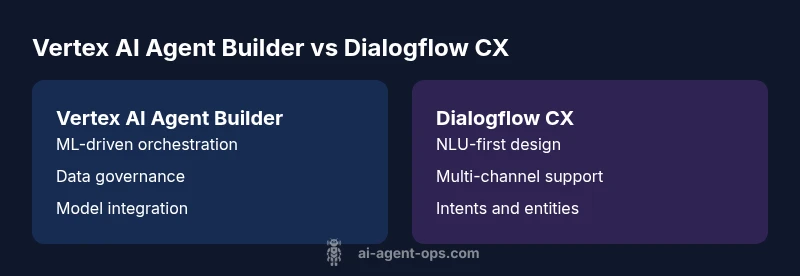
Vertex AI Agent Builder vs Dialogflow CX: An In-Depth Comparison
A thorough, analytics-driven comparison of Vertex AI Agent Builder and Dialogflow CX to help developers, product teams, and business leaders choose the right Google Cloud tool for ML-driven agents and conversational UX.


Vertex AI Agent Builder and Dialogflow CX target different AI agent use cases. For ML-driven agent orchestration and data governance, Vertex AI offers deep integration with Google Cloud ML tooling, while Dialogflow CX excels in conversational UX with robust NLU and multi-channel support. The right choice depends on whether your priority is end-to-end ML workflows or conversation-first experiences.
Architectural Vision and Scope
Vertex AI Agent Builder sits within Google Cloud's Vertex AI ecosystem, emphasizing end-to-end ML workflows, data governance, and scalable orchestration of agents that can reason over data and run ML-powered tasks alongside traditional logic. Dialogflow CX, by contrast, is built around conversational UX, graph-based flows, and robust natural-language understanding designed to manage intents, entities, contexts, and multi-channel experiences. According to Ai Agent Ops, the choice between these platforms should align with organizational priorities: ML-driven agent orchestration and data-centric governance versus conversation-first UX and rapid prototyping. In enterprise contexts, Vertex AI tends to appeal to teams that want to integrate agent orchestration with data pipelines, model evaluation, and governance controls. Dialogflow CX remains a strong option when speed to value in conversation design, agent testing across channels, and telephony integration are paramount for customer-facing applications.
-100-200 words
blockdata1
Comparison
| Feature | Vertex AI Agent Builder | Dialogflow CX |
|---|---|---|
| Core approach | ML-driven agent orchestration with Vertex AI tools | Intent-based conversational flows with graph-style dialog management |
| NLU/Intelligence | Custom ML models, retrieval augmented generation, and tool use within Vertex AI ecosystem | Built-in NLU with intents/entities, multi-language support, and rich conversation state handling |
| Development experience | Tight integration with Vertex AI pipelines, data governance, and model monitoring | Visual flow editor with versioning, testing, and rapid prototyping for chat experiences |
| Orchestration & state | Orchestration across ML tasks, memory, and agent cognition within a data-driven framework | Dialog state, context management, and multi-turn dialogue control |
| Integrations & ecosystem | Strong ties to BigQuery, Cloud Storage, Vertex AI models, and MLOps | Out-of-the-box connectors to telephony, messaging, and Google Cloud services |
| Telephony & channels | Limited telephony out-of-the-box; strong data integrations for enterprise apps | Robust multi-channel support including voice, chat, and messaging apps |
| Deployment & hosting | Hosted within Vertex AI with enterprise-scale deployment options | Cloud-hosted with cross-region availability and testing tooling |
| Pricing model | Usage-based pricing for ML workloads; hosting and tooling within Vertex AI ecosystem | Per-request and tiered usage pricing with channel-specific costs |
| Best for | Organizations seeking ML-driven automation, data governance, and model-centric workflows | Conversation-first use cases, rapid prototyping, and customer-contact automation |
Positives
- Deep integration with Google Cloud ML tooling and governance
- Strong data lineage, monitoring, and compliance capabilities
- Flexible deployment options across enterprise environments
- Robust tool integration for ML workflows and retrieval-augmented reasoning
- Unified platform for agents that blend ML and automation
What's Bad
- Higher learning curve for teams focused solely on conversational UX
- Pricing complexity due to multiple ML and data components
- Potential vendor lock-in within the broader Vertex AI suite
Vertex AI Agent Builder is the go-to when ML-driven agent orchestration and data governance are priorities; Dialogflow CX excels for conversation-first workloads with rapid prototyping and broad channel support.
Choose Vertex AI Agent Builder when your use case centers on ML-powered agents and enterprise data workflows. Opt for Dialogflow CX when the primary need is robust natural language understanding and quick, channel-agnostic conversational experiences. Both can complement organizational goals if used in a phased migration strategy.
Questions & Answers
What is Vertex AI Agent Builder and where does it fit in?
Vertex AI Agent Builder is a tool within Google Cloud that emphasizes building and orchestrating AI agents as part of a broader ML-driven automation platform. It integrates with Vertex AI services for model hosting, data management, and governance, enabling complex agent behaviors that leverage ML models and retrieval strategies.
Vertex AI Agent Builder helps you create ML-powered agents tied to your data and models. It sits in the ML toolkit alongside other Vertex AI services, so you can orchestrate tasks and reasoning across your data pipelines.
What is Dialogflow CX best for in real-world use cases?
Dialogflow CX is best for conversational UX projects where rapid development of multi-turn dialogs, robust NLU, and multi-channel distribution are priorities. It excels in customer support bots, virtual assistants, and agent-assisted workflows that rely on natural language understanding.
Dialogflow CX shines when you need strong language understanding and smooth conversation flows across channels.
Can I combine Vertex AI Agent Builder with Dialogflow CX?
Yes. Teams can design conversational components in Dialogflow CX while leveraging Vertex AI Agent Builder for ML-backed decision-making, data processing, and orchestration capabilities. A hybrid approach often offers best-of-both-worlds in large enterprises.
You can use Dialogflow CX for the conversation layer and Vertex AI for the heavy ML and orchestration parts.
What are migration considerations when moving from Dialogflow CX to Vertex AI Agent Builder?
Migration involves mapping Dialogflow intents and flows to Vertex AI’s agent architecture, re-creating dialog management as sequences of ML-powered actions, and ensuring data governance and monitoring align with Vertex AI tooling. Plan for testing and phased rollout to minimize disruption.
Migration requires rethinking flows as ML-enabled tasks and validating data governance across the new setup.
How do pricing models typically compare between the two platforms?
Both platforms use usage-based pricing, with Vertex AI often pricing ML workloads and data processing separately from hosting, while Dialogflow CX charges per interaction or flow usage alongside channel-specific costs. Consult current pricing guides for practical budgeting.
Pricing depends on usage patterns; expect ML workloads to influence Vertex AI costs and conversational traffic to drive Dialogflow CX charges.
What ecosystems or integrations should I consider beyond Google Cloud?
Consider whether your organization needs third-party CRM, analytics, or telephony providers. Dialogflow CX has broader conversational integration out of the box, while Vertex AI Agent Builder emphasizes ML-centric integrations with data platforms and MLOps tools.
Look for integrations that match your data sources and customer channels beyond Google Cloud.
Is there a recommended path for teams new to AI agents?
Begin with Dialogflow CX to learn conversation design and rapid prototyping. As needs grow toward ML-driven automation and governance, gradually introduce Vertex AI Agent Builder to leverage ML models and advanced orchestration.
Start with Dialogflow CX for UX, then layer in Vertex AI Agent Builder for ML-powered capabilities.
Key Takeaways
- Assess your cloud stack alignment before choosing
- Prioritize ML governance needs for Vertex AI
- Value Dialogflow CX for rapid conversational UX prototyping
- Plan for multi-channel support in Dialogflow CX
- Account for pricing complexity in both platforms