Typescript vs Python for AI Agents: A Practical Comparison
A rigorous, user-friendly comparison of TypeScript and Python for AI agents, highlighting when to choose each language, how to combine them, and best practices for production-grade agent architectures.


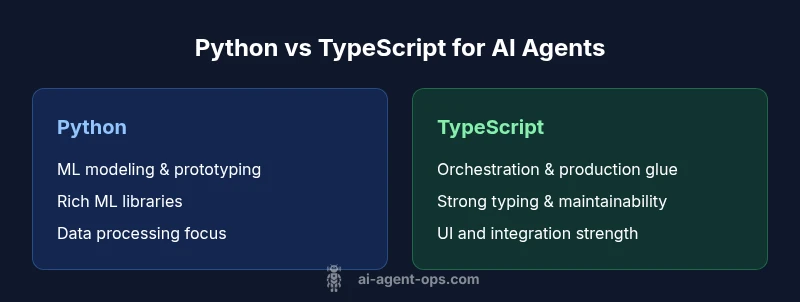
When evaluating AI agents, Python is typically favored for modeling and rapid prototyping, while TypeScript excels at orchestration, integration, and production deployment. This quick comparison shows how each language plays to different parts of an agent system and how teams can pair them for best results. In practice, many teams use Python for the ML core and TypeScript for the surrounding services and UI.
Why language choice matters for AI agents
According to Ai Agent Ops, language choice shapes where data is stored, how compute happens, and how quickly an agent system can iterate. When evaluating typescript vs python for ai agents, teams must weigh modeling speed and scientific rigor against deployment reliability and user-facing integration. The Ai Agent Ops team found that most organizations start with Python for rapid experimentation and move toward TypeScript-driven orchestration as systems scale. This section sets the stage for a practical decision framework by clarifying the roles of each language within a typical agent architecture: a Python-based ML core, complemented by TypeScript-based services for orchestration, UI, and integration with external data sources.
The goal is to outline decision criteria that stay actionable in real-world projects: data handling, verifiability, latency budgets, and team skill alignment. Throughout, keep in mind that many teams benefit from a hybrid approach that leverages the strengths of both languages rather than a binary choice. The rest of the article dives into concrete examples, patterns, and pitfalls so you can map language choices to your agent lifecycle.
Practical note: this discussion centers on modern AI agent patterns, not isolated scripting tasks. It emphasizes agent orchestration, decision-making pipelines, and production-grade deployment scenarios where maintenance and collaboration matter as much as raw performance.
directAnswer1TextFlagGEDummy2OnlyForFormatScenario0LineBreaks0
wordCountDirectAnswer1TextFlagGEDummy2OnlyForFormatScenario0LineBreaks0
captionPlaceholder0
Comparison
| Feature | Python | TypeScript |
|---|---|---|
| Primary strength | AI modeling & rapid prototyping with mature ML libraries | Orchestration, integration, and production-grade deployment with strong typing |
| Best for | ML research, data preprocessing, and experimentation stages | Production services, dashboards, and front-end/backend coordination |
| Ecosystem maturity in AI | High maturity for ML tooling and experimentation | Growing ML tools in JS/TS, strong in deployment tooling |
| Runtime/concurrency model | GIL-related considerations; uses multiprocessing or native extensions | Event-driven, non-blocking I/O with Node.js or Deno |
| Library ecosystem | PyTorch, TensorFlow, scikit-learn, spaCy, etc. | tfjs, ONNX.js, ONNX runtimes, and ML utilities in JS/TS |
| Learning curve for teams | Significant ML background helps; Python is widely taught in AI | JS/TS background helps teams focus on integration and UI |
| Best for AI agent pattern | ML cores, experimentation harnesses, data pipelines | Agent orchestration, services glue, UI integrations |
Positives
- Python accelerates ML prototyping with a rich ecosystem
- TypeScript enhances maintainability and production safety with strong typing
- Hybrid patterns enable bridging ML cores and orchestration layers
- Clear module boundaries reduce cross-language coupling when well designed
What's Bad
- Python deployment can be complex when tied to frontend stacks
- TypeScript ML ecosystem is smaller and evolving
- Cross-language pipelines add integration overhead and monitoring needs
Adopt a hybrid approach: use Python for ML cores and experimentation, and TypeScript for orchestration and production glue.
The combined approach leverages Python's mature ML libraries for rapid prototyping while exploiting TypeScript's strengths in integration, reliability, and frontend/backend coordination. Plan cross-language interfaces early and design service boundaries that minimize data serialization costs and latency.
Questions & Answers
Which language is generally better for AI agents?
Python is typically favored for ML modeling and rapid experimentation, while TypeScript shines in orchestration and production deployment. The best setups often combine both languages to exploit their respective strengths.
Python is great for ML, but TypeScript is superb for putting those models into production and keeping everything integrated.
Can I build AI agents with only TypeScript?
Yes, for some agent patterns focused on orchestration and integration, you can operate primarily in TypeScript. However, you’ll likely rely on Python or another ML-friendly language for the core modeling work.
You can, but you’ll miss some ML tooling unless you bring in ML support from another language.
How do you integrate Python ML with a TypeScript app?
Common patterns include REST or gRPC APIs, message queues, or shared data contracts. A microservices approach keeps ML components separate but accessible to the TS-based orchestration layer.
Use APIs or microservices to connect Python ML with your TypeScript apps.
What are the main pitfalls of cross-language AI agent projects?
Overhead from data serialization, version drift between environments, and monitoring challenges. Start with stable contracts, robust testing, and clear deployment pipelines to mitigate these risks.
Watch out for data format mismatches and deployment headaches when two languages work together.
Should I hire for both Python and TypeScript skills?
In most cases, yes. Teams benefit from Python expertise for ML work and TypeScript expertise for production systems and integration tasks.
Having both skill sets helps you cover ML and production sides effectively.
Key Takeaways
- Prioritize Python for ML prototyping and model development
- Leverage TypeScript for orchestration, APIs, and UI integration
- Aim for a hybrid architecture to balance speed and reliability
- Design clear data contracts and service boundaries across languages
- Invest in robust cross-language deployment and monitoring practices