Java vs Python for AI Agents: A Practical Comparison
Compare Java and Python for AI agents across performance, ecosystems, deployment, and developer experience to choose the right language for scalable, reliable agent-based AI.


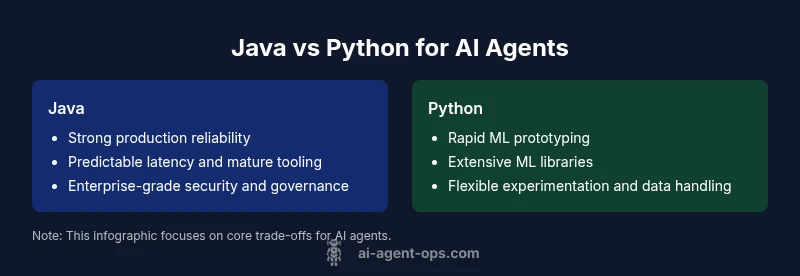
For most AI-agent workloads today, Python leads for development speed and ecosystem, while Java offers performance and enterprise scalability; if you prioritize fastest prototyping, choose Python; for production-grade, latency-sensitive, and large-scale deployments, Java can be preferable. Overall, Python is recommended for rapid agent development, with Java reserved for mission-critical, high-throughput environments.
Java vs Python for AI agents: The big picture
Choosing a language for AI agents determines how quickly you can prototype, how easily you can scale, and how smoothly you integrate with existing systems. When weighing Java vs Python for AI agents, teams trade rapid experimentation and ML library richness (Python) against strong performance, static typing, and enterprise-grade tooling (Java). The Ai Agent Ops team has observed that the Python ecosystem accelerates iteration on agent behaviors, while Java excels in production-grade services that demand predictable latency and robust concurrency. This article uses the phrase java vs python for ai agents to frame the decision space, highlighting where each language shines and where tradeoffs appear. As you move from proof of concept to production, considerations such as deployment architecture, team skills, and security requirements become decisive. In short, there is no one-size-fits-all answer; the best choice depends on your goals, constraints, and growth trajectory.
According to Ai Agent Ops, the landscape favors pragmatic, staged adoption: start with Python to unlock rapid ML iteration, then evaluate Java for mission-critical components that require stability, speed, and scalable deployment models.
Core differences: runtime, ecosystem, and deployment
The most visible differences between Java and Python for AI agents lie in runtime characteristics and ecosystem maturity. Java’s static typing, ahead-of-time compilation options, and mature JVM tooling typically yield predictable latency, stronger memory control, and robust profiling—attributes valued in large enterprise deployments. Python, by contrast, emphasizes developer productivity with dynamic typing, an extensive ML/AI library ecosystem, and rapid prototyping capabilities. For AI agents, Python’s libraries (e.g., PyTorch, TensorFlow, scikit-learn) enable fast experimentation on agent policies, while Java’s performance-oriented stack (e.g., JVM tuning, modern garbage collectors) supports stable long-running agents in production.
A practical way to view this is through deployment models: Python shines in research sandboxes and microservices that emphasize iteration, whereas Java excels when agents are embedded in existing JVM ecosystems or require tight integration with enterprise services and data pipelines.
Language-specific considerations for AI agent development
Python remains the go-to for many AI researchers due to its concise syntax, expressive data structures, and a vast collection of ML frameworks. When building AI agents, Python enables quick feature experimentation, rapid iteration on controller logic, and accessible data processing pipelines. Java offers strong performance guarantees, better static analysis, and a long track record in mission-critical systems, which can be crucial for agent orchestration within large-scale enterprise environments. Java libraries for AI exist, such as DeepLearning4J and ND4J, but they are often less mature than Python’s, requiring more custom work for cutting-edge models. A mixed approach—Python for model development and Java for orchestration and deployment—can leverage the strengths of both worlds.
Consider your team’s expertise, the nature of the agent tasks, and how models will be served or updated in production when weighing this factor.
Performance, scalability, and memory management in practice
Performance considerations often tilt the balance. Java generally provides more predictable CPU performance and lower per-request latency in high-throughput environments due to JIT optimizations, mature thread models, and robust GC strategies. Python, while fast to develop, can incur higher CPU overhead and, in pure CPython, limited parallelism due to the Global Interpreter Lock (GIL). For AI agents with real-time decisioning or heavy concurrent I/O, Java may offer lower tail latency and better throughput under sustained load. However, Python can deliver faster time-to-value during prototyping and experimentation, which accelerates learning about agent behaviors before optimizing the production path in Java. A practical pattern is to prototype in Python and implement critical, latency-sensitive paths in Java, or to use interoperable architectures that let Python models run as microservices called by a Java orchestration layer.
Security, observability, and governance implications
Static typing in Java enables earlier detection of certain classes of errors during compile time, contributing to safer, more maintainable codebases—an advantage in regulated environments where governance is critical. Python’s flexibility can lead to runtime surprises if tests and observability are lax, making rigorous test suites and monitoring essential. For AI agents, observability tooling—logs, metrics, traces, and model versioning—matters as much as language choice. Java ecosystems often provide mature security and monitoring stacks (log aggregation, APM, tracing) that integrate well with enterprise SIEM and governance processes. Python users should invest in strong CI/CD pipelines, unit tests around agent policies, and robust model versioning to maintain reliability as you scale.
Both languages benefit from disciplined security practices, dependency management, and clear data handling policies to avoid drift and ensure compliance across the agent lifecycle.
Developer ergonomics: learning curve, hiring, and tooling
For teams, the learning curve is a practical factor. Python’s concise syntax, interactive shells, and abundant tutorials shorten ramp-up time for ML engineers and data scientists who design AI agent behaviors. Java, with its verbose syntax and broader enterprise focus, can pose a steeper initial learning curve for purely ML-centric developers but pays dividends in large-scale system design, fault tolerance, and maintainability. Hiring dynamics also matter: Python skills are widely available in the AI community, while Java expertise remains abundant in enterprise software and backend engineering. tooling ecosystems diverge as well: Python’s package managers and notebooks enable quick experimentation, whereas Java’s build systems, profiling tools, and JVM-based deployment pipelines favor long-term stability and auditability. When teams balance speed against reliability, a hybrid approach often emerges as the most practical path.
Practical guidance: when to choose Java vs Python for AI agents
If rapid prototyping and model exploration drive your project, Python is usually the better starting point. Its ML libraries and data-processing capabilities accelerate agent development, reduce initial hurdles, and support experimentation with different strategies. If your priority is production-grade reliability, predictable latency, and integration with existing enterprise systems, Java provides a safer path to scale. For many teams, a hybrid architecture works best: use Python for model development and evaluation, then deploy the agent orchestrator and critical services in Java. Additionally, consider federation patterns that allow Python-based models to run as services invoked by a Java-based controller, enabling you to retain Python’s strengths while ensuring enterprise-grade deployment.
Finally, align language choice with organizational goals, available talent, and your roadmap for governance and security. The right mix often yields faster iteration without sacrificing stability.
Ecosystem and library support for AI agents
Python’s ecosystem remains the strongest driver for AI agents, with first-class libraries for data handling, model training, and experimentation. PyTorch and TensorFlow offer broad community support, while libraries like Gym, Ray, and Hugging Face accelerate agent research and deployment. Java’s ecosystem is robust for production systems: JVM performance, mature packaging and deployment tooling, strong concurrency primitives, and enterprise-grade observability. While Java’s AI libraries are growing, developers often supplement with cross-language integration or microservices to leverage Python’s ML capabilities while maintaining Java’s scalability. The practical takeaway is to map your AI agent lifecycle to the strengths of each ecosystem: rapid ML iteration in Python, reliable orchestration and deployment in Java, and well-defined interfaces to ensure smooth inter-language communication.
Comparison
| Feature | Java | Python |
|---|---|---|
| Typing and safety | Static typing with compile-time checks | Dynamic typing with runtime checks |
| Core performance | Predictable, optimized JVM performance | Higher development speed, potentially higher micro-benchmark variance |
| ML library ecosystem | Largely enterprise-friendly but growing; DL4J, ND4J | Dominant ML libraries; PyTorch, TensorFlow, scikit-learn |
| Concurrency model | Managed by JVM threads with scalable GC | GIL can limit CPU-bound parallelism; multiprocessing often used |
| Deployment and tooling | Strong in large-scale deployments, mature monitoring | Fast prototyping, rich notebooks, easier CI/CD for ML |
| Learning curve for teams | Steeper initial curve for ML teams; enterprise integration strengths | Gentler learning curve for ML/AI prototyping |
| Ecosystem maturity | Longstanding enterprise ecosystems and standards | Vibrant AI/ML research community and rapid innovation |
| Best for | Production-grade, latency-sensitive services in JVM stacks | Rapid ML experimentation and agent prototyping |
Positives
- Rapid development and rich ML ecosystem in Python
- Java’s mature tooling and strong performance for long-running services
- Robust concurrency models and scalability in Java
- Rich deployment and monitoring tooling for Java-based stacks
- Better static typing and compile-time checks in Java for safety
What's Bad
- Python's slower CPU-bound performance due to the GIL and interpreter overhead
- Java's steeper development curve for ML-centric experimentation
- Python's dynamic typing can lead to runtime errors without tests
- Interoperability gaps when tightly integrating Python AI models into Java services
Python is generally recommended for AI-agent development due to rapid prototyping and rich ML libraries, while Java excels in scalable, enterprise-grade deployments.
For most teams, starting with Python accelerates learning and model iteration. If you require predictable latency and deep enterprise integration, Java provides a solid production path, making a hybrid approach increasingly common.
Questions & Answers
Which language is generally faster for AI agents, Java or Python?
In raw execution speed for AI workloads, Java often delivers lower latency and more predictable performance in production. Python shines in development speed and ML iteration, which can translate to faster overall delivery during prototyping. The right choice depends on whether you prioritize speed to prototype or stability at scale.
Java tends to be faster for production reliability, while Python speeds up experimentation. The best approach is to start with Python for prototyping and move to Java for production when needed.
Is Python sufficient for production AI agents at scale?
Python can be used in production AI agents, especially when models and decision logic are served as separate services. To scale reliably, it’s common to pair Python-based models with a Java or other language orchestrator, ensure robust monitoring, and implement strong CI/CD processes and model versioning.
Yes, with careful architecture and good observability, Python can power production AI agents.
What about library support for AI agents in Java?
Java offers AI libraries like DeepLearning4J and ND4J, plus solid enterprise tooling. While not as expansive as Python's ML ecosystem, Java provides mature deployment, security, and integration capabilities that fit large-scale systems.
Java has solid AI tooling, especially for production-grade systems, though Python often leads for experimentation.
How does typing impact reliability in AI agent code?
Static typing in Java helps catch certain classes of bugs early and supports safer refactoring in large codebases. Python’s dynamic typing accelerates development but places more emphasis on tests and contracts to maintain reliability as the system grows.
Static typing helps safety in Java; Python relies more on tests to catch issues.
What factors should teams consider when choosing between Java and Python?
Consider development speed, required production latency, existing tech stack, talent availability, and governance needs. If rapid ML iteration is critical, Python wins. If integration with JVM services and enterprise-scale reliability matter, Java is the safer bet. A hybrid approach often yields the best balance.
Balance speed and scale. A hybrid approach often works best.
Can inter-language integration be a solution?
Yes. Serving ML models as Python microservices consumed by a Java orchestrator is a common pattern. This lets teams retain Python’s ML strengths while leveraging Java’s scalability and enterprise tooling.
Inter-language integration is a practical pattern to get the best of both worlds.
Key Takeaways
- Prototype quickly with Python to test AI-agent concepts
- Set up a production path in Java for stability and scale
- Use inter-language architecture to leverage strengths from both worlds
- Invest in strong testing, observability, and governance from day one