How to Get AI Agents for Free: A Practical Guide 2026
Learn practical, ethical ways to access ai agents for free—open-source options, free trials, and education licenses. Ai Agent Ops guides you through setup, governance, and ROI so you can prototype with zero or minimal cost.


You can access AI agents for free by leveraging open-source frameworks, free trial tiers, and educational licenses. This quick path helps you prototype quickly while you validate feasibility. According to Ai Agent Ops, start with open-source options, verify licensing, and plan a small pilot to prove ROI.
Overview: how to get ai agents for free and why it matters
If you’re exploring how to get ai agents for free, you’re in the right place. This guide helps developers, product teams, and business leaders bootstrap agentic AI workflows without heavy up-front costs. We’ll cover practical paths, tradeoffs, and governance considerations that matter when you prototype with zero or low-cost resources. According to Ai Agent Ops, free access is feasible through a mix of open-source tooling, community projects, and educational programs. The goal is to validate use cases, not to replace paid licenses in production—yet a well-scoped prototype can reliably prove ROI before scaling. Expect a mix of technical setup, licensing awareness, and risk management woven into actionable steps that you can apply in days rather than weeks.
What you’ll be able to do after following this guide
- Boot a wallet-friendly AI agent that can perform simple tasks (data gathering, automation triggers, reporting).
- Validate a use case with a minimal risk footprint and clear success criteria.
- Document licensing, data handling, and safety considerations from day one.
This approach aligns with Ai Agent Ops’s emphasis on practical, responsible agentification that fits modern teams’ budgets and timelines.
Core terms you should know
- AI agent: a software entity that autonomously performs tasks, makes decisions, or interacts with services to achieve a goal.
- Open-source: software whose source code is available for use, modification, and redistribution with public licenses.
- Free tier: a usage limit offered by vendors or communities that allows experimentation without payment.
- Agent orchestration: coordinating multiple agents or tools to accomplish complex workflows.
Understanding these terms helps you compare options without getting trapped by terminology or marketing.
The strategic value of free access for teams
Free access lowers the barrier to experimentation, enabling faster learning cycles, more frequent feedback, and quicker hypothesis testing. For startups, product teams, and developers, this means you can prototype smarter automation, validate ROI, and iterate with less financial risk. Ai Agent Ops data suggests that many early-stage projects gain meaningful insight from a well-structured free-access experiment, provided you constrain scope, monitor usage, and document outcomes.
A caution about over-reliance on free resources
Free offerings come with limits—whether on usage, support, data sovereignty, or latency. Treat free access as a learning tool and a proof-of-concept enabler, not a production-ready solution. Always define guardrails, implement monitoring, and have a plan to move to paid licenses if criteria for success are met. This prudent approach helps you avoid cost surprises and maintain compliance as you scale.
Tools & Materials
- Computer with internet access(A modern OS and browser; ensure you can install software and run local containers.)
- Open-source AI agent framework(Follow official installation docs; ensure you understand licensing and current community status.)
- Code editor (e.g., VS Code)(For scripting, configuration, and debugging agent workflows.)
- Local or free-tier hosting environment(Docker Desktop or a free cloud compute tier; use for testing agents in a safe sandbox.)
- Ethics and safety guidelines(Optional but recommended to align with internal governance and data handling rules.)
Steps
Estimated time: 2-4 hours
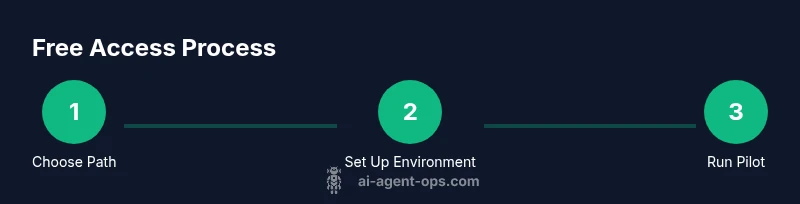
- 1
Define a small, measurable goal
Choose a narrowly scoped task (e.g., data gathering from a public API or simple report generation) that a free-access AI agent could execute. Define success criteria and a non-production safety boundary to prevent overreach. This clarity reduces waste and sets you up for a clean pilot.
Tip: Document the objective and success metrics before starting to avoid scope creep. - 2
Select a free pathway
Pick a free option that matches your tech stack: an open-source agent framework, a free trial with usage caps, or an academic licensing path. Compare licensing terms, limits, and community support to choose the most suitable route.
Tip: Start with open-source to maximize flexibility and avoid vendor lock-in. - 3
Set up a minimal environment
Install the chosen framework, set up a local runtime (or a cloud-lite environment), and verify you can run a basic agent workflow. Keep the environment lean to limit maintenance overhead and cost.
Tip: Use containerized setups to simplify cleanup and reuse in future experiments. - 4
Configure a first agent workflow
Create a simple workflow where the agent accepts input, performs a task (like fetching data), and returns results. Test error handling and basic decision-making to validate autonomy without escalating to human intervention.
Tip: Log decisions and outputs to facilitate later audit and improvement. - 5
Run a controlled pilot
Execute the workflow against a limited data set or a single process in a sandbox environment. Monitor latency, output quality, and failure modes. Adjust parameters to balance speed and accuracy.
Tip: Set timeouts and guardrails to prevent runaway automation. - 6
Evaluate, document, and decide
Assess results against predefined criteria. Capture learnings, costs avoided, and potential ROI. Decide whether to expand the pilot or upgrade to a paid plan for production use.
Tip: Create a one-page ROI summary to communicate value to stakeholders.
Questions & Answers
What does it mean to access AI agents for free?
Free access typically comes from open-source tools, free trial tiers, or educational licenses. Each option has limits on usage, support, and deployment scope. Use it for learning and prototyping, not for full-scale production without a plan to move to paid options when needed.
Free access usually means open-source tools, trials, or student licenses with limits. Use it to learn and test ideas before committing to paid options.
Are there risks to using free AI agents in production?
Yes. Free options often have limits on uptime, support, and data handling. They may also impose licensing constraints and lack formal SLAs. Treat them as experiments and implement governance, monitoring, and data safeguards.
There are limits and potential licensing or support gaps with free options. Use them for testing, with governance and monitoring in place.
How long can I run a free AI agent before costs?
Duration depends on the provider and path chosen. Free tiers usually cap usage or time, after which you would need to upgrade or switch plans. Plan your pilot within those limits and quantify outcomes.
Free runs are limited by quotas; plan within those limits and track outcomes to justify upgrades.
What should I evaluate before choosing a free option?
Assess licensing, usage limits, data policies, community support, and compatibility with your tech stack. Also consider how easy it is to upgrade later if results are positive.
Check licenses, limits, data rules, and upgrade paths before choosing.
Can I scale from free to paid later?
Yes. Most platforms offer paid tiers or enterprise licenses that preserve configurations from your free setup. Plan a staged transition with cost projections and governance changes as you scale.
You can upgrade later; plan a staged transition with cost estimates and governance changes.
Watch Video
Key Takeaways
- Identify legitimate free paths early to save time.
- Pilot scope matters: define success before starting.
- Open-source options reduce risk of vendor lock-in.
- Document licenses and safety policies upfront.