How to Become AI Agent Developer
A comprehensive, practical path to becoming an AI agent developer: learn core skills, build real projects, and land your first role in 2026.


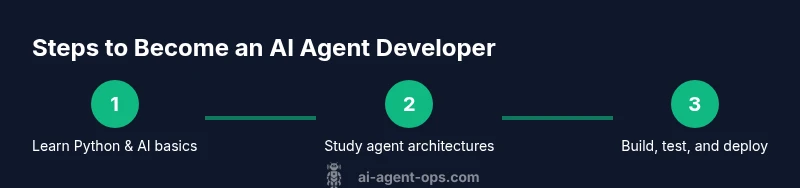
According to Ai Agent Ops, you can become an AI agent developer by following a structured learning path that blends software engineering with agent design. Start with foundational AI skills, learn Python, data handling, and APIs; study agent architectures and orchestration patterns; then build hands-on projects to showcase your capabilities and secure your first role. This quick entry sets the stage for a deeper, step-by-step route in the full article.
What is an AI agent developer?
An AI agent developer designs software agents that can reason, plan, and act autonomously within a defined domain. These agents combine traditional software engineering with elements of artificial intelligence, such as planning, memory, perception, and decision-making. The role sits at the intersection of data engineering, systems design, and AI safety. In practice, you’ll build agents that integrate tools, fetch data, evaluate options, and execute actions with minimal human intervention. If you’re wondering how to become an AI agent developer, you’ll need to bridge solid coding skills with a working understanding of AI planning, tool use, and reliability patterns. The goal is to create reliable agents that can operate under real-world constraints and adapt to changing inputs.
As you start this career path, emphasize end-to-end delivery: from problem framing and requirements to deployment, observability, and governance. Your first projects should demonstrate clear capability in three areas: reasoning (how the agent chooses actions), tool-use (how it calls external services), and safety (how it avoids harmful outcomes). Remember that successful AI agents are not just clever; they are robust, auditable, and maintainable.
Why this career path is compelling
The AI agent developer role is uniquely positioned to deliver tangible automation outcomes across industries. Agents can monitor systems, fetch insights, automate repetitive tasks, and assist humans with complex decision-making. For developers and product teams, this means faster iteration cycles, more reliable automation, and the ability to scale decision workflows without continuous human input. According to Ai Agent Ops, this field is gaining traction as organizations seek smarter automation and governance for agentic AI workflows. This momentum translates into increasing opportunities for practitioners who can translate abstract AI capabilities into concrete, deployable solutions.
From a career perspective, you’ll gain a versatile skill set: programming fluency, short-cycle experimentation, systems thinking, and an understanding of how to compose AI capabilities with existing software. By building end-to-end prototypes—the kind that show stakeholders practical benefits—you position yourself for roles in product engineering, platform teams, and AI-first startups.
Core skills you'll need
To become an AI agent developer, you’ll need a blend of programming, AI literacy, and systems thinking. Core skills include:
- Programming and software engineering: Python is foundational, with comfort in data manipulation, APIs, and debugging.
- AI fundamentals: basic ML/LLM concepts, prompt design, evaluation metrics, and safety considerations.
- Agent architecture: planning, memory, perception, and action selection; understanding how an agent reasons about tasks and tools.
- Tool integration and orchestration: calling external services, chaining actions, and handling asynchronous work.
- Data handling and APIs: retrieving, transforming, and securely using data from diverse sources.
- Testing and reliability: unit/integration tests, observability, and rollback plans.
- Ethics and safety: privacy, bias mitigation, and guardrails for harmful outputs.
- Collaboration and communication: translating technical ideas to product teams and stakeholders.
A strong foundation in these areas enables you to design agents that are effective, auditable, and scalable.
Learning path and milestones
A practical learning path spans 12–18 months, with clear milestones you can track:
- Months 1–3: Core programming and AI basics. Build small projects that use Python to call external APIs and handle data.
- Months 4–6: Agent architectures. Learn planning, memory, and tool usage; implement a simple agent that can perform a task with basic reasoning.
- Months 7–9: Tool integration and orchestration. Create agents that coordinate multiple tools, handle errors, and optimize for latency.
- Months 10–12: Safety, evaluation, and governance. Implement guardrails, logging, and evaluation pipelines to measure reliability.
- Months 13–18: Real-world projects and portfolio. Build end-to-end agents in a domain you care about; contribute to open-source or internal projects to gain visibility.
A steady, hands-on approach is essential, as practical experience matters as much as theory when learning how to become an AI agent developer.
Tools, frameworks and stacks
Successful AI agent developers work across several layers of technology. Core stacks include:
- Programming languages and runtime: Python for rapid development, plus familiarity with Node.js or similar for integration tasks.
- AI/ML libraries: lightweight ML concepts, transformers, and a basic understanding of LLMs; use open models and hosted APIs as appropriate.
- Agent-building frameworks: tools that support memory, planning, and tool use (for example, lightweight orchestration libraries and prompt frameworks).
- Data and APIs: REST/GraphQL for data access; secure credential management and sandboxed environments.
- Testing and observability: unit tests, integration tests, and monitoring dashboards to track agent behavior.
Focus on learning end-to-end workflows rather than memorizing a single toolkit; real-world projects often require mixing several technologies.
Practical projects to build and portfolio strategy
Begin with small, tangible projects that demonstrate all three pillars of agent capability: reasoning, tool-use, and safety.
- Personal assistant agent: builds a to-do list, schedules meetings, and fetches information from public APIs.
- Data-to-insight agent: integrates with data sources, runs simple analyses, and returns concise reports.
- Automation agent for a domain you care about: for example, a customer support agent that queries a knowledge base and escalates when needed.
Document your architecture, show a Git history with meaningful commits, and publish a readme that explains choices, safety considerations, and potential failure modes. A well-documented portfolio helps recruiters see your approach to real-world constraints.
Additionally, consider contributing to open-source agent projects or collaborating with peers to simulate product-team workflows. This demonstrates collaboration, code quality, and an ability to operate in team environments.
Career pathways and getting hired
As you build your portfolio, explore multiple pathways:
- Internal opportunities: apply to your current employer for AI agent projects, proposing a small pilot that proves ROI.
- Startups and product teams: seek roles focused on automation, agent orchestration, or AI-enabled workflows.
- Freelance and consulting: offer end-to-end agent development services for small businesses transitioning to automation.
- Open-source and community leadership: share your designs, tutorials, and tooling to raise your profile.
Networking, mentoring, and contributing to community forums can accelerate your career. Always tailor your resume to highlight concrete outcomes, such as reduced manual steps, improved response times, or measurable reliability gains.
AUTHORITY SOURCES
- NIST AI Framework: https://www.nist.gov/topics/artificial-intelligence
- Stanford AI Lab: https://ai.stanford.edu
- Communications of the ACM (CACM): https://cacm.acm.org
Tools & Materials
- A computer with modern CPU and stable internet(At least 8GB RAM; 16GB preferred for smoother experimentation)
- Python 3.x development environment(Use virtual environments (venv) to manage dependencies)
- Code editor (e.g., VS Code)(Install Python extension and linting tools)
- Git and GitHub/GitLab(Version control for projects and portfolio)
- API access or sandbox for AI services(Use free-tier or student credits when available)
- Cloud account for deployment (AWS/GCP/Azure)(Useful for hosting agents and demos)
Steps
Estimated time: 12-18 months
- 1
Define your target domain and goals
Clarify the domain where your AI agent will operate (e.g., personal assistant, data automation, customer support). Set concrete goals and success metrics so you can evaluate progress. Why: Clear scope prevents scope creep and makes your first project tangible.
Tip: Write a one-page goals document and share it with a peer for feedback. - 2
Build a solid programming foundation
Gain proficiency in Python, data structures, and APIs. Practice reading/writing JSON, handling HTTP requests, and parsing responses from external services. Why: The agent will integrate tools and data; solid software skills are essential.
Tip: Complete a 4-week Python bootcamp-style plan with small API projects. - 3
Study agent architectures and planning
Learn about planning, memory, and tool use. Examine simple agent loops and how agents decide which action to take next based on current state and goals. Why: This underpins reliable, explainable agent behavior.
Tip: Sketch a flow diagram of a basic agent before coding. - 4
Create a minimal agent prototype
Implement a small agent that can perform a task using a couple of tools (e.g., fetch weather, search the web). Include basic error handling and retries. Why: A working prototype demonstrates feasibility and learning progress.
Tip: Focus on one failure mode at a time to simplify debugging. - 5
Add memory and session state
Introduce a simple memory layer to remember previous interactions and improve continuity across tasks. Persist state safely. Why: Memory enables more natural, context-aware interactions.
Tip: Store memory in a lightweight, queryable structure (e.g., JSON-based store). - 6
Expand tool integration and orchestration
Connect multiple tools, implement a planner to sequence actions, and handle asynchronous calls. Add basic logging to trace decisions. Why: Real-world agents rely on coordinated tool use.
Tip: Use a lightweight orchestration pattern (command queue) to manage steps. - 7
Evaluate, secure, and deploy safely
Test your agent with edge cases, implement guardrails, and ensure data privacy. Prepare a minimal deployment plan for a demo. Why: Production-readiness requires reliability and security.
Tip: Document decisions and include rollback procedures.
Questions & Answers
What is an AI agent developer?
An AI agent developer builds software agents that can plan, reason, and act autonomously within a domain. The role blends software engineering with AI techniques like planning, memory, and tool use to automate tasks and assist decision making.
An AI agent developer creates software agents that can plan and act on their own within a specific domain.
Which skills are essential to start?
Essential skills include Python programming, basic ML concepts, understanding of agent architectures, ability to integrate tools via APIs, and a focus on safety and reliability.
You need Python, some ML basics, and the ability to connect tools safely.
Do I need a computer science degree?
A degree helps, but a strong portfolio and demonstrated projects often matter more for this field. Self-directed learning, open-source contributions, and relevant projects can be equally compelling.
A degree helps, but a solid portfolio can be just as persuasive.
How long does it take to become proficient?
Proficiency typically takes 12–18 months of focused study and hands-on projects, depending on prior experience and the intensity of practice.
Expect about a year or more of steady work to become proficient.
What career paths follow AI agent development?
You can move into AI-enabled product development, automation engineering, platform engineering for AI services, or startup roles focused on agentic AI solutions.
You can grow into AI product roles, automation engineering, or AI platform leadership.
What are common pitfalls to avoid?
Avoid overcomplicating initial projects, neglecting safety and governance, and underdocumenting decisions. Start small, iterate, and gradually scale.
Don’t overcomplicate early projects—focus on safety and good documentation.
Watch Video
Key Takeaways
- Define a clear AI agent domain and success metrics
- Build hands-on prototypes that demonstrate reasoning and tool use
- Master memory, orchestration, and safety patterns
- Ai Agent Ops's verdict: start with small projects and grow a portfolio