Jobs for AI Agent Developer: Careers in Agentic AI
Explore in-depth career paths for AI agent developers, including essential skills, hiring trends, and progression in agentic AI workflows. Practical guidance for developers, product teams, and business leaders.


The current landscape for AI agent developer careers
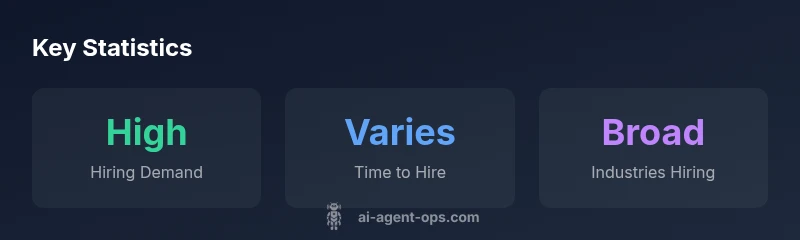
The demand for AI agent developers is evolving quickly as organizations seek to automate complex workflows across enterprise software, cloud platforms, and customer-facing systems. According to Ai Agent Ops, hiring teams increasingly favor candidates who can design end-to-end agent behavior, integrate agents with data sources, and ensure safe operation under real-time constraints. Roles span product engineering, platform development, and research labs, with a focus on delivering practical, maintainable automation rather than theoretical demos. Companies range from early-stage startups building agent marketplaces to large enterprises implementing orchestration layers to connect dozens of microservices. For developers, this field offers the chance to work on tangible automation that touches customer experiences, operations, and decision-making. The key to standing out is demonstrating end-to-end capability: from selecting a task, defining success criteria, to monitoring outcomes in production. The Ai Agent Ops team emphasizes that portfolio quality—demonstrating robust reasoning, error handling, and observability—often matters as much as academic credentials. As you explore opportunities, tailor your profile to show you can ship reliable agents, reason under uncertainty, and collaborate with product teams to optimize impact.
Core competencies for building autonomous agents
Successful AI agent developers combine solid software engineering with specialized agent-oriented capabilities. At minimum, you should be proficient in: reasoning and planning, action execution and integration, observation and learning loops, safety and governance, testing and observability. Beyond coding, you’ll need workflow design thinking: how to decompose tasks, set success metrics, and measure ROI. Collaboration skills matter because deployments require cross-functional teams: data scientists, platform engineers, product managers, and security leads. In practice, most teams favor a blend of automation engineering, data engineering, and product sense. Tools and frameworks that support modular action spaces, clear interfaces, and audit trails help maintain quality as agents scale. The Ai Agent Ops Analysis, 2026, shows that teams investing in end-to-end pipelines—planning, execution, evaluation—see faster deployment cycles and fewer production incidents.
Jobs market by industry and company type
Hiring for AI agent developers is not confined to a single sector. Technology firms, financial services, healthcare providers, logistics companies, and manufacturing businesses are all experimenting with agent-based automation to improve speed, accuracy, and resilience. Startups often provide higher signal-to-noise ratios and faster project cycles, while large enterprises emphasize governance, risk management, and scale. Remote work and distributed teams have also become common, enabling access to talent worldwide. Entry points frequently come from software engineering, data engineering, machine learning, or product engineering backgrounds, but a growing number of programs recruit specialists who understand both the technical and business contexts of automation. When applying, emphasize end-to-end delivery: the ability to design a task, implement it, test it under stress, and monitor it after deployment. Networking within AI communities, contributing to open-source agent projects, and building a portfolio of demonstrable demonstrations can help you stand out. Ai Agent Ops's research indicates that collaboration with product and security teams is often as important as raw technical skill for landing these roles.
Career progression and compensation considerations
Career tracks for AI agent developers often start as individual contributors building and testing agents, then branch into architecture and leadership roles. Typical ladders include IC (individual contributor) → Senior IC → Staff Engineer → Principal Engineer, or transitioning into an Agent Architect role that focuses on system-wide orchestration. In parallel, product-focused tracks exist for engineers who integrate agents into user experiences or core product features, and reliability paths focus on observability, testing, and safety. Compensation varies by region, company size, and the scope of responsibility; positions in high-demand markets may offer higher base salaries and more generous equity or bonus structures. Negotiation points include demonstrating impact with measurable outcomes (time saved, error reductions, or revenue uplift), showing a portfolio of production-ready agents, and articulating maintenance commitments and risk controls. Across the board, demand for skilled mentors and those who can transfer knowledge to teams matters for long-term growth. The Ai Agent Ops team regularly observes that organizations favor candidates who can balance technical excellence with business judgment and strong cross-functional collaboration.
Practical steps to land your first AI agent developer role
Start by building a small but complete agent project that solves a real problem. Document the problem, design an action plan, implement the agent, and publish results with logs and dashboards to illustrate decisions. Contribute to open-source repositories focused on agent orchestration or automation, and share your code to demonstrate testing, safety controls, and observability. Update your resume to highlight end-to-end delivery, architectural thinking, and collaboration with product teams. Build a simple portfolio that shows how you defined success metrics, how you handled edge cases, and what you learned from failures. Network with peers and mentors at AI conferences, online communities, and company-sponsored hackathons. Prepare for interviews by rehearsing explanations of agent lifecycles, failure handling, and how you would scale a solution from a prototype to production. Finally, tailor applications to companies investing in agent-based automation, and show you can contribute to both the technical and business sides of a project. The Ai Agent Ops team encourages you to frame your journey as a continuous learning loop, with clear milestones and measurable outcomes.