Can You Train an AI Agent? A Practical Guide
Learn how to train an AI agent with data, environments, rewards, evaluation, and governance. Practical steps, tools, and safety considerations for scalable agentic AI workflows.


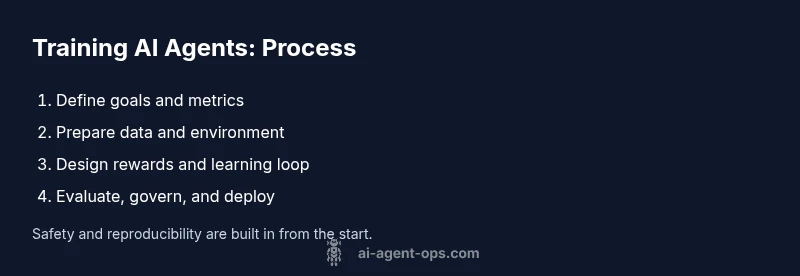
Yes. You can train an AI agent by clearly defining objectives, selecting a suitable learning method, and creating a safe experimentation loop with data, an environment, reward design, and ongoing governance. This rapid path emphasizes reliability, safety, and measurable outcomes, enabling iterative improvement toward dependable, scalable agentic AI workflows. It also helps bridge technical teams and business leaders toward shared success.
Foundational idea: can you train an ai agent
The fundamental question is can you train an ai agent without sacrificing safety. At its core, training an AI agent means teaching a system to perceive a task, choose actions, and improve based on feedback. This requires a well-defined objective, a learning approach, and a controlled environment where mistakes do not cause real-world harm. For developers, product teams, and leaders, the path hinges on four ingredients: goals, data, an environment to learn in, and governance. When combined, these create an experimental loop: define success, supply representative examples, let the agent act, observe outcomes, and adjust. According to Ai Agent Ops, success also hinges on reliability, safety, and governance—not only raw performance. In practice, you will map the decision space, outline acceptable risk, and prepare fallback strategies. The remainder of this article expands on practical steps to set up a trainable AI agent that aligns with business objectives and operational realities.
Why this matters for teams building agentic AI
Understanding how to train an AI agent matters because it frames product and system design around observable outcomes and guardrails. When teams articulate what success looks like, they can align data collection, model choice, and testing strategies with business goals. This alignment reduces rework, speeds iteration, and improves governance by making decisions auditable. The Ai Agent Ops team emphasizes that the most valuable agents are not only capable but controllable and trustworthy. Practically, you’ll prototype in safe spaces, monitor behavior, and scale only after validating performance against defined criteria.
The learning loop: goals, data, environment, and feedback
A robust training loop rests on four pillars. First, clear goals define what success means in measurable terms. Second, data quality and coverage determine the agent’s ability to generalize. Third, the learning environment—real or simulated—must reflect the real task, with varied scenarios to test robustness. Fourth, feedback signals—rewards or corrections—guide learning. Together, these create an iterative cycle: design, train, evaluate, adjust, and repeat. Always document decisions to ensure reproducibility and enable governance reviews.
Types of learning you might use
Several learning paradigms fit different agent tasks. Reinforcement learning excels when the agent learns by interacting with an environment and receiving rewards. Supervised learning works well when historical, labeled examples guide behavior. Imitation learning blends these by mimicking expert actions, while hybrid approaches combine multiple signals. The choice depends on risk tolerance, data availability, and the desired level of autonomy. In all cases, start with a conservative scope and a safety net to prevent unintended effects.
The role of governance from day one
Governance isn’t an afterthought; it shapes how you collect data, run experiments, and deploy agents. Establish guardrails, auditing processes, and change management early. Define who can modify the agent, what actions are allowed, and how to roll back or pause operations if needed. Document data provenance and model versions to support future audits. The Ai Agent Ops team recommends embedding governance into every stage of the training lifecycle to avoid brittle, untraceable decisions.
Summary of this section
Training an AI agent is a structured, multi-disciplinary process that combines technical design with organizational governance. By starting with clear goals, responsible data practices, realistic environments, and strong safety measures, teams can build agents that perform well and remain controllable in production.
Tools & Materials
- Cloud compute resources (GPUs/TPUs)(Sufficient to support iterative training and experiments)
- Representative datasets(Curated, labeled, versioned, and documented)
- Simulation or staging environment(Reflects target tasks and edge cases)
- Agent framework/library(RL libraries or agent-centric toolkits)
- Experiment tracking tool(Log runs, hyperparameters, and outcomes)
- Version control and reproducibility plan(Code, config, and data lineage)
- Data labeling and annotation tools(Useful for supervised/imitation signals)
- Safety and governance plan(Risk assessments, guardrails, and monitoring)
Steps
Estimated time: 2-6 weeks
- 1
Define task and success criteria
Identify the task the agent should perform and specify objective metrics. Align success metrics with business outcomes and establish safe operating boundaries.
Tip: Write down the exact metrics and acceptable failure modes before data collection. - 2
Choose learning paradigm
Select whether reinforcement learning, supervised learning, imitation, or a hybrid approach best fits the task. Consider data availability and risk tolerance.
Tip: Start with a conservative approach and plan for gradual autonomy. - 3
Assemble data and environment
Gather diverse data representative of real scenarios. Build or select a simulated environment that mirrors deployment conditions.
Tip: Label data carefully and document data provenance. - 4
Design rewards and feedback
Create reward signals that incentivize the desired behavior while avoiding unintended optimization tricks. Include penalties for unsafe actions.
Tip: Test reward signals in a sandbox before large-scale training. - 5
Establish a training loop
Set up the iterative loop: train, evaluate, adjust hyperparameters, and re-train. Automate logging and anomaly detection.
Tip: Automate stopping criteria to prevent runaway training. - 6
Evaluate performance and safety
Use predefined metrics and scenario tests. Assess reliability, robustness, and potential safety issues.
Tip: Include edge-case tests and stress tests. - 7
Iterate and refine
Refine data, architecture, or rewards based on evaluation results. Repeat until metrics meet acceptance thresholds.
Tip: Document all iterations and rationale. - 8
Add governance and safeguards
Integrate guardrails, access controls, and monitoring. Prepare rollback plans and a monitoring dashboard.
Tip: Run a dry-run in staging before any real deployment. - 9
Pilot deployment and monitoring
Release to a controlled subset of production or a sandboxed real environment. Monitor behavior and collect feedback.
Tip: Have an emergency stop and rollback policy in place. - 10
Plan maintenance and updates
Schedule periodic retraining, dataset reviews, and governance audits. Align updates with compliance needs.
Tip: Version all assets and have a clear deprecation path.
Questions & Answers
What is an AI agent?
An AI agent is a software entity that perceives its environment, makes decisions, and takes actions to achieve a goal. It operates within defined rules and can improve over time through learning signals such as rewards or supervised feedback.
An AI agent is a decision-making program that acts to achieve a goal, improving with feedback.
What data do I need to train an AI agent?
You need representative, labeled data suitable for the learning paradigm you choose. If learning from interaction, ensure simulated or safe environments are rich enough to expose the agent to diverse scenarios.
Gather representative data and ensure environments reflect real tasks.
How long does training typically take?
Training duration varies with task complexity, data size, and compute resources. Start with a small pilot to establish a baseline, then scale as needed.
It varies; start small and pilot before scaling.
What are common failure modes in AI agents?
Common issues include reward hacking, overfitting to training environments, unsafe actions, and data drift. Build monitoring and rollback plans to catch these early.
Watch for reward misalignment, unsafe actions, and drift.
How can governance improve agent safety?
Governance provides guardrails, audit trails, and clear ownership. It helps ensure compliance, transparency, and controllability across the training and deployment lifecycle.
Guardrails, audits, and clear ownership keep agents safe.
Watch Video
Key Takeaways
- Define objectives before building data pipelines.
- Choose learning methods aligned with data availability.
- Build a sandboxed training loop with guardrails.
- Governance should accompany every training phase.
- Pilot before large-scale deployment.